Facts
Torrent Power Limited, a distribution licensee, petitioned the Gujarat Electricity Regulatory Commission seeking refund of past short-term open-access (STOA) charges and uniform treatment in the future.
Source reference: para. 6The Commission directed GETCO to apply the open-access mechanism without discrimination and to verify and refund specified STOA charges recovered from Torrent Power.
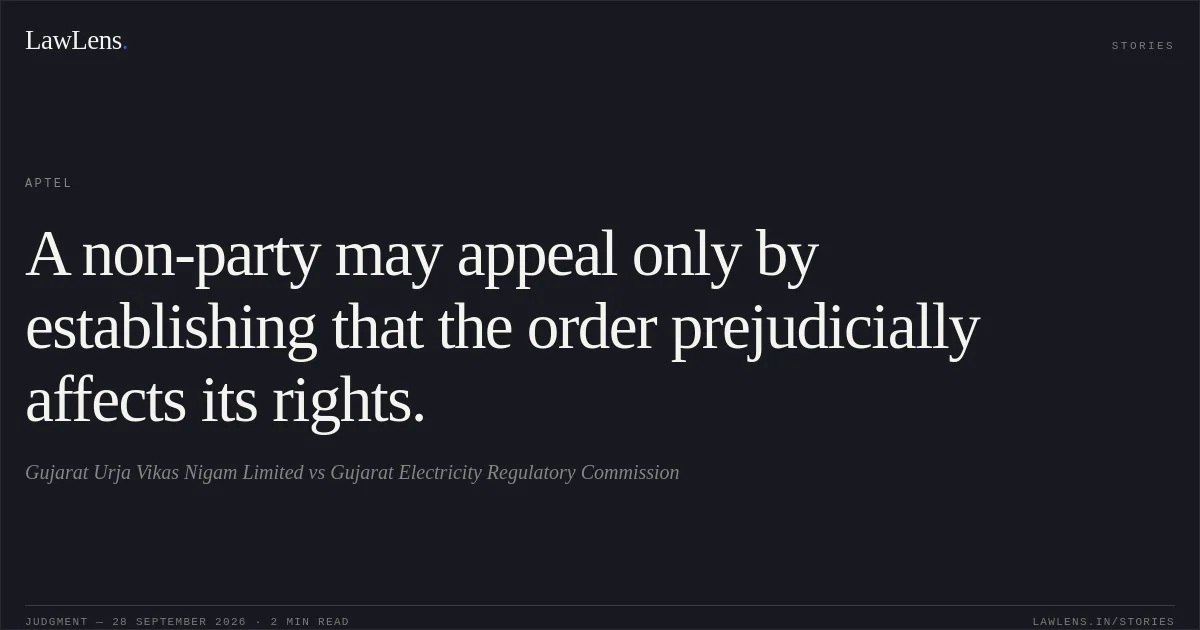
Source reference: para. 7Gujarat Urja Vikas Nigam Limited and four State distribution licensees, who had not been parties to that proceeding, sought leave to appeal under Section 111 of the Electricity Act, 2003.
Source reference: para. 8–9They contended that the refund would increase their residual transmission-charge burden and that the Commission had considered a transmission service agreement to which they were signatories.
Source reference: para. 12Issues
Whether non-parties to proceedings before the Commission may obtain leave to appeal under Section 111 of the Electricity Act, 2003, and what they must establish to qualify as “persons aggrieved”
Source reference: para. 17–20Whether the appellants were sufficiently affected by the Commission’s directions concerning STOA charges to be granted leave to appeal
Source reference: para. 21–30Law Applied
Section 111(1) of the Electricity Act, 2003 permits a “person aggrieved” by an order of the Appropriate Commission to appeal to the Tribunal.
Source reference: para. 17A person who was not a party to the original proceedings must obtain leave and demonstrate that the order prejudicially affects a right or causes actual harm; a merely psychological, imaginary, remote, or indirect injury is insufficient.
Source reference: para. 18–20The Tribunal applied the principles stated in H. Anjanappa v. A. Prabhakar, 2025 SCC OnLine SC 183, including that leave should ordinarily be granted to a non-party who would be bound by the decision and precluded from challenging it in other proceedings.
Source reference: para. 18–20The Tribunal also considered Emmar MGF Construction Pvt. Ltd. v. Delhi Electricity Regulatory Commission, Appeal No. 123 of 2008, and Municipal Corporation for Greater Bombay v. Lala Pancham, (1965) 1 SCR 542, but found them distinguishable.
Source reference: para. 29Reasoning
The Tribunal found that the Commission’s order issued directions to GETCO, not to the appellants, and that Torrent Power had sought no relief against them.
Source reference: para. 21–22The refund concerned charges recovered despite Torrent Power’s alleged non-use of GETCO’s intra-State network; GETCO had verified the refund claim and found it in order.
Source reference: para. 23–24The asserted increase in the appellants’ residual transmission burden did not establish that they were harmed by the order.
Source reference: para. 23–24The appellants had opportunities to participate in the relevant proceedings but did not seek impleadment, and the order did not make any operative determination concerning the transmission service agreement.
Source reference: para. 25–28Accordingly, their asserted interest was, at most, remote or indirect.
Source reference: para. 30Holding
The Tribunal held that the appellants had not shown that they were “persons aggrieved” by the Commission’s order and dismissed the application for leave to appeal.
Consequently, the appeal was dismissed as not maintainable; the Tribunal clarified that its observations were confined to the leave application and were not findings on the merits.
Source reference: para. 31–32Acts & Sections Cited
4 provisions across 2 statutes referred to in this judgment. Each provision opens on LawLens.
Electricity Act, 20032
Code of Civil Procedure, 19082
Original Court PDF
Gujarat Urja Vikas Nigam LimitedvsGujarat Electricity Regulatory Commission
Click to open original judgment
Original judgment, available to read, download and summarize on LawLens.in