Facts
On 21 June 2010, the respondent was charge-sheeted for five charges, one concerning alleged financial irregularity and four concerning absence from duty. The alleged misconduct related to events occurring between 1999 and 2001. The respondent retired on superannuation on 30 April 2011 while the disciplinary inquiry was pending
Source reference: paras. 1–2; pp. 1–2The Inquiry Officer submitted a report dated 20 March 2013, exonerating the respondent from four charges and finding only one charge partly proved. The disciplinary authority issued a show-cause notice on 18 September 2013, to which the respondent replied on 6 December 2013. Subsequently, approximately one and a half years later, the disciplinary authority expressed disagreement with the Inquiry Officer’s findings and called for an additional defence. The disciplinary proceedings thereafter proceeded on the basis that all charges were proved
Source reference: paras. 3–4; p. 2The disciplinary authority initially proposed a pension deduction of ₹1,500 per month for five years. After the Gujarat Public Service Commission recommended a ten-year deduction, the disciplinary authority imposed a pension cut of ₹1,500 per month for ten years
Source reference: para. 5; p. 2The respondent challenged the punishment by filing a writ petition. The learned Single Judge quashed the disciplinary action, holding that the inquiry suffered from inordinate delay, procedural unfairness, failure to properly communicate the reasons for disagreement, absence of proof of the principal financial charge, and issuance of a non-speaking punishment order
Source reference: paras. 6–11; pp. 2–5Issues
1. Whether the disciplinary inquiry was vitiated by inordinate delay, when the alleged misconduct occurred in 1999–2001 but the charge-sheet was issued only in 2010 and the inquiry continued after the respondent’s retirement
Source reference: paras. 7, 12; pp. 3, 52. Whether the disciplinary authority lawfully disagreed with the Inquiry Officer’s findings without properly furnishing the reasons for disagreement and providing an effective opportunity of defence
Source reference: para. 8; p. 33. Whether the finding of guilt on the financial irregularity charge was supported by the evidence, particularly in light of the Storekeeper’s explanation that the goods had been returned as defective before the surprise inspection and were subsequently replaced
Source reference: paras. 8–9; pp. 3–44. Whether the punishment order was sustainable, when it was non-speaking and imposed a pension deduction of ₹1,500 per month for ten years
Source reference: paras. 5, 11; pp. 2, 4–5Law Applied
The Court applied the principles of natural justice and fair disciplinary procedure, including the requirement that a disciplinary authority proposing to disagree with an Inquiry Officer must communicate its reasons for disagreement and provide the delinquent employee a meaningful opportunity to respond
Source reference: para. 8; p. 3It further applied the principle that an unexplained and prejudicial delay in initiating or concluding disciplinary proceedings may vitiate the inquiry, particularly where the charges concern stale events
Source reference: paras. 7, 12; pp. 3, 5The Court also applied the requirement that disciplinary and punishment orders must be reasoned and speaking orders, and that findings of misconduct must be supported by reliable evidence
Source reference: paras. 8–11; pp. 3–5No specific statutory provision or precedent was cited in the judgment.
Source reference: no citationReasoning
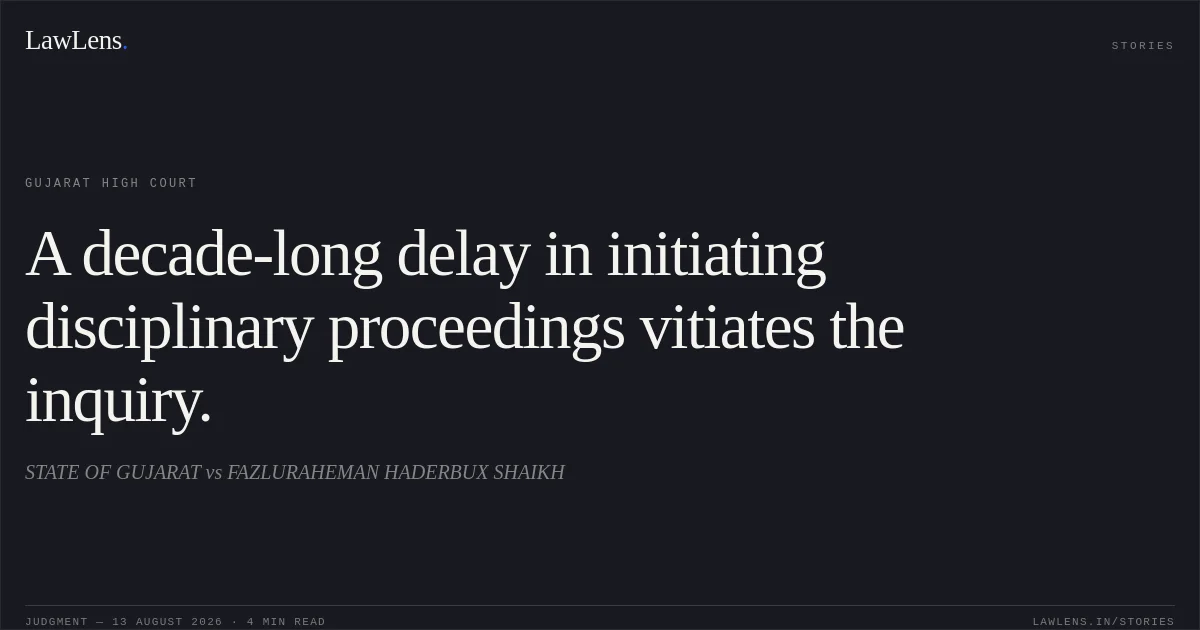
The Court upheld the Single Judge’s conclusion that the disciplinary proceedings were fundamentally defective. The alleged misconduct dated back to 1999–2001, yet the charge-sheet was issued nearly a decade later in 2010, and the inquiry continued even after the respondent’s retirement; this delay, by itself, was held sufficient to vitiate the inquiry
Source reference: paras. 7, 12; pp. 3, 5The disciplinary authority also failed to comply with the requirements of a fair disagreement procedure, since the respondent was not properly furnished with the reasons for departing from the Inquiry Officer’s exoneration findings; the subsequent indication of disagreement in 2015 further suggested that the authority had already formed an opinion on guilt
Source reference: para. 8; p. 3On the merits, the only serious financial charge concerned goods unavailable during a surprise inspection. The Storekeeper’s evidence showed that the goods had arrived, were returned as defective before the inspection, and were replaced two days later, which negated any inference of wrongdoing by the respondent
Source reference: paras. 8–9; pp. 3–4The Court also noted that the Supervisor Instructor, who had been charged in relation to the same alleged lapse, was exonerated, making the respondent’s conviction on the same basis unsustainable
Source reference: para. 10; p. 4Finally, the punishment order was non-speaking and therefore could not stand
Source reference: para. 11; p. 4Holding
The Division Bench held that the disciplinary inquiry and the consequential finding of guilt were legally unsustainable because of the inordinate delay, breach of the disagreement procedure, lack of evidentiary support for the financial charge, and the non-speaking nature of the punishment order
The Letters Patent Appeal was dismissed for want of merit.
Source reference: paras. 12–13; p. 5The Court granted four weeks to comply with the directions of the learned Single Judge concerning payment of the respondent’s retiral and other consequential benefits
Source reference: paras. 12–13; p. 5Original Court PDF
STATE OF GUJARATvsFAZLURAHEMAN HADERBUX SHAIKH
Click to open original judgment
Original judgment, available to read, download and summarize on LawLens.in