Facts
The Decree Holder (DH) and Judgment Debtors (JDs) entered into a franchise arrangement in 2013, followed by a supplementary agreement in 2015.
Source reference: pp. 1–4, paras 1–4After disputes arose, the DH sued for recovery of Rs. 2,53,66,750.
Source reference: pp. 1–4, paras 1–4The parties settled, and on 19 July 2018 the High Court decreed the suit in accordance with their Settlement Deed.
Source reference: pp. 1–4, paras 1–4The decree was for Rs. 1,19,43,000.
Source reference: pp. 1–4, paras 1–4In execution proceedings, JD No. 4 objected that the High Court lacked pecuniary jurisdiction because the amount sought to be recovered was below Rs. 2 crores
Source reference: pp. 1–4, paras 1–4The Court reserved the question of maintainability for decision
Source reference: p. 3, para 5Issues
1. Whether the High Court could entertain execution of its decree when the decretal amount was below its Rs. 2 crore pecuniary threshold, although the original suit had been filed for an amount exceeding that threshold
Source reference: p. 5, para 112. Whether the Commercial Courts Act displaced the application of Sections 37 and 38 CPC to execution of the decree
Source reference: pp. 4–5, paras 8–9, 18Law Applied
Sections 37 and 38 CPC identify the court which passed a decree and provide that a decree may be executed by that court or by a court to which it is transferred; Section 39 CPC governs transfer of a decree to another competent court
Source reference: pp. 5–7, para 12A change in the pecuniary jurisdiction of the court that passed a decree does not, by itself, extinguish that court’s jurisdiction to execute it. The Court relied on Gulab Chand Sharma v. Saraswati Devi, 1974 SCC OnLine Del 202, and Pearey Lal and Sons (Pvt.) Ltd. v. M/s Jamuna Properties (P) Ltd., 2004 SCC OnLine Del 11, for that principle
Source reference: pp. 7–14, paras 13–14Section 16 of the Commercial Courts Act applies the CPC, as amended by that Act, to trials of commercial disputes of specified value; the Court held that Sections 37 and 38 CPC therefore apply to execution of decrees passed in such suits
Source reference: pp. 16–17, para 18The Court also considered Asian Patent Attorneys Assn. (Indian Group) v. Registrar General, Delhi High Court, 2026 SCC OnLine Del 360, which had left the judicial determination of the issue open
Source reference: p. 15, para 17Reasoning
The Court reasoned that the relevant jurisdictional question was whether the court that passed the decree retained authority to execute it, not whether the settlement reduced the decretal amount below the current pecuniary threshold. The original commercial suit claimed Rs. 2,53,66,750—above the threshold—and the High Court passed the decree in that suit
Source reference: pp. 15–16, para 16Under Sections 37 and 38 CPC, a change in pecuniary jurisdiction does not make the decree court cease to exist or automatically remove its execution jurisdiction. The Commercial Courts Act did not produce a different result because the CPC provisions governing execution remained applicable
Source reference: pp. 16–17, paras 16, 18The cited Division Bench decision did not decide the present maintainability question and therefore did not bar the petition
Source reference: p. 15, para 17Holding
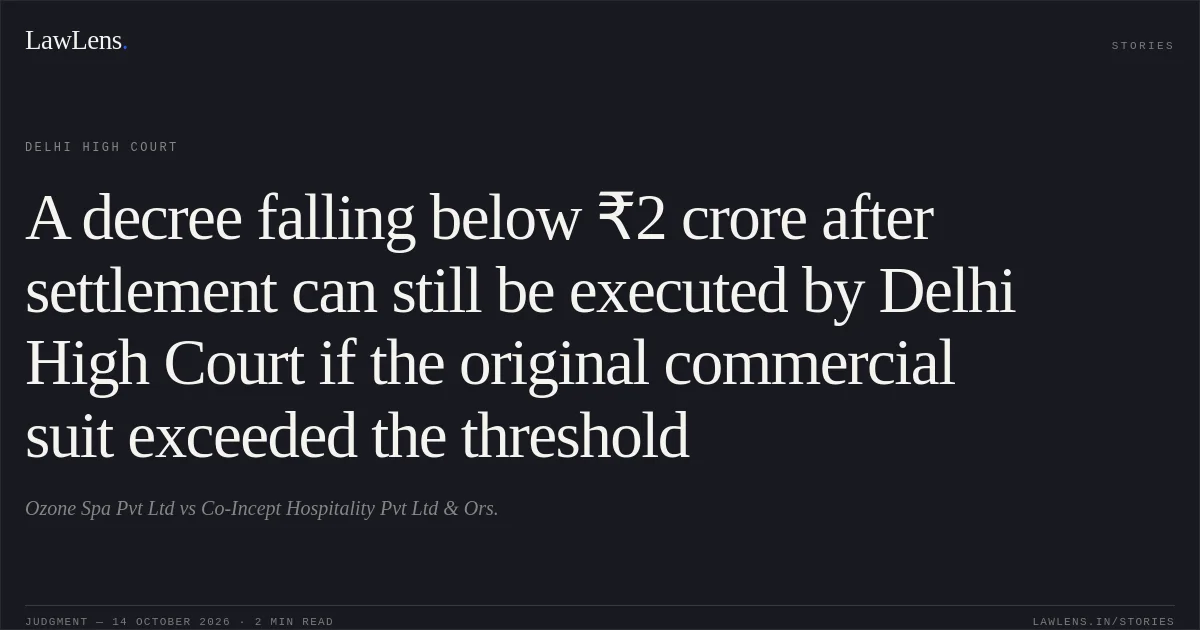
The Court held that the High Court retained jurisdiction to execute its decree notwithstanding that the decretal amount was below Rs. 2 crores, where the suit had been filed for a value exceeding that threshold.
It rejected JD No. 4’s maintainability objection and directed that the matter be listed before the Roster Bench on 14 October 2026
Source reference: p. 17, paras 19–20Acts & Sections Cited
3 provisions across 1 statute referred to in this judgment. Each provision opens on LawLens.
Code of Civil Procedure, 19083
Original Court PDF
Ozone Spa Pvt LtdvsCo-Incept Hospitality Pvt Ltd & Ors.
Click to open original judgment
Original judgment, available to read, download and summarize on LawLens.in