Facts
Kalu Ram preferred a first appeal under Section 96 read with Order XLI Rule 1 CPC against the ex parte judgment and decree dated 30.04.2025 passed by the Additional District Judge, Pali, in Civil Original Suit No. 196/2015 (166/2013).
Source reference: para. 1The appeal was delayed by 345 days; the Court condoned the delay under Section 5 of the Limitation Act after accepting the appellant’s explanation that he acquired knowledge of the decree only upon commencement of execution proceedings.
Source reference: paras. 2–4During pendency of the suit, the sole plaintiff, Lala Ram, died on 26.05.2023, approximately two years before the decree was passed.
Source reference: para. 6No application was filed for substitution of his legal representatives within the prescribed period, nor was any application filed for condonation of delay or setting aside the abatement under Order XXII Rule 9 CPC.
Source reference: paras. 8, 16The respondents, claiming to be Lala Ram’s legal representatives, nevertheless initiated execution proceedings on the basis of the decree.
Source reference: paras. 7, 17Issues
Whether, after the death of the sole plaintiff and the consequent statutory abatement of the suit, the trial Court could proceed to pronounce a judgment and decree without setting aside the abatement and bringing the legal representatives on record.
Source reference: para. 10Whether the persons claiming to be the legal representatives of the deceased sole plaintiff could maintain execution proceedings without having been substituted in the suit and without a valid decree having been passed in their favour.
Source reference: paras. 10, 17–19Law Applied
The Court applied Order XXII Rule 1 CPC, under which death does not cause abatement where the right to sue survives; Order XXII Rule 3 CPC, requiring the legal representatives of a deceased sole plaintiff to be brought on record within the prescribed period; and Order XXII Rule 9 CPC, which permits setting aside of abatement upon sufficient cause.
Source reference: paras. 11–15Failure to seek substitution within the prescribed period results in abatement by operation of law, without the necessity of a formal order recording it.
Source reference: paras. 11–15Where the application for setting aside abatement is delayed, it must be accompanied by an application under Section 5 of the Limitation Act.
Source reference: para. 14A suit cannot proceed unless the delay is condoned, the abatement is set aside, and the legal representatives are duly substituted.
Source reference: paras. 14–15A decree may be executed only by a decree-holder—namely, a person in whose favour a decree has been passed or who has otherwise acquired a lawful entitlement to execute it; a decree that is a nullity is incapable of execution.
Source reference: paras. 17, 20Reasoning
The Court treated the death of Lala Ram on 26.05.2023, coupled with the failure to seek substitution within the prescribed period, as resulting in automatic abatement of the suit.
Source reference: paras. 12–16Since no application under Section 5 of the Limitation Act or Order XXII Rule 9 CPC was filed, and no order setting aside the abatement or bringing the legal representatives on record was passed, the suit was never legally revived.
Source reference: paras. 16, 18The alleged legal representatives did not become plaintiffs merely because of their relationship with the deceased; substitution required an order of the competent Court.
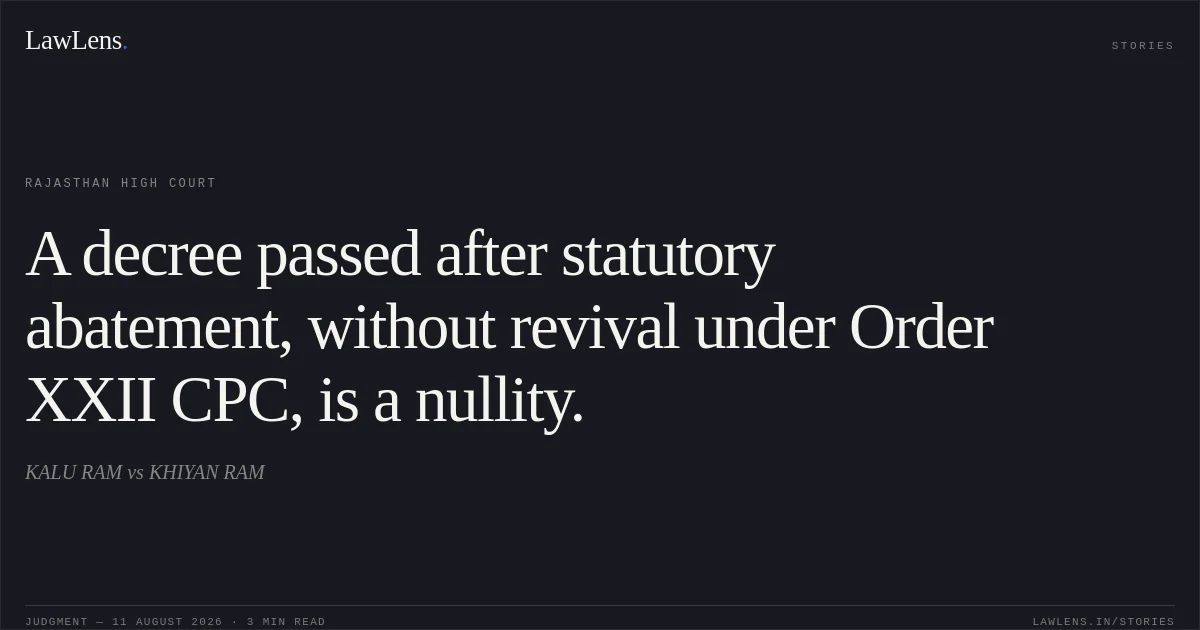
Source reference: para. 17Consequently, the trial Court lacked a subsisting proceeding in which it could validly adjudicate the suit, and the decree passed nearly two years after the plaintiff’s death was held to be a nullity.
Source reference: paras. 18, 20As the respondents had never been substituted and no decree had validly been passed in their favour, they could not qualify as decree-holders or maintain execution proceedings.
Source reference: paras. 17, 19Holding
The Court answered both issues against the respondents.
It held that the suit had abated by operation of law and that, in the absence of setting aside the abatement and lawful substitution of the legal representatives, the judgment and decree dated 30.04.2025 were null and non est.
Source reference: paras. 18, 20The appeal was allowed, the impugned judgment and decree were set aside, and the execution proceedings founded upon that decree were also set aside.
Source reference: para. 21The Court clarified that it had not adjudicated the merits of the original dispute and left the legal representatives at liberty to pursue remedies available under Order XXII CPC before the competent Court.
Source reference: para. 22No order as to costs was made.
Source reference: para. 23Acts & Sections Cited
2 provisions across 2 statutes referred to in this judgment. Each provision opens on LawLens.
Code of Civil Procedure, 19081
Limitation Act, 19631
Original Court PDF
KALU RAMvsKHIYAN RAM
Click to open original judgment
Original judgment, available to read, download and summarize on LawLens.in