Facts
The plaintiffs sought a declaration and permanent injunction concerning a cart track leading to their land.
Source reference: p. 2–3, 5–7, 8–9They relied on sale deeds dated 21 April 1924, which they said referred to the pathway, and claimed a right to use it.
Source reference: p. 2–3, 5–7, 8–9The defendants disputed the claimed width and extent, contending that only a narrow footpath existed along part of the route.
Source reference: p. 2–3, 5–7, 8–9The trial court decreed the suit; the first appellate court reversed that decree and dismissed the suit.
Source reference: p. 2–3, 5–7, 8–9The plaintiffs appealed under Section 100 CPC.
Source reference: p. 2–3, 5–7, 8–9Issues
Whether the plaintiffs’ claimed right to use the cart track was established, having regard to the parties’ co-ownership and the recitals in the 1924 sale deeds.
Source reference: p. 10, 19–20Whether the first appellate court was justified in reversing the trial court’s decree, including on the ground that the plaintiffs had framed their claim as one of easement and had not impleaded the Government.
Source reference: p. 16–17, 19–20Law Applied
In a first appeal, the appellate court must apply its mind to the issues and contentions raised, record reasoned findings, and, when reversing factual findings, engage with the trial court’s reasoning and explain why a different conclusion is warranted.
Source reference: p. 17–19The Court relied on Santosh Hazari v. Purushottam Tiwari (2001) 3 SCC 179, Mahender Pal Chabra v. Subhash Aggrawal (2024) 14 SCC 767, and Dheeraj Singh v. Greater Noida Industrial Development Authority (2023) 19 SCC 214 for these principles.
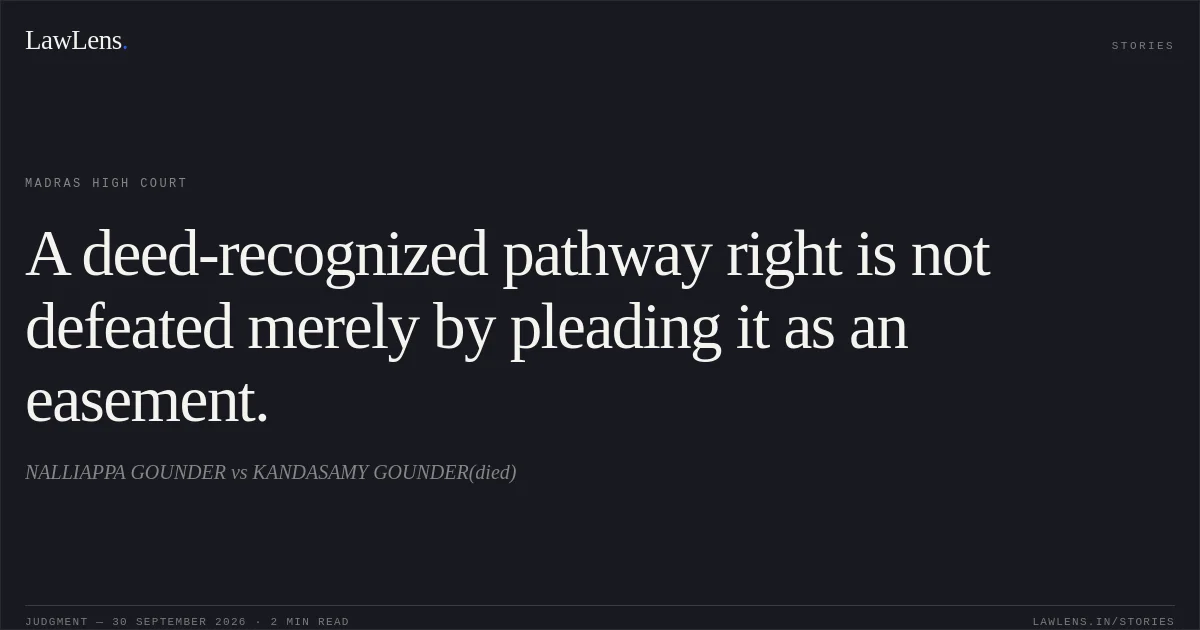
Source reference: p. 17–19The Court also held that the plaintiffs’ reference to easement in the plaint did not displace the documentary basis of their claim where the relevant deeds recorded the pathway.
Source reference: p. 20Reasoning
The Court found that the defendants admitted the existence of a pathway between points I and J and that the Commissioner’s report and plan recorded a cart track extending to the plaintiffs’ land, with its width shown in the plan.
Source reference: p. 14–16It considered that the first appellate court had not adequately addressed the sale-deed recitals or the trial court’s findings, and had relied on the Government’s non-joinder despite the dispute before it concerning the pathway between I and J.
Source reference: p. 16–20In the Court’s view, the appellate court’s reversal lacked proper reasoning and rested on matters beyond the pleaded dispute.
Source reference: p. 17–19Holding
The Court answered the substantial questions of law in favour of the plaintiffs, set aside the first appellate court’s judgment and decree, and restored the trial court’s decree in the plaintiffs’ favour.
The second appeal was allowed; the connected miscellaneous petition was closed, with no order as to costs.
Source reference: p. 20Acts & Sections Cited
1 provisions across 1 statute referred to in this judgment. Each provision opens on LawLens.
Code of Civil Procedure, 19081
Original Court PDF
NALLIAPPA GOUNDERvsKANDASAMY GOUNDER(died)
Click to open original judgment
Original judgment, available to read, download and summarize on LawLens.in