Facts
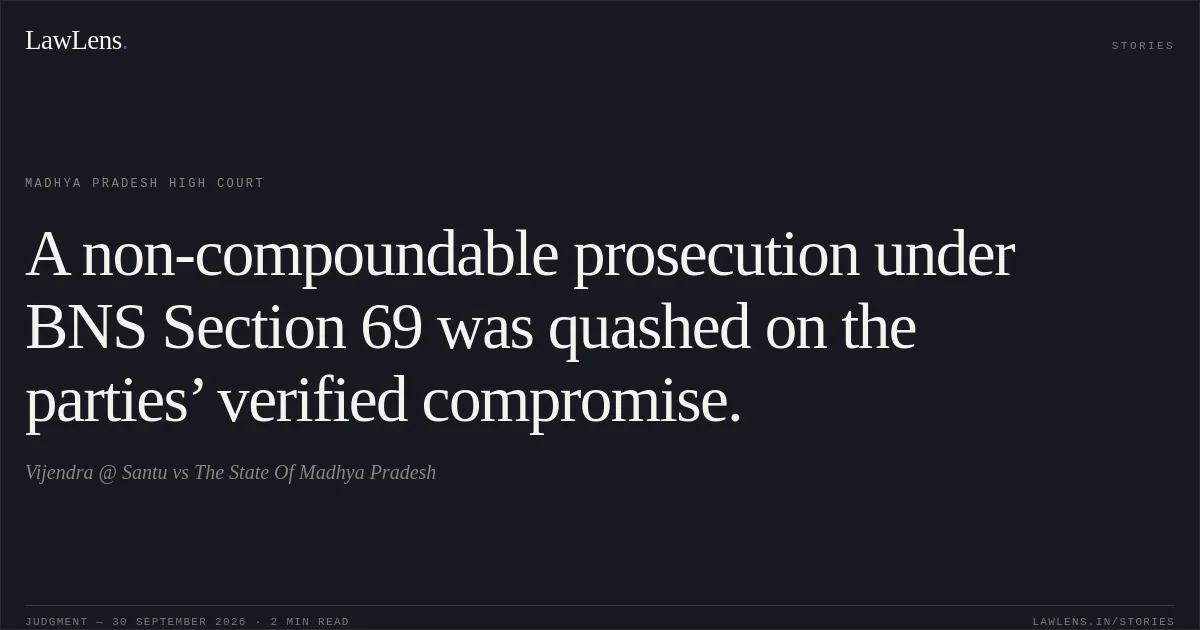
The prosecutrix moved to Indore with her minor children in March 2025. The applicant, a resident of her village, allegedly offered to arrange employment, proposed marriage, and promised to care for her children. They allegedly had physical relations on 15 June and 28 December 2025. After the applicant allegedly became angry when asked about the job and stopped contact, the prosecutrix lodged an FIR on 26 May 2026 under Sections 69 and 351(3) of the Bharatiya Nyaya Sanhita, 2023 (BNS).
Source reference: para. 2The applicant sought quashing under Section 528 of the Bharatiya Nagarik Suraksha Sanhita, 2023 (BNSS), relying on a compromise with the prosecutrix, verified by the Principal Registrar. The verification recorded that Section 351(3) was compoundable and Section 69 was non-compoundable.
Source reference: paras. 1, 3Issues
1. Whether the High Court could quash the FIR and consequential proceedings for the non-compoundable offence under Section 69 of the BNS on the basis of a compromise between the applicant and the prosecutrix.
Source reference: paras. 3–52. Whether, in the circumstances of this case, quashing the proceedings would serve the ends of justice.
Source reference: para. 5Law Applied
Section 528 of the BNSS, corresponding to Section 482 of the Code of Criminal Procedure, 1973, preserves the High Court’s inherent power to quash criminal proceedings to secure the ends of justice. Section 320 of the CrPC governs compounding and is distinct from the High Court’s inherent quashing jurisdiction.
Source reference: para. 4Relying on Gian Singh v. State of Punjab, (2012) 8 SCR 753, the Court noted that proceedings for non-compoundable offences may be quashed following settlement where the nature and circumstances of the case justify that exercise; serious offences, including rape and other crimes of mental depravity, ordinarily cannot be treated as settled merely by agreement between the parties.
Source reference: para. 4Reasoning
The Court noted that the parties had entered into a compromise and that it had been verified by the Principal Registrar; it also acknowledged that Section 69 was non-compoundable.
Source reference: para. 3Referring to Gian Singh, the Court distinguished quashing under inherent powers from statutory compounding and stated that the exercise must be guided by the ends of justice.
Source reference: para. 4It concluded, without further elaboration on the nature of the allegations under Section 69, that there was no purpose in disallowing the compromise and that quashing would meet the ends of justice.
Source reference: para. 5Holding
The High Court allowed the application under Section 528 of the BNSS and quashed the FIR in Crime No. 286/2026, registered at Police Station Pardeshipura, Indore Urban, under Sections 69 and 351(3) of the BNS, together with all consequential proceedings pending against the applicant.
The petition was disposed of on the terms of the compromise.
Source reference: para. 6Acts & Sections Cited
5 provisions across 3 statutes referred to in this judgment. Each provision opens on LawLens.
Bharatiya Nagarik Suraksha Sanhita, 20231
Code of Criminal Procedure, 19732
Bharatiya Nyaya Sanhita, 20232
Original Court PDF
Vijendra @ SantuvsThe State Of Madhya Pradesh
Click to open original judgment
Original judgment, available to read, download and summarize on LawLens.in