Facts
The claimants sought compensation under Sections 166 and 140 of the Motor Vehicles Act, 1988, following the death of Girish Chaubey, aged 24, in a car accident on 24 March 2017.
Source reference: para. 3, 18, 22They alleged that respondent no. 1, the car’s owner and driver, drove negligently, struck a tree, and caused the deceased’s fatal injuries; they claimed that he earned a monthly salary of ₹20,620
Source reference: para. 3, 18, 22The Motor Accident Claims Tribunal dismissed the petition, finding no rash or negligent driving and leaving the other issues undecided.
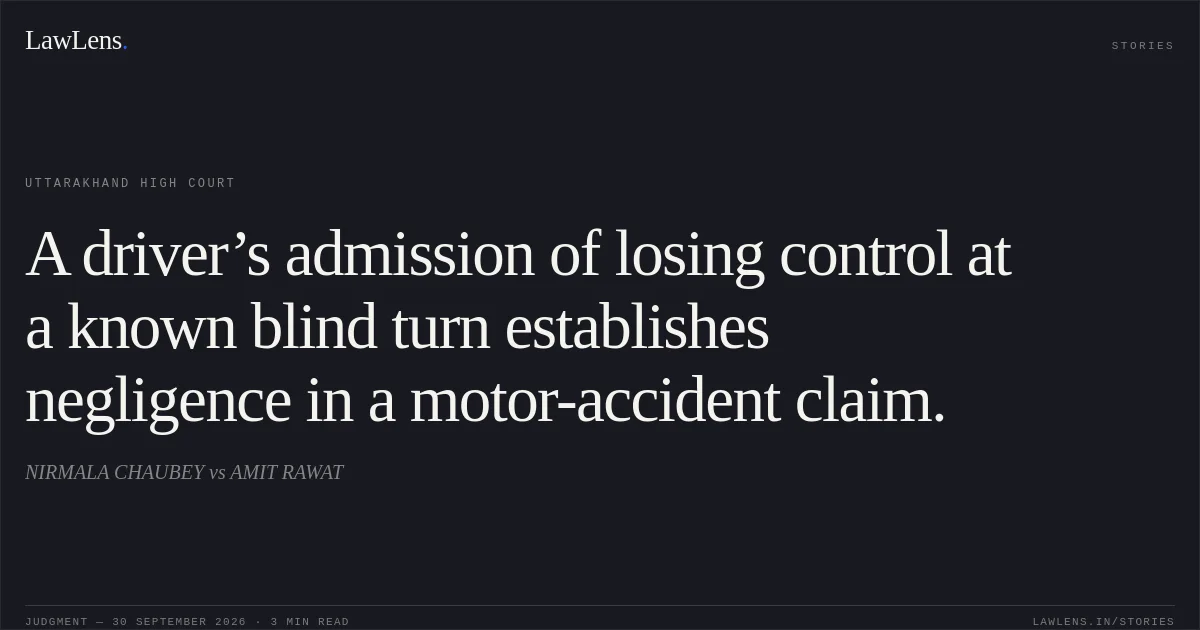
Source reference: para. 8On appeal, the High Court considered the driver’s written statement, which denied the accident in one paragraph but admitted it elsewhere and described losing control at an S-turn after being blinded by oncoming headlights.
Source reference: para. 4, 19Issues
Whether the admitted circumstances in the driver’s written statement established that the accident resulted from his rash or negligent driving, despite the claimants not producing an eyewitness to the accident
Source reference: para. 16–20Whether the vehicle’s driver and vehicle had valid documents at the time of the accident
Source reference: para. 21Whether the claimants established the deceased’s income and were entitled to compensation, and, if so, in what amount and against whom
Source reference: para. 22–26Law Applied
Under Sections 166 and 140 of the Motor Vehicles Act, 1988, compensation may be claimed for death arising from a motor accident; the Court referred to Smt. Kaushnuma Begum v. New India Assurance Co. Ltd., (2001) 2 SCC 9, in discussing motor-accident compensation and no-fault liability.
Source reference: para. 12Negligence is assessed contextually by reference to the conduct of a reasonable and prudent person, and drivers must take reasonable care to avoid endangering road users, as explained in Ravi Kapur v. State of Rajasthan, (2012) 9 SCC 284.
Source reference: para. 11The principle of res ipsa loquitur may permit negligence to be inferred from the circumstances of an accident; the Court also referred to its earlier decision in Niranjan Vishwas v. Sohan Pal Singh, Appeal From Order No. 50 of 2009, decided 5 April 2021.
Source reference: para. 13An admitted fact need not be proved by further evidence.
Source reference: para. 16Reasoning
The Court treated the driver’s pleadings as admissions that the accident occurred and that he lost control at the S-turn after being blinded by oncoming headlights. Because he knew the road’s visibility was limited at that turn, he was required to take additional care; his failure to do so supported a finding of negligence.
Source reference: para. 18–20The circumstances also justified applying res ipsa loquitur, notwithstanding the absence of an eyewitness produced by the claimants.
Source reference: para. 18–20The Court found the driving licence, registration certificate, and insurance policy on record, with nothing shown to undermine their validity.
Source reference: para. 21It accepted the salary evidence of ₹20,620 per month and calculated compensation using a 50% future-prospects addition, a 50% deduction for personal expenses, and a multiplier of 18.
Source reference: para. 22, 24Holding
The High Court held that the accident resulted from respondent no. 1’s rash and negligent driving, found the vehicle’s documents valid, and assessed compensation at ₹34,10,440, with interest at 6% per annum from the date the claim petition was filed.
It set aside the Tribunal’s award, allowed the claim petition and appeal, and directed respondent no. 2, the insurer, to pay the compensation.
Source reference: para. 26–28Acts & Sections Cited
2 provisions across 1 statute referred to in this judgment. Each provision opens on LawLens.
Motor Vehicles Act, 19882
Original Court PDF
NIRMALA CHAUBEYvsAMIT RAWAT
Click to open original judgment
Original judgment, available to read, download and summarize on LawLens.in