Facts
The respondent instituted a commercial suit for recovery of ₹14,33,873 with interest on 27 July 2024.
Source reference: paras. 2–4The petitioner was served on 20 August 2024 and filed his written statement on 6 November 2024, within the outer period of 120 days, but with procedural defects concerning signatures and the Statement of Truth.
Source reference: paras. 2–4The corrected written statement was filed on 20 December 2024, and on 28 February 2025 the Trial Court took it on record, noting that it had been filed within the prescribed outer limit, subject to further costs of ₹2,000.
Source reference: paras. 5–6By order dated 30 May 2025, the Trial Court struck off the petitioner’s defence and directed that the written statement be taken off the record, rejecting the explanation of “server error”.
Source reference: para. 8His review application under Order XLVII Rule 1 read with Section 151 CPC was dismissed on 6 April 2026 on the grounds that it disclosed no error apparent, lacked a prayer clause, was delayed, and appeared dilatory.
Source reference: paras. 10–11Before the High Court, the petitioner produced evidence that he had transferred amounts to his erstwhile counsel towards the costs and had subsequently paid ₹5,000 directly to the respondent.
Source reference: paras. 13–15Issues
Whether the petitioner’s defence ought to have been struck off solely on account of non-payment of costs where the written statement had been filed within the prescribed 120-day period and the petitioner claimed to have made payments towards the costs through his erstwhile counsel?
Source reference: paras. 18–21Whether, notwithstanding the absence of an apparent error in the review order and the advanced stage of the proceedings, the High Court could grant supervisory relief to prevent a disproportionate denial of an opportunity to contest the suit on merits?
Source reference: paras. 22–24Law Applied
The Court applied the principles governing payment of costs and closure of a party’s right under Sections 35A and 35B CPC.
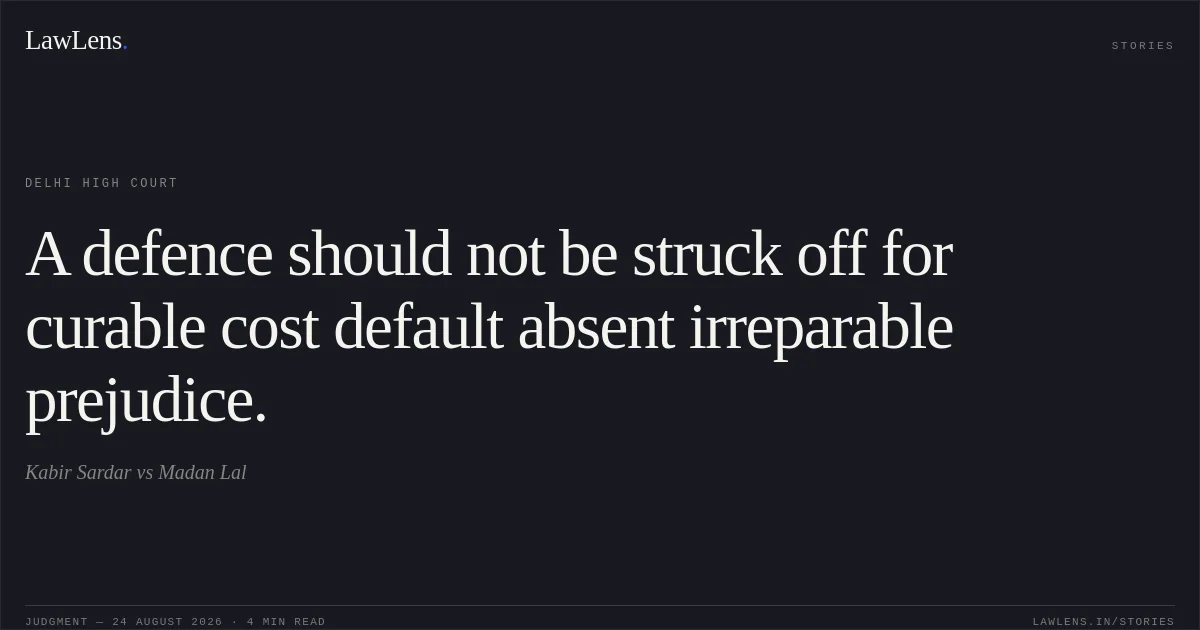
Source reference: para. 22Section 35A concerns compensatory costs for false or vexatious claims or defences, whereas Section 35B permits withholding of further proceedings by a defaulting party until payment of costs, but does not invariably require irreversible forfeiture of the defence where the default is subsequently cured and no irreparable prejudice is caused.
Source reference: para. 22The Court also considered Order XLVII Rule 1 CPC, which limits review to, inter alia, discovery of new matter, mistake or error apparent on the face of the record, or other sufficient reason.
Source reference: paras. 10–11, 23It relied on Rafiq v. Munshilal, 1981 SCC (2) 788, and Dwarika Prasad (Deceased) through LRs v. Prithvi Raj Singh, 2024 INSC 1030, for the principle that a litigant should not ordinarily suffer for the bona fide negligence or default of counsel and that adjudication on merits is preferable to shutting out a defence on technical grounds.
Source reference: para. 14Reasoning
The High Court distinguished the petitioner’s default from a failure to file the written statement within the statutory period.
Source reference: para. 21The Trial Court had already found that the written statement was filed within 120 days and had accepted it subject to costs; therefore, the subsequent default concerned only compliance with a monetary condition and was capable of being cured.
Source reference: para. 21The petitioner’s transfers of ₹2,000, ₹3,000 and ₹2,500 to his erstwhile counsel, although not paid directly to the respondent, demonstrated that he had arranged and transmitted substantial amounts towards compliance.
Source reference: para. 19His later direct payment of ₹5,000 to the respondent further supported the contention that the default was not intended to evade payment or delay the proceedings.
Source reference: para. 20The Court also found that Section 35A had been incorrectly invoked because there was no finding that the petitioner’s defence was false or vexatious; the costs were, in substance, costs for delay or non-compliance falling within Section 35B.
Source reference: para. 22While Section 35B permits withholding further proceedings until costs are paid, the Court held that it does not mandate the permanent extinction of a defence where the default is curable and compensatory terms can protect the opposite party.
Source reference: paras. 21–24Striking off the defence would cause disproportionate prejudice by preventing the petitioner from contesting a substantial recovery claim on merits, whereas the respondent could be compensated through additional costs and procedural safeguards.
Source reference: paras. 21–24Holding
The High Court allowed the petition and set aside the orders dated 30 May 2025 and 6 April 2026.
It directed that the petitioner’s written statement be taken on record.
Source reference: para. 25The ₹5,000 paid directly to the respondent was directed to be adjusted towards the costs imposed by the Trial Court, subject to the petitioner paying an additional ₹10,000 to the respondent within one week.
Source reference: para. 25The petitioner was also permitted to seek recall of PW-1 for cross-examination, which the Trial Court was directed to allow as the petitioner’s last and final opportunity.
Source reference: para. 25The Trial Court was directed to dispose of the suit expeditiously, preferably within six months.
Source reference: paras. 25–27The Court clarified that its observations would not affect the merits of the suit.
Source reference: para. 28Acts & Sections Cited
4 provisions across 2 statutes referred to in this judgment. Linked provisions open on LawLens.
Code of Civil Procedure, 19083
Limitation Act, 19631
Original Court PDF
Kabir SardarvsMadan Lal
Click to open original judgment
Original judgment, available to read, download and summarize on LawLens.in