Facts
The plaintiffs challenged the Trial Court’s order dated 27 November 2019 allowing defendants’ application under Order VI Rule 17 read with Section 151 CPC to amend their written statement.
Source reference: pp. 6–8, paras. 1, 3–5The plaintiffs had also sought amendment of the plaint, and the Trial Court allowed both applications in the same order.
Source reference: pp. 6–8, paras. 1, 3–5The defendants’ proposed amendments included typographical corrections and additional pleas concerning non-inclusion of properties, a 1964 Gift Deed, alleged impersonation, khata transfer, and a 2016 Gift Deed.
Source reference: pp. 6–8, paras. 1, 3–5The applications were allowed when the suit was posted for cross-examination of the plaintiffs.
Source reference: pp. 6–8, paras. 1, 3–5Issues
1. Whether the Trial Court’s order allowing the defendants to amend their written statement at the stage of cross-examination warranted interference under Article 227 of the Constitution
Source reference: pp. 6–8, paras. 1, 4–52. Whether the proposed additional pleas caused prejudice to the plaintiffs or displaced the foundational case or character of the defence
Source reference: pp. 8–10, paras. 5–8Law Applied
Order VI Rule 17 CPC governs amendment of pleadings; the judgment noted that an amendment sought after commencement of trial must satisfy the applicable parameters.
Source reference: p. 7, para. 4Section 151 CPC was invoked in the defendants’ application, while the High Court exercised its supervisory jurisdiction under Article 227.
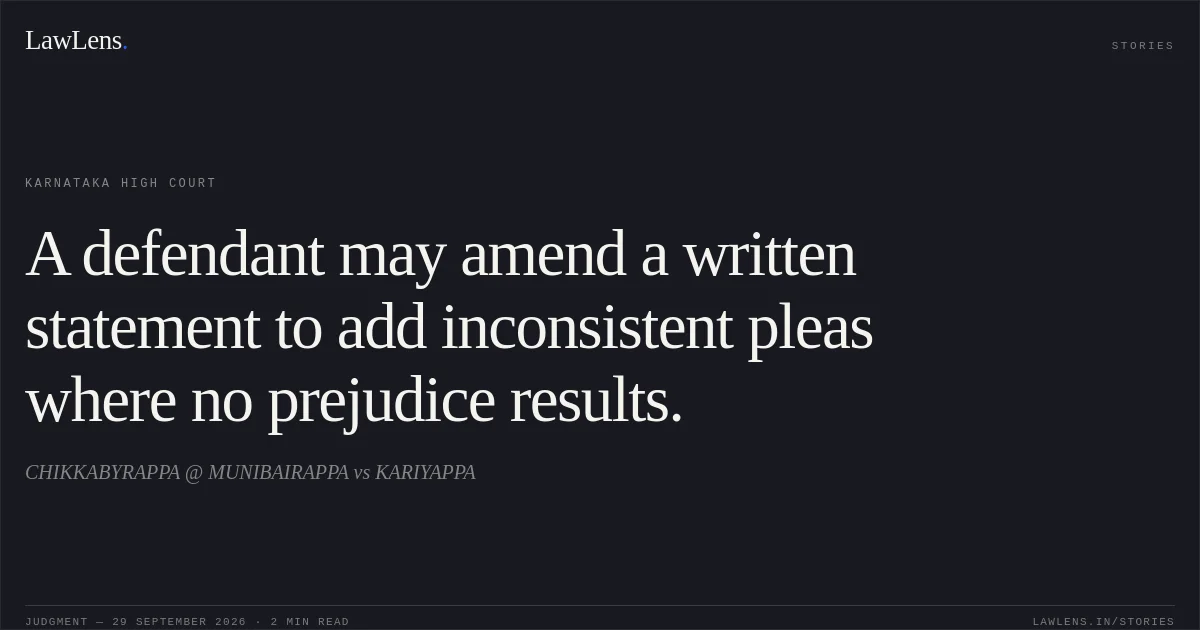
Source reference: pp. 7–8, para. 4a defendant may raise inconsistent or even mutually inconsistent pleas in a written statement, provided they do not prejudice the plaintiff or completely displace the nature and character of the defence
Source reference: pp. 7–8, para. 4Reasoning
The Court considered that the Trial Court had allowed both the plaintiffs’ plaint amendment and the defendants’ written-statement amendment in the same order.
Source reference: pp. 8–10, paras. 5–8It held that the proposed defence did not alter or displace the plaintiffs’ foundational case and that the defendants retained the burden of proving their additional allegations.
Source reference: pp. 8–10, paras. 5–8The plaintiffs could controvert those pleas by rejoinder and evidence; permitting the amendments therefore caused no prejudice.
Source reference: pp. 8–10, paras. 5–8The amendments did not establish the truth of the allegations or determine their merits.
Source reference: pp. 8–10, paras. 5–8Holding
The High Court found no infirmity or jurisdictional error warranting interference under Article 227 and dismissed the writ petition.
It permitted the plaintiffs to file a rejoinder to the amended written statement, if not already filed, and left all merits contentions open for independent consideration by the Trial Court.
Source reference: p. 11Acts & Sections Cited
1 provisions across 1 statute referred to in this judgment. Each provision opens on LawLens.
Code of Civil Procedure, 19081
Original Court PDF
CHIKKABYRAPPA @ MUNIBAIRAPPAvsKARIYAPPA
Click to open original judgment
Original judgment, available to read, download and summarize on LawLens.in