01Facts
The plaintiff instituted O.S. No. 222 of 2022 before the I Additional Senior Civil Judge and JMFC, Bagalkot, seeking partition and separate possession of her share in the family properties.
¶ 4–5, 8–10The petitioner was defendant No.1, while Bharati was defendant No.3.
¶ 4–5Defendant No.3 filed a written statement supporting the plaintiff’s claim and independently asserted entitlement to a one-fourth share, expressing willingness to pay the requisite court fee.
¶ 4–5, 8–10During the pendency of the suit, the plaintiff settled with defendant No.1 and withdrew her claim.
¶ 6Thereafter, defendant No.3 filed an additional written statement, described as a counter-claim under Order VIII Rule 6A CPC, seeking inclusion of additional properties in the partition proceedings and claiming a share therein.
¶ 6, 12–13The Trial Court allowed the applications filed under Order VIII Rule 1A and Order VIII Rule 9(6) read with Order VIII Rule 6A and Section 151 CPC.
¶ 1–2Defendant No.1 challenged those orders under Articles 226 and 227 of the Constitution.
¶ 1–202Issues
i.Whether a defendant in a partition suit who supports the plaintiff’s claim and independently asserts a right to partition can be treated, in substance, as a co-plaintiff despite being described as a defendant in the cause title?
¶ 5, 9–11, 27–29ii.Whether the withdrawal of the original plaintiff’s claim extinguished the independent partition claim already asserted by defendant No.3, thereby requiring her to institute a fresh suit?
¶ 12, 18–20, 28, 31–32iii.Whether defendant No.3 could bring additional properties on record through a subsequent pleading, notwithstanding the objection that it amounted to an impermissible second counter-claim?
¶ 7, 14–17, 23–24, 3003Law Applied
The Court applied Order VIII Rules 1A, 6A and 9(6), along with Section 151 of the Code of Civil Procedure, 1908.
¶ 10–11, 15, 21–22, 29, 34It held that the substance of a pleading, rather than its nomenclature, determines its legal character.
¶ 10–11, 29In a partition suit, a defendant who supports the plaintiff and asserts an independent entitlement to a share, upon payment or undertaking to pay the requisite court fee, may be treated in substance as a co-plaintiff.
¶ 10–11, 29The Court further applied the principle that partition proceedings should ordinarily comprehensively determine the rights of all co-sharers in respect of the entire joint family estate, and that procedural rules should not promote multiplicity of proceedings.
¶ 15, 21–22, 34It relied on Sampath Kumar v. Ayyakannu, (2002) 7 SCC 559, for the principle that appropriate amendments should be permitted to avoid multiplicity of litigation and enable effective adjudication of the real controversy.
¶ 10–11, 15, 21–22, 29, 34Provisions in the judgment · 1 · Linked ones open on LawLens
Code of Civil Procedure, 1908 Section 151
04Reasoning
The Court found that defendant No.3 had not merely contested the plaintiff’s suit; she had accepted the claim for partition and independently sought determination and separate possession of her own one-fourth share.
¶ 8–10, 27–29Accordingly, her pleading substantively constituted a claim for partition, notwithstanding its description as a counter-claim.
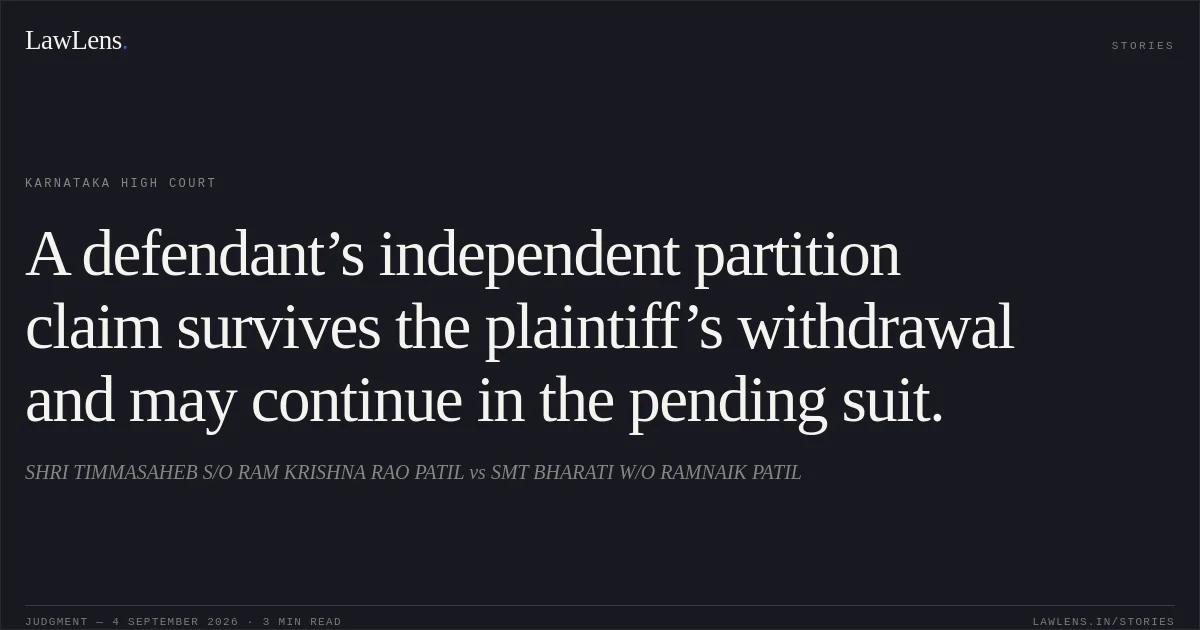
¶ 8–10, 27–29That independent claim survived the plaintiff’s subsequent withdrawal because it was founded on defendant No.3’s own asserted co-sharer rights and was not dependent upon the plaintiff continuing to prosecute the suit.
¶ 12, 19, 28, 31The additional properties could therefore be considered in the pending partition proceedings, particularly because a comprehensive determination of the joint family estate would avoid parallel proceedings and inconsistent findings.
¶ 14–17, 20–23However, the Court clarified that permitting their inclusion did not establish that they were joint family or ancestral properties; defendant No.3 retained the initial burden of proving their nature and availability for partition, while the other parties remained entitled to contest those claims.
¶ 25–26, 3605Holding
The High Court dismissed the writ petition and upheld the Trial Court’s orders permitting defendant No.3 to place the additional properties on record.
¶ 40(i)It held that her original pleading had to be construed as an independent claim for partition and that the plaintiff’s withdrawal did not extinguish that surviving claim or compel defendant No.3 to file a fresh suit.
¶ 37–39The petitioner was permitted to file a rejoinder or additional written statement.
¶ 40(ii)–(iii)The Trial Court was directed to consider the further pleadings and frame additional issues if necessary.
¶ 40(ii)–(iii)All questions concerning the title, nature, character, availability of the additional properties for partition, and the parties’ respective shares were left open for independent adjudication by the Trial Court on the basis of pleadings and evidence.
¶ 40(iv)–(v)Original Court PDF
SHRI TIMMASAHEB S/O RAM KRISHNA RAO PATILvsSMT BHARATI W/O RAMNAIK PATIL
Click to open original judgment
Original judgment, available to read, download and summarize on LawLens.in