Facts
On 28.05.1983, Anand Kishore Singh and Sajid Ali were allegedly intercepted near Girdhari Singh’s grove by four armed assailants. They were tied with their own clothing and fired upon; Anand died at the spot and Sajid sustained firearm injuries and later died during treatment on 04.06.1983.
Source reference: paras. 5–7PW2 and PW3 claimed to have witnessed the occurrence in torchlight and identified the assailants subsequently. The FIR was lodged against unknown persons on 29.05.1983 at approximately 7:25–7:30 a.m.
Source reference: paras. 5–7, 27Following investigation, Ram Bilas, Suresh Chandra and another person were arrested, and Ram Bilas and Suresh were charged under Sections 302/34 and 307/34 IPC.
Source reference: para. 8The Trial Court convicted them under Section 302 read with Section 34 IPC and sentenced them to life imprisonment on 20.08.1985.
Source reference: paras. 21–22Ram Bilas died during the pendency of the appeal, resulting in abatement of the appeal as against him; the appeal survived only for Suresh.
Source reference: para. 3Issues
Whether the ocular testimony of PW2 and PW3 was trustworthy and sufficient to sustain the conviction
Source reference: para. 26(A)Whether the Test Identification Parade suffered from material irregularities that rendered the identification evidence unreliable
Source reference: para. 26(B)Whether the judgment of conviction suffered from illegality, material infirmity or perversity warranting appellate interference
Source reference: para. 26(C)Law Applied
The Court applied Sections 302 and 34 IPC concerning murder committed with common intention, and the prosecution’s obligation to establish guilt beyond reasonable doubt.
Source reference: no citationUnder Vadivelu Thevar v. State of Madras, ocular testimony may be wholly reliable, wholly unreliable, or require corroboration where it falls in the intermediate category.
Source reference: para. 29The Court relied on Rai Sandeep v. State (NCT of Delhi) and Manjunath v. State of Karnataka for the requirement that a “sterling witness” must give a consistent, natural and unassailable account.
Source reference: para. 30Regarding identification, Budhsen v. State of U.P. and Amitsingh Bhikamsingh Thakur v. State of Maharashtra establish that a TIP is an investigative and corroborative measure, not substantive evidence, and should be conducted promptly with safeguards against the accused being shown to witnesses beforehand.
Source reference: paras. 49–50The Court further applied the principles in Musheer Khan v. State of M.P. and Gireesan Nair v. State of Kerala that unexplained delay in conducting a TIP may undermine its reliability.
Source reference: paras. 58–59Confessions made to police officers while in custody are inadmissible under Section 25 of the Indian Evidence Act, 1872, absent a legally admissible discovery.
Source reference: para. 36Investigative deficiencies generating reasonable doubt must enure to the accused’s benefit under State of U.P. v. Wasif Haider.
Source reference: para. 63Reasoning
The Court found the testimony of PW2 and PW3 materially unreliable. Their conduct in leaving the seriously injured Sajid unattended at the scene throughout the night, despite the assailants having fled, was inconsistent with ordinary human conduct.
Source reference: paras. 34, 42–43Although PW2 and PW3 allegedly informed PW1 and Sajid about the assailants, the FIR named no accused and contained no description of their physical features; Sajid’s statement to the Investigating Officer likewise referred only to unknown assailants.
Source reference: para. 35Their statements under Section 161 CrPC were recorded 20–22 days after the incident, without a satisfactory explanation.
Source reference: paras. 36, 62The Court also noted the material contradiction between the site plan, which placed the witnesses approximately 50 paces from the assailants, and their deposition that they were only 3–4 paces away.
Source reference: paras. 38, 40The prosecution failed to recover the torches or weapons and did not produce reliable corroborative evidence.
Source reference: paras. 36, 56, 67The TIP was further discredited by conflicting arrest dates, absence of an arrest memo and arrest witnesses, unexplained delay between arrest and the TIP request, and the accused’s recorded assertion that they had already been shown to the witnesses.
Source reference: paras. 52–53, 60The parade was held on 09.08.1983, more than two months after the occurrence, although the accused had allegedly been arrested on 01.07.1983.
Source reference: paras. 53, 57Since the prosecution case rested substantially on the disputed eyewitness identification and no independent evidentiary link connected Suresh to the offence, the Court held that the prosecution failed to prove his complicity beyond reasonable doubt.
Source reference: paras. 61–68Holding
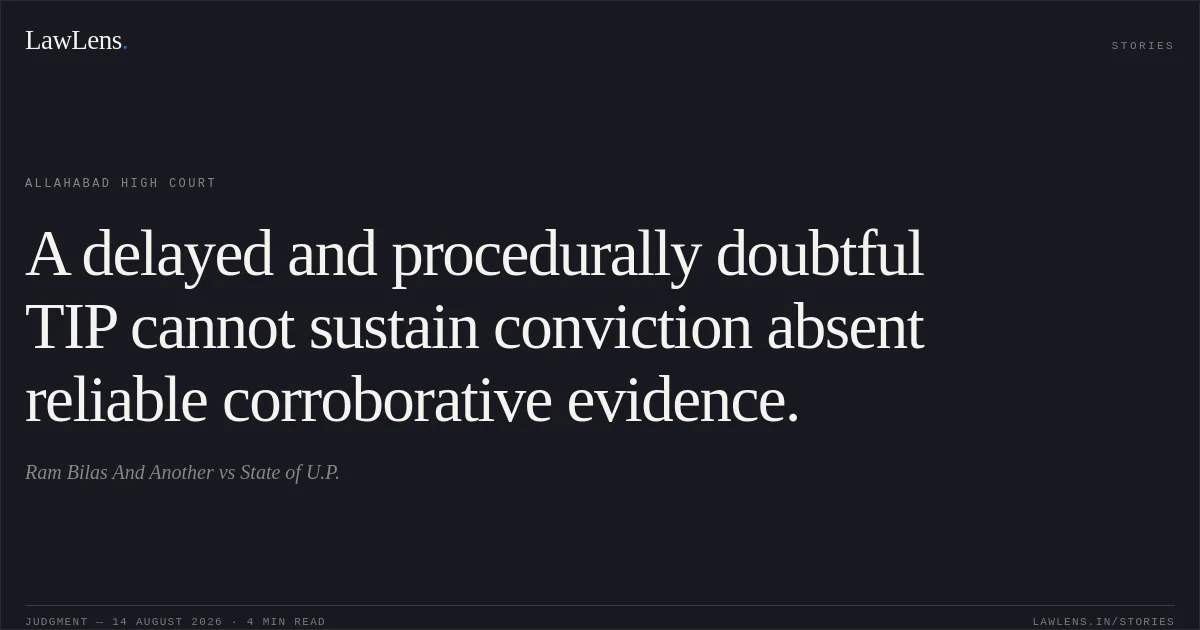
The Court answered the issues against the prosecution, holding that PW2 and PW3 were not wholly reliable and that the TIP was unsafe to rely upon.
The conviction and sentence dated 20.08.1985 under Section 302 read with Section 34 IPC were set aside, and the surviving appellant, Suresh, was acquitted by extending the benefit of doubt.
Source reference: para. 70As Suresh was stated to be in custody, the Court directed issuance of a release warrant.
Source reference: para. 71He was additionally directed to furnish a personal bond and two sureties under Section 437-A CrPC within fifteen days.
Source reference: para. 71Acts & Sections Cited
7 provisions across 2 statutes referred to in this judgment. Each provision opens on LawLens.
Indian Penal Code, 18603
Code of Criminal Procedure, 19734
Original Court PDF
Ram Bilas And AnothervsState of U.P.
Click to open original judgment
Original judgment, available to read, download and summarize on LawLens.in