01Facts
The respondent-plaintiff was enrolled as a Home Guard in 1985 and subsequently enrolled, on 18.06.1992, as a Special Police Officer on daily wages under Section 17 of the Police Act, 1861.
¶ 8The defendants alleged that, while posted on naka duty, he was found to have consumed liquor and that a report dated 02.09.1993 recommended his termination. He was disengaged from service in September 1993.
¶ 2–3, 8The plaintiff alleged that he had been orally informed of his dismissal without a departmental inquiry, show-cause notice, written order, or opportunity of hearing. He instituted a suit for declaration in June 2005, challenging the alleged dismissal/disengagement as illegal and void.
¶ 2, 8The trial court partly decreed the suit by directing the department to provide him an opportunity of hearing and pass an appropriate order. The first appellate court affirmed that decision. The defendants thereafter preferred the present second appeal.
¶ 5–602Issues
i.Whether the plaintiff’s suit challenging his dismissal/disengagement from service, instituted nearly twelve years after the alleged disengagement, was barred by limitation?
¶ 8–10ii.Whether the courts below were justified in directing the department to provide the plaintiff an opportunity of hearing and pass a fresh order?
¶ 5–6, 10–11iii.Whether the issuance of a subsequent request or notice to the department could revive or extend the limitation period for challenging the 1993 disengagement?
¶ 1003Law Applied
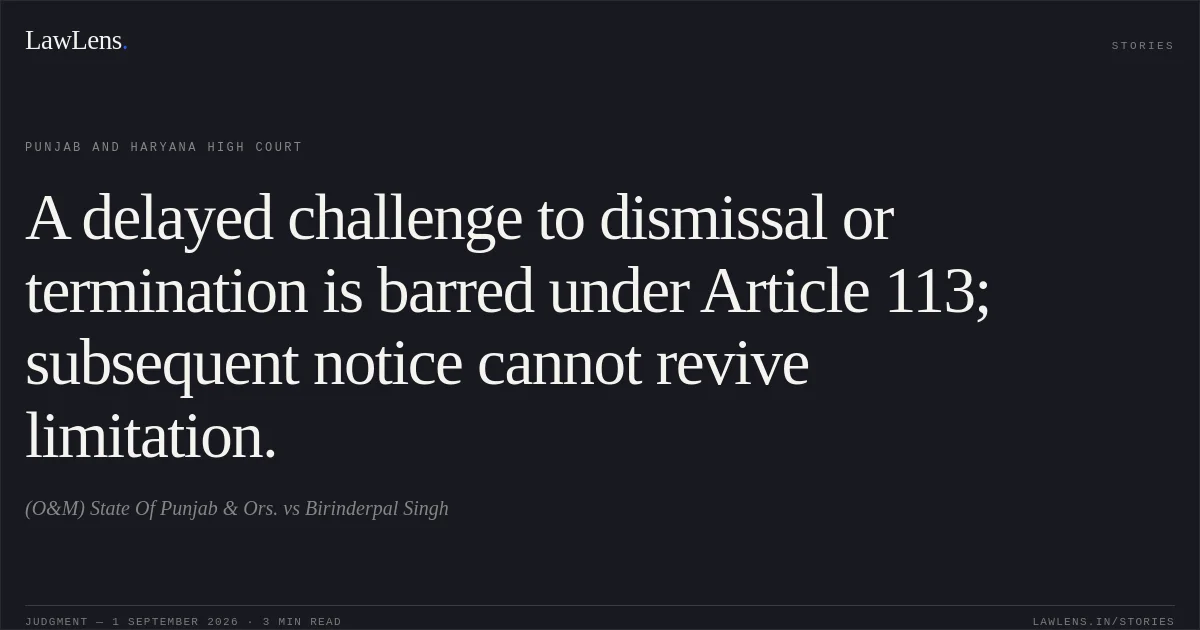
The Court applied Article 113 of the Limitation Act, 1963, holding that a suit seeking a declaration that an order of dismissal or termination from service is wrongful, illegal, or ultra vires must be instituted within the prescribed limitation period.
¶ 9Relying on the three-Judge Bench decision in State of Punjab v. Gurdev Singh and Ashok Kumar, 1991 (3) SCT 91, the Court reiterated that a person aggrieved by an invalid service order must approach the court within the statutory period; after expiry of that period, the court cannot grant the declaration sought.
¶ 9The Court also noted that the plaintiff’s status as a Special Police Officer arose under Section 17 of the Police Act, 1861.
¶ 8A subsequent notice or representation does not extend limitation or revive a stale cause of action.
¶ 10Provisions in the judgment · 2 · Linked ones open on LawLens
Police Act, 1861 Section 17
Limitation Act, 1963 Section 113
04Reasoning
The material cause of action arose when the plaintiff was disengaged in September 1993, irrespective of his allegation that the order was oral or that a written order was not supplied.
¶ 8The plaintiff challenged the disengagement for the first time only in June 2005, after an unexplained delay of nearly twelve years. Applying Gurdev Singh, the Court held that a declaration challenging the legality or validity of a termination order must be sought within the limitation period under Article 113 of the Limitation Act.
¶ 9–10The plaintiff could not postpone commencement of limitation by relying on a later request for the dismissal order or reinstatement, since such correspondence neither extended the statutory period nor revived the extinguished cause of action.
¶ 9–10Consequently, the finding of the courts below granting an opportunity of hearing could not stand because the suit itself was barred by limitation.
¶ 10–1105Holding
The Court answered the principal issue in favour of the appellants and held that the suit filed in June 2005 challenging the plaintiff’s September 1993 disengagement was clearly barred by limitation.
¶ 10The second appeal was allowed, and the judgments and decrees of the trial court and the first appellate court were set aside. The direction requiring the department to provide the plaintiff an opportunity of hearing and pass a fresh order was therefore vacated.
¶ 11Any pending application was also disposed of.
¶ 12Original Court PDF
(O&M) State Of Punjab & Ors.vsBirinderpal Singh
Click to open original judgment
Original judgment, available to read, download and summarize on LawLens.in