Facts
The Respondent was employed by the Petitioner-Trust, which manages the Breach Candy Club, from 1 November 2000 until his termination on 2 July 2023, completing approximately 23 years of service.
Source reference: paras. 3, 19The Trust alleged that, during digitisation of membership records, the Respondent had shredded original records and caused substantial financial loss. He was suspended and subsequently terminated after disciplinary allegations were raised.
Source reference: paras. 4–5The Respondent’s civil suit challenging his suspension and termination was partly decreed, with the City Civil Court holding the termination illegal and awarding him Rs.15,38,874 towards salary arrears; the parties’ appeals were pending.
Source reference: paras. 7, 20Following the Respondent’s unsuccessful efforts to obtain gratuity from the Trust, he filed Application (PGA) No. 127 of 2025 before the Controlling Authority under the Payment of Gratuity Act, 1972.
Source reference: paras. 5–6, 30The Controlling Authority proceeded ex parte and, by order dated 19 November 2025, directed the Petitioners to pay Rs.11,67,785 as gratuity with simple interest at 10% per annum from 2 July 2023.
Source reference: para. 6The Petitioners contended that they had not been duly served and that the Respondent’s gratuity had been forfeited or could be adjusted against alleged losses under Section 4(6) of the Act. They did not pursue the statutory appeal under Section 7(7) and instead filed the present petition under Articles 226 and 227 of the Constitution.
Source reference: paras. 9–13, 22–23Issues
Whether the writ petition was maintainable when the Petitioners had not availed the statutory appellate remedy under Section 7(7) of the Payment of Gratuity Act, 1972?
Source reference: paras. 21–29Whether the Petitioners were duly served with the gratuity proceedings through the Trust’s Administrative Manager, and were therefore justified in seeking interference on the ground that the order was passed ex parte?
Source reference: paras. 30–41Whether the Respondent’s gratuity could be forfeited or withheld under Section 4(6) of the Payment of Gratuity Act on the basis of alleged misconduct and loss caused to the Trust?
Source reference: paras. 43–51Whether the interest awarded by the Controlling Authority required modification, and what consequential relief should be granted?
Source reference: paras. 52–55Law Applied
Section 7(7) of the Payment of Gratuity Act provides a statutory appeal against an order of the Controlling Authority within 60 days, with condonation permissible only for a further period of 60 days; an employer’s appeal cannot be entertained unless the awarded gratuity is deposited.
Source reference: para. 22The Court relied on Nanded Zilla Dekhrekh Sahakari Sanstha Maryadit v. Narhar Pralhadrao Kulkarni, holding that an appeal cannot be entertained beyond the maximum 120-day period, and on Assistant Commissioner (CT), LTU, Kakinada v. Glaxo Smith Kline Consumer Health Care Ltd., regarding the consequences of an exhausted statutory remedy.
Source reference: paras. 27, 29Rule 15 of the Payment of Gratuity Rules, 1972 permits service of notices personally, by registered post or in the manner prescribed by the CPC, and service on an authorised person may constitute valid service.
Source reference: paras. 36–37Rule 11(5) permits recall of an ex parte order where sufficient cause is shown within 30 days.
Source reference: para. 40Under Section 4(6), gratuity may be forfeited only to the extent of direct damage or loss caused by the employee’s wilful omission or negligence, or in the specified cases of violence, disorderly conduct or an offence involving moral turpitude.
Source reference: para. 44Rule 8 requires the employer to issue Form-M where the gratuity claim is not admissible; the Court, relying on Chairman and Managing Director, Bank of Maharashtra v. Kishore, held that forfeiture must be preceded by a fair notice specifying the basis and extent of the alleged loss.
Source reference: paras. 45–46Section 8 and the Central Government notification prescribe recovery with compound interest at 15% on unpaid gratuity.
Source reference: para. 52Reasoning
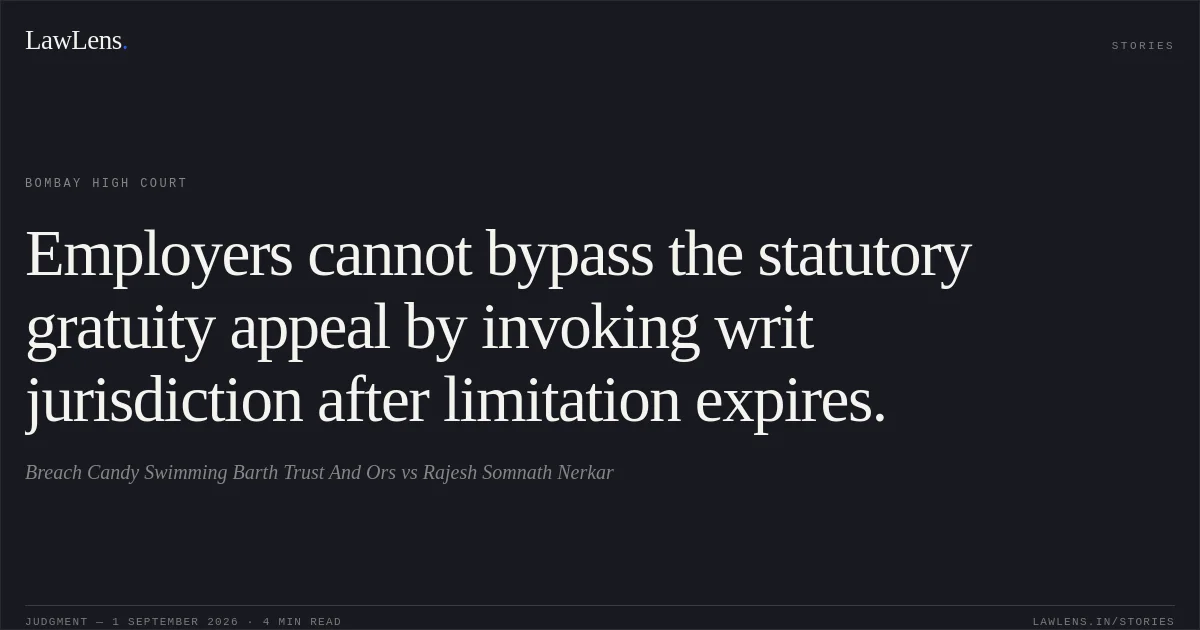
The Court held that the Petitioners could not bypass Section 7(7) merely because the limitation period for filing an appeal had expired. The Trust had received the Controlling Authority’s order through the Respondent’s advocate on 29 November 2025 and had sufficient opportunity either to appeal or seek recall of the ex parte order under Rule 11(5), but deliberately took no action.
Source reference: paras. 23, 38–41The plea of non-service was rejected because the bailiff had served all eight notices on Mr. Krishnanath Satardekar, the Trust’s Administrative Manager, who was authorised to receive communications on behalf of the Trust and its trustees. The Court distinguished the earlier correspondence relied upon by the Petitioners, noting that it concerned authority to sanction leave and not authority to accept service.
Source reference: paras. 34–37On merits, the Court found that no valid forfeiture had been effected. The Petitioners had not issued Form-M or otherwise communicated a decision forfeiting gratuity.
Source reference: paras. 45–47The termination letter referred to an alleged loss of Rs.5 crores and adjustment against salary, but did not state that gratuity was forfeited.
Source reference: paras. 48–49Further, the alleged shredding of membership records did not establish the direct loss contemplated by Section 4(6)(a), and the Trust’s counterclaim for Rs.5 crores had been rejected by the Civil Court.
Source reference: para. 50Accordingly, the Respondent remained entitled to statutory gratuity. In view of the pending recovery proceedings and the Petitioners’ continued failure to pay, the Court directed payment with the statutory 15% compound interest rather than the 10% simple interest awarded by the Controlling Authority.
Source reference: para. 52Holding
The writ petition was dismissed. The Court held that the Petitioners had been duly served, had failed to pursue the statutory remedies under Section 7(7) and Rule 11(5), and could not invoke writ jurisdiction to overcome their own inaction.
It further held that the Respondent’s gratuity had not been validly forfeited under Section 4(6), as no Form-M notice or legally sufficient basis for forfeiture had been established.
Source reference: paras. 47–51The Petitioners were directed to pay Rs.11,67,785 towards gratuity with statutory compound interest at 15%, together with costs of Rs.1,00,000, within six weeks.
Source reference: paras. 52, 54–55Acts & Sections Cited
1 provisions across 1 statute referred to in this judgment. Each provision opens on LawLens.
Maharashtra Recognition of Trade Unions and Prevention of Unfair Labour Practices Act, 19711
Original Court PDF
Breach Candy Swimming Barth Trust And OrsvsRajesh Somnath Nerkar
Click to open original judgment
Original judgment, available to read, download and summarize on LawLens.in