Facts
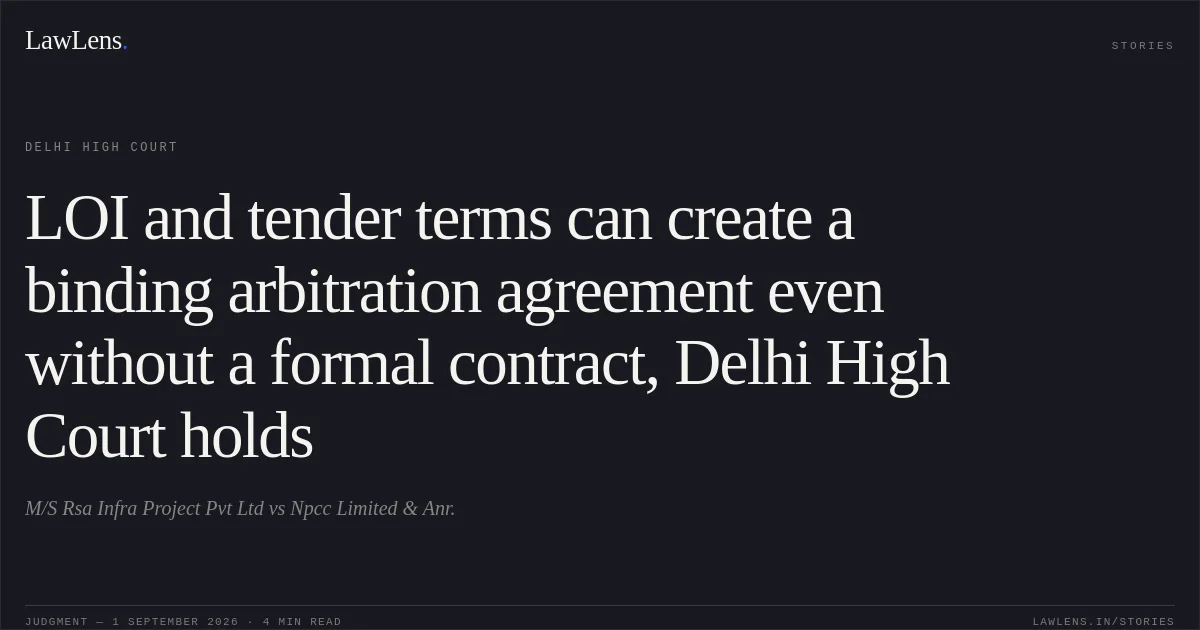
NPCC Limited issued a Notice Inviting Tender dated 23 January 2024 for construction of a Limited Height Subway and Railway Overbridge on the Bilaspur–Jharsuguda railway section. The petitioner was declared the lowest bidder, and NPCC issued a Letter of Intent dated 12 June 2024 for a contract value of ₹36,82,47,053.44.
Source reference: paras. 2–3The petitioner furnished a performance guarantee of ₹1,84,12,354, mobilised resources, and commenced and partly executed the work.
Source reference: paras. 4, 35–36The petitioner alleged that site hindrances, including non-clearance of S&T cables, impeded progress. NPCC subsequently issued show-cause notices alleging poor performance and non-execution of the formal contract agreement.
Source reference: paras. 5–7Although the formal agreement contemplated by the tender documents was not executed, NPCC terminated the LOI on 20 June 2025, directed that the balance work be completed at the petitioner’s risk and cost, and sought encashment of the performance guarantee.
Source reference: paras. 8–10The petitioner initiated pre-institution mediation, but NPCC declined to participate and Respondent No. 2 failed to appear. The petitioner thereafter invoked arbitration under Section 21 of the Arbitration and Conciliation Act, 1996, on 29 January 2026. The respondents did not respond, leading to the present petition under Section 11(6) seeking appointment of a sole arbitrator.
Source reference: paras. 11–13Issues
Whether, notwithstanding the non-execution of the formal contract agreement, the LOI read with the tender documents constituted a binding contract containing a valid arbitration agreement?
Source reference: paras. 27–35, 44–51Whether Respondent No. 2, the Principal Employer/Client and a non-signatory to the petitioner’s contractual arrangement with NPCC, could be joined in the arbitral proceedings?
Source reference: paras. 20, 23–26, 54–56Whether the contractual mechanism authorising the CMD of NPCC to appoint the sole arbitrator could be given effect under Section 12(5) read with the Seventh Schedule to the A&C Act?
Source reference: paras. 57–59Law Applied
At the Section 11 stage, the court is required to examine only the prima facie existence of an arbitration agreement, leaving questions of jurisdiction, arbitrability, limitation, and other merits-related objections to the arbitral tribunal under Section 16, as held in SBI General Insurance Co. Ltd. v. Krish Spinning and In Re: Interplay between Arbitration Agreements under the Arbitration and Conciliation Act, 1996 and the Indian Stamp Act, 1899.
Source reference: para. 27Section 7 of the A&C Act recognises an arbitration agreement in writing, including an arbitration clause incorporated by reference under Section 7(5).
Source reference: para. 29Under M.R. Engineers & Contractors (P) Ltd. v. Som Datt Builders Ltd., incorporation by reference is established where the contract clearly refers to the document containing the arbitration clause and indicates an intention to incorporate it.
Source reference: para. 40UNISSI (India) (P) Ltd. v. Post Graduate Institute of Medical Education and Research establishes that a valid arbitration agreement may exist even where the formal contract is unsigned, if the tender containing the arbitration clause was accepted and acted upon.
Source reference: paras. 38–39Under Cox and Kings Ltd. v. SAP India Pvt. Ltd., the question whether a non-signatory is bound by the arbitration agreement should ordinarily be left to the arbitral tribunal under the doctrine of competence-competence.
Source reference: para. 56Under Section 12(5) read with the Seventh Schedule, as explained in TRF Ltd. v. Energo Engineering Projects Ltd., Bharat Broadband Network Ltd. v. United Telecoms Ltd., Perkins Eastman Architects DPC v. HSCC (India) Ltd., and Bhadra International (India) Pvt. Ltd. v. Airports Authority of India, an interested party disqualified from acting as arbitrator cannot unilaterally appoint a sole arbitrator.
Source reference: paras. 57–58Reasoning
The court found that Clause 5.3(b) of the tender documents expressly provided that the notification of award constituted formation of the contract, subject only to furnishing of performance security. That condition was satisfied when the petitioner furnished the performance guarantee.
Source reference: paras. 30–31Clause 85.0(i) further provided that, until execution of the formal agreement, the LOI read with the bidding documents would constitute a binding contract, while Clause 8 of the LOI incorporated the tender terms, including the dispute-resolution clause in Clause 76.
Source reference: paras. 32–35The parties’ conduct reinforced this conclusion: the petitioner mobilised resources and partly executed the work, and NPCC itself terminated the arrangement by invoking the GCC, encashed the performance guarantee, and reserved risk-and-cost claims.
Source reference: paras. 35–37, 47–50Accordingly, NPCC could not rely on the absence of a formal signed agreement to deny the existence of the arbitration agreement.
Source reference: paras. 47–51As to Respondent No. 2, Clause 76(v) contemplated that the Principal Employer/Client could be made a party to arbitral proceedings where the contractual conditions were satisfied. The court held that Respondent No. 2 was not prima facie a complete stranger to the transaction, but left the final determination of its status as a party to the arbitration agreement to the arbitral tribunal under Cox and Kings.
Source reference: paras. 54–56The court also held that the clause conferring appointment power on NPCC’s CMD was a unilateral appointment mechanism incompatible with Section 12(5) and the Seventh Schedule. Consequently, an independent arbitrator had to be appointed by the court.
Source reference: paras. 57–59Holding
The court held that, prima facie, a binding contract and arbitration agreement existed notwithstanding the non-execution of the formal contract agreement.
It appointed Ms. Justice (Retd.) Rekha Palli, former Judge of the Delhi High Court, as the sole arbitrator to adjudicate the disputes.
Source reference: para. 60The issue whether Respondent No. 2 is bound by the arbitration agreement, along with all objections concerning jurisdiction, arbitrability, claims, and counterclaims, was left open for determination by the arbitral tribunal.
Source reference: paras. 61, 65The arbitrator was directed to furnish the disclosures required under Section 12; fees were to be governed by the Fourth Schedule or otherwise agreed, and the parties were directed to share the fees and arbitral costs equally.
Source reference: paras. 62–64The petition was disposed of accordingly.
Source reference: para. 66Acts & Sections Cited
6 provisions across 1 statute referred to in this judgment. Each provision opens on LawLens.
Arbitration and Conciliation Act, 19966
Original Court PDF
M/S Rsa Infra Project Pvt LtdvsNpcc Limited & Anr.
Click to open original judgment
Original judgment, available to read, download and summarize on LawLens.in