Facts
Respondent No. 2 alleged that he entered into an agreement to purchase 2 acres and 29 guntas of land from petitioner Nos. 1 and 2 in 2007, paid advance consideration, and later obtained an endorsement acknowledging further payment.
Source reference: pp. 3–5, paras. 2–4The petitioners did not execute the sale deed or return the money.
Source reference: pp. 3–5, paras. 2–4Respondent No. 2 filed a civil suit for specific performance in 2021; he subsequently alleged that the property was sold to petitioner No. 4 and filed a private complaint.
Source reference: pp. 3–5, paras. 2–4On reference under Section 156(3) CrPC, Mulbagal Town Police registered Crime No. 125/2023 for offences under Sections 406, 463, 420, 471 and 120B IPC.
Source reference: pp. 3–5, paras. 2–4The petitioners sought quashing under Section 482 CrPC, contending that the dispute was civil, the complaint was delayed, and the criminal process was being used to give the contractual dispute a criminal colour.
Source reference: pp. 3–5, paras. 2–4Issues
1. Whether the allegations arising from the sale agreement and non-execution of a sale deed disclosed offences under Sections 406, 463, 420, 471 and 120B IPC, or were essentially civil in nature.
Source reference: pp. 6–9, paras. 5–92. Whether the criminal proceedings should be quashed under Section 482 CrPC in light of the pending specific-performance suit and the delay in filing the complaint.
Source reference: pp. 5–9, paras. 4, 8–9Law Applied
Section 482 CrPC empowers the High Court to quash criminal proceedings where their continuation would amount to an abuse of the process of court.
Source reference: pp. 7–10, paras. 8–9For cheating under Sections 415 and 420 IPC, dishonest or fraudulent intent must exist when the representation or promise is made; mere subsequent failure to perform a contract is insufficient.
Source reference: pp. 7–10, paras. 8–9Criminal breach of trust under Sections 405 and 406 IPC requires entrustment and dishonest misappropriation or conversion.
Source reference: pp. 7–10, paras. 8–9The Court relied on Arshad Neyaz Khan v. State of Jharkhand, 2025 SCC OnLine SC 2058, including its discussion of the distinction between cheating and criminal breach of trust, delay, and the impermissibility of using criminal proceedings to pursue a contractual dispute or personal vendetta.
Source reference: pp. 7–10, paras. 8–9Reasoning
The Court considered the transaction to arise from an agreement of sale, with a civil suit for specific performance already pending.
Source reference: pp. 6–10, paras. 8–9It held that the effect of the alleged subsequent sale to petitioner No. 4 was a matter for determination by the civil court.
Source reference: pp. 6–10, paras. 8–9The agreement dated 2007, civil suit filed in 2021, and criminal complaint filed in 2023 supported the Court’s view that the complaint sought to give a civil dispute a criminal colour.
Source reference: pp. 6–10, paras. 8–9Applying Arshad Neyaz Khan, the Court concluded that continuation of the prosecution would be an abuse of process.
Source reference: pp. 6–10, paras. 8–9Holding
The High Court allowed the petition and quashed the proceedings in Crime No. 125/2023, arising from PCR No. 132/2023, against the petitioners for the alleged offences under Sections 406, 463, 420, 471 and 120B IPC.
It clarified that its observations would not affect disposal of the pending suit for specific performance, O.S. No. 79/2021.
Source reference: pp. 10–11, para. 9 and order clauses (i)–(iii)Acts & Sections Cited
8 provisions across 2 statutes referred to in this judgment. Each provision opens on LawLens.
Code of Criminal Procedure, 19732
Indian Penal Code, 18606
Original Court PDF
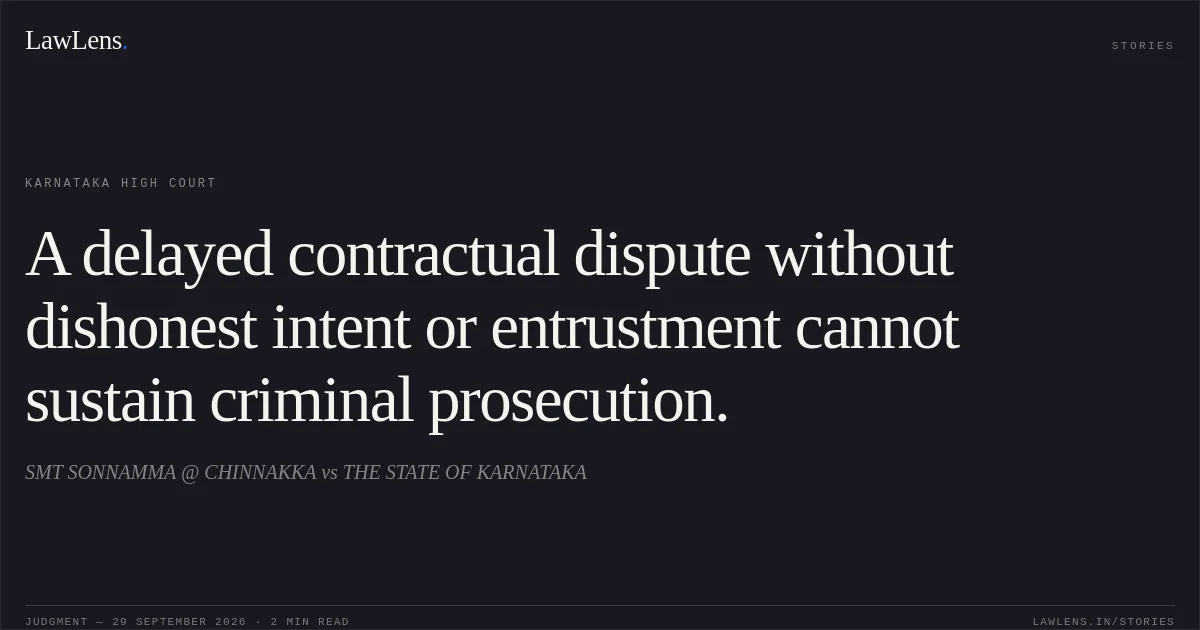
SMT SONNAMMA @ CHINNAKKAvsTHE STATE OF KARNATAKA
Click to open original judgment
Original judgment, available to read, download and summarize on LawLens.in