Facts
The petitioner was elected as a delegate of respondent No.7–Primary Agricultural Credit Co-operative Society to represent it in the election of the Board of Directors of respondent No.6–Taluk Agricultural Produce Marketing Co-operative Society, a secondary co-operative society, scheduled for 26 July 2026.
Source reference: paras. 1, 4The final voters’ list had been published on 2 July 2026 and the election calendar on 3 July 2026.
Source reference: paras. 1, 4On 23 July 2026, the Board of respondent No.7 was superseded and a Special Officer was appointed under Section 31 of the Karnataka Co-operative Societies Act, 1959.
Source reference: paras. 1, 4The petitioner challenged that order and sought permission to vote on the basis that his name appeared in the final electoral roll.
Source reference: paras. 1, 4By an interim order dated 24 July 2026, the High Court permitted him to cast his vote, directed that it be kept in a separate sealed box, and restrained declaration of the election result without the Court’s leave.
Source reference: para. 2The petitioner subsequently cast his vote.
Source reference: para. 3During final hearing, he did not press the challenge to the appointment of the Special Officer and confined his claim to having his vote counted.
Source reference: para. 5Issues
Whether the petitioner, whose name appeared in the final electoral roll as a delegate of respondent No.7, retained the right to vote in the election to respondent No.6 despite the subsequent supersession of respondent No.7’s Board and appointment of a Special Officer under Section 31 of the Act.
Source reference: paras. 5–6, 17–19Whether publication of the final voters’ list and commencement of the election process prevented the authorities from denying the petitioner’s statutory voting entitlement on the basis of the subsequent supersession of the Primary Society’s Board.
Source reference: paras. 6–10, 17–19Law Applied
The Court applied Section 2(e-1-a) of the Karnataka Co-operative Societies Act, 1959, defining a “delegate” as a member appointed by the Board to represent the society in another co-operative society, including the power to participate and vote.
Source reference: para. 9However, the definition was subject to the context and other provisions of the Act.
Source reference: para. 17Section 20(2)(b)(i) expressly denies a co-operative society the right to vote where its Board has been superseded or a Special Officer has been appointed under Section 31.
Source reference: paras. 12–13, 18Section 31(3) provides that, upon appointment of a Special Officer, the members of the Board vacate and are deemed to have vacated office.
Source reference: para. 13Section 21(2)(a) permits the Board of a member society to appoint one of its Board members to vote on its behalf, while Section 18-B(iii) provides for cessation of directorship in a secondary society when the Board of the representative’s Primary Society is removed or a Special Officer is appointed.
Source reference: para. 13Rule 13-D governs preparation and finalisation of electoral rolls, including the list of delegates entitled to vote.
Source reference: paras. 6–7The Court considered Gunjahalli Nagappa v. State of Karnataka, 1975 SCC OnLine Kar 19, affirmed in State of Karnataka v. Gunjahalli Nagappa, 1975 SCC OnLine SC 211, on the principle that an electoral roll ordinarily remains unchanged throughout an election process.
Source reference: paras. 8, 10The Court considered Sri H.S. Mohan Reddy v. State of Karnataka, ILR 2022 KAR 3543, on the principle that statutory disqualifications may operate even after election or appointment.
Source reference: para. 14Reasoning
The Court accepted that the petitioner had initially been validly appointed as a delegate by the Board of respondent No.7 and that his name was included in the final electoral roll.
Source reference: para. 17Nevertheless, the right to vote in the secondary society’s election was not determined solely by the general definition of “delegate” or by inclusion in the electoral roll.
Source reference: para. 18Section 20(2)(b)(i) specifically operated where the Board of the Primary Society had been superseded or a Special Officer appointed under Section 31.
Source reference: para. 18Since respondent No.7’s Board had been superseded before the poll, the statutory condition disabling the Primary Society from voting had arisen.
Source reference: para. 19The Court therefore held that the petitioner remained a delegate in a general sense but could not exercise the voting power attached to representation of respondent No.7 in the election to respondent No.6.
Source reference: para. 19The principle in Gunjahalli Nagappa concerning the stability of electoral rolls did not override the express statutory disqualification contained in Section 20(2)(b)(i), particularly where the Act itself contemplated the relevant change in status during the election process.
Source reference: paras. 17–19Holding
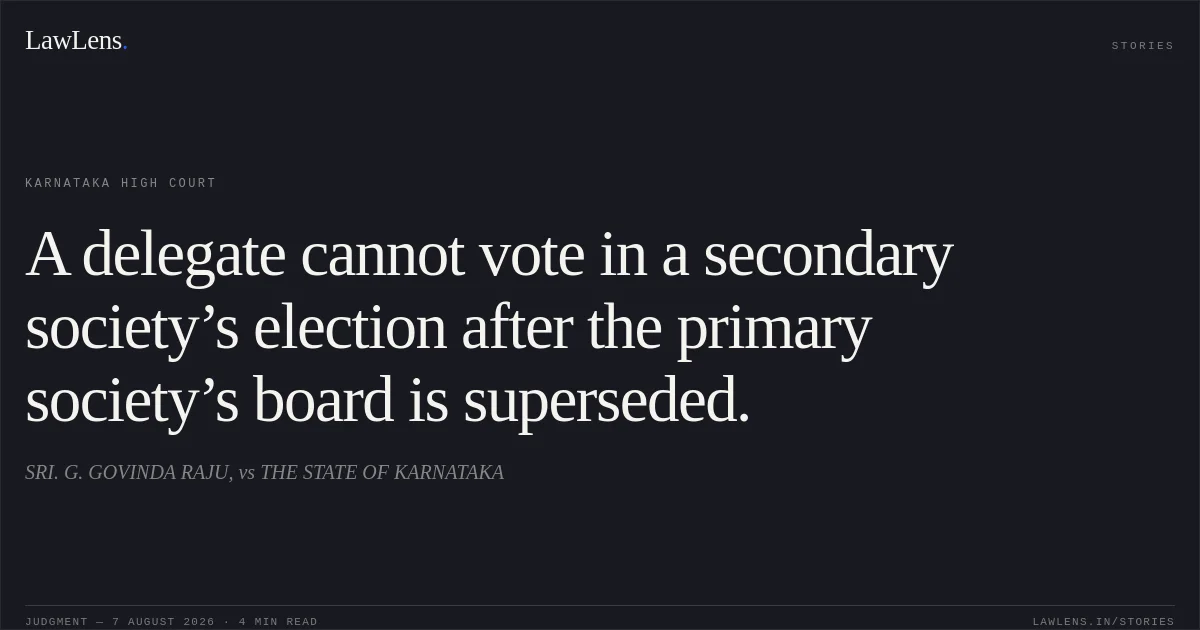
The Court answered the principal issue against the petitioner.
Although he was a valid delegate of respondent No.7, the supersession of respondent No.7’s Board and appointment of a Special Officer under Section 31 attracted Section 20(2)(b)(i), disentitling him from voting in the election to respondent No.6.
Source reference: paras. 18–19The petitioner’s challenge to the appointment of the Special Officer was not pressed, and the writ petition was dismissed.
Source reference: para. 20Consequently, the interim arrangement permitting the petitioner to cast a vote in a separate sealed box did not result in any direction to count that vote.
Source reference: para. 20Pending interlocutory applications, if any, were disposed of.
Source reference: para. 20Acts & Sections Cited
9 provisions across 2 statutes referred to in this judgment. Each provision opens on LawLens.
KARNATAKA CO-OPERATIVE SOCIETIES ACT, 1959.8
Representation of the People Act, 19501
Original Court PDF
SRI. G. GOVINDA RAJU,vsTHE STATE OF KARNATAKA
Click to open original judgment
Original judgment, available to read, download and summarize on LawLens.in