Facts
The respondents were landlords and the petitioner was their tenant. The landlords initiated eviction proceedings in RLTOP No. 97 of 2020 under the Tamil Nadu Regulation of Rights and Responsibilities of Landlords and Tenants Act, 2017 (“the Act”), seeking eviction and double rent on the ground that the tenant continued in possession after expiry of the tenancy. The Rent Court ordered the petitioner to vacate but did not grant the claim for double rent.
Source reference: paras. 4–5The landlords subsequently initiated EP No. 139 of 2022, obtained possession, and the execution petition was closed on 10.10.2023 upon recording full satisfaction. Thereafter, they filed OS No. 7089 of 2023 before the VII Additional City Civil Court, Chennai, seeking recovery of ₹13,74,237 towards arrears of rent, removal/replacement of temporary structures, and damages with interest.
Source reference: paras. 6–7The petitioner filed an application under Order VII Rule 11 CPC contending that the suit was barred because the landlords had already pursued their remedies before the Rent Court and the execution proceedings had been fully satisfied. The trial court dismissed the application on 23.03.2026, leading to the present revision petition.
Source reference: paras. 8–9Issues
Whether the suit for recovery of arrears of rent and compensation/damages to the property was barred by the provisions of the Tamil Nadu Regulation of Rights and Responsibilities of Landlords and Tenants Act, 2017?
Source reference: paras. 10–11Whether the plaint was liable to be rejected under Order VII Rule 11 CPC on the ground that the landlords had already invoked the remedies available before the Rent Court and the execution proceedings had been closed upon full satisfaction?
Source reference: paras. 8–11Law Applied
The Court considered Section 23 of the Act, which provides a special remedy for a landlord to claim compensation equivalent to double the monthly rent where a tenant continues in occupation after termination of the tenancy; such a statutory claim must be pursued before the Rent Court and cannot ordinarily be brought through a civil suit.
Source reference: paras. 14–15Sections 33 and 40(1) restrict the jurisdiction of civil courts over disputes and matters covered by the Act.
Source reference: para. 15Section 37(9) gives finality to orders passed under the Act, subject to the statutory framework.
Source reference: para. 10The Court also referred to Section 24, concerning refund of advance amounts, and the doctrine of election where a party has already invoked the specific statutory remedy.
Source reference: paras. 16–18Relying on Pushpavalli Suresh Babhu v. Sopos Technology Pvt. Ltd., reported in 2025 5 MLJ 29, the Court held that remedies specifically created by the Act must be pursued through the mechanism provided by the Act, whereas independent contractual or common-law claims not covered by the Act may be instituted before a civil court.
Source reference: paras. 10, 14–18Order VII Rule 11 CPC permits rejection of a plaint only where the bar to the suit is apparent from the plaint itself.
Source reference: para. 8Reasoning
The Court examined the plaint and found that the landlords were not seeking the statutory relief of double monthly rent under Section 23 of the Act. Their claims were for arrears of rent and compensation/damages allegedly caused by the petitioner, including removal of temporary structures and damage to the property.
Source reference: paras. 12–13, 19Although a claim for double rent after termination of tenancy would fall exclusively within the Rent Court’s statutory jurisdiction, the present claims were distinct and were based on arrears and alleged property damage. Consequently, Sections 37(9) and 40(1) did not bar the civil suit, and the previous eviction and execution proceedings did not prevent the landlords from pursuing these independent monetary claims.
Source reference: paras. 18–20The plaint therefore did not disclose an apparent legal bar warranting rejection under Order VII Rule 11 CPC.
Source reference: paras. 18–20Holding
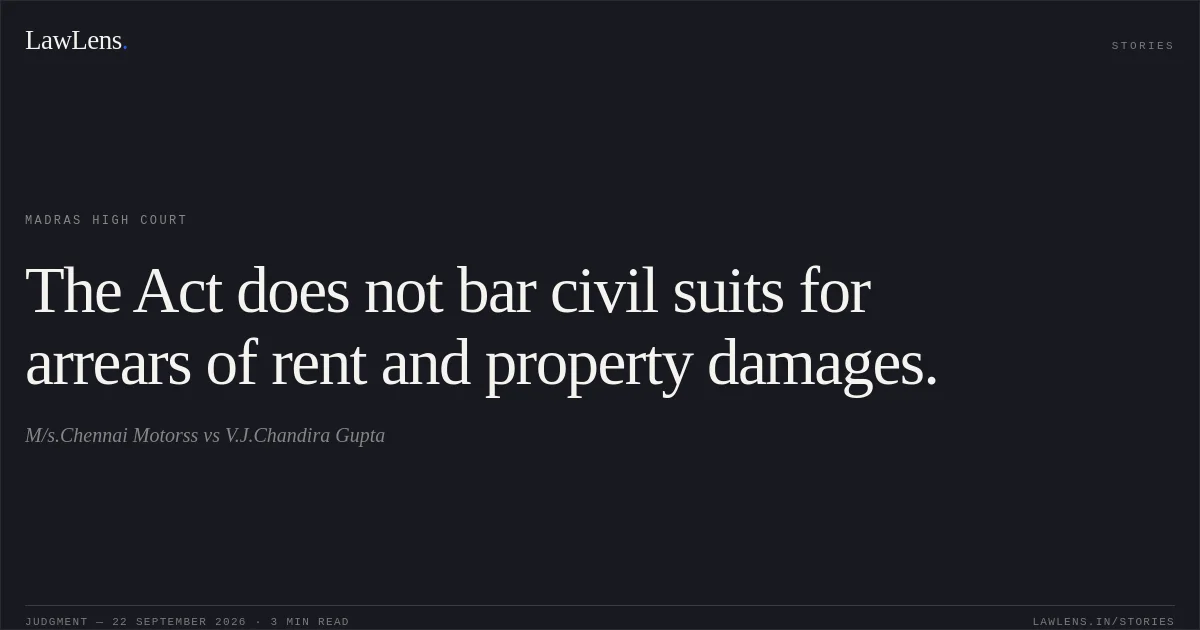
The Court held that the suit for recovery of arrears of rent and compensation for alleged damage to the property was not barred by the Tamil Nadu Regulation of Rights and Responsibilities of Landlords and Tenants Act, 2017.
Since the reliefs claimed were not the statutory double-rent remedy under Section 23, the civil court had jurisdiction to entertain the suit.
Source reference: paras. 19–21The order dated 23.03.2026 dismissing the petitioner’s application under Order VII Rule 11 CPC was confirmed, and the Civil Revision Petition was dismissed without costs. The connected miscellaneous petition was closed.
Source reference: paras. 19–21Acts & Sections Cited
1 provisions across 1 statute referred to in this judgment. Each provision opens on LawLens.
Code of Civil Procedure, 19081
Original Court PDF
M/s.Chennai MotorssvsV.J.Chandira Gupta
Click to open original judgment
Original judgment, available to read, download and summarize on LawLens.in