Facts
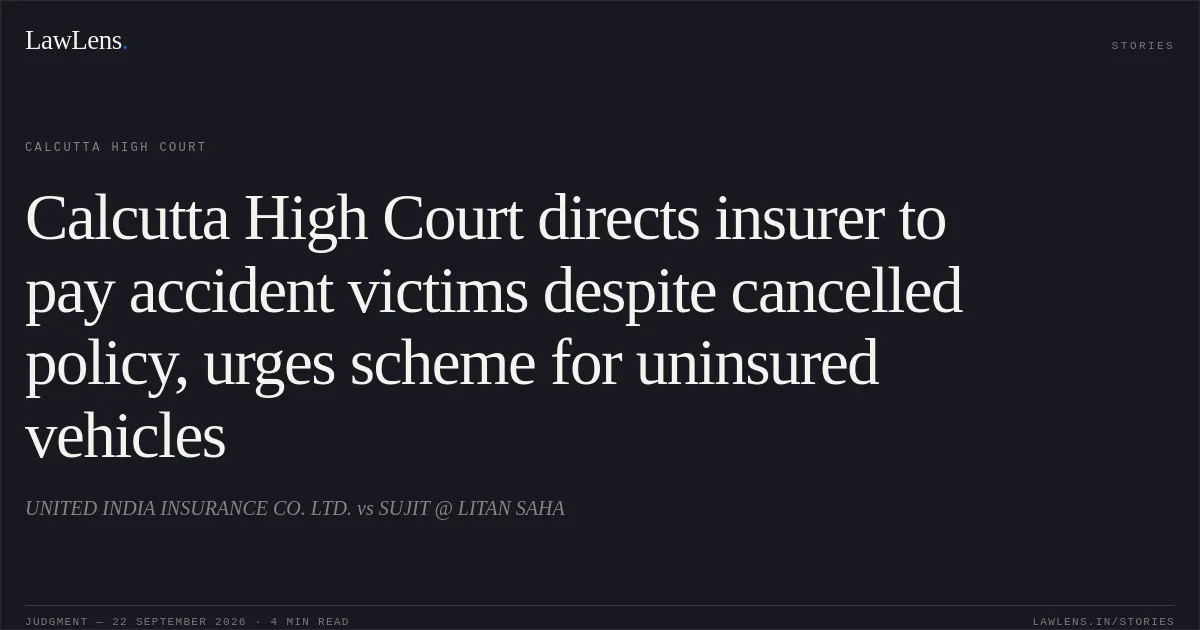
On 25 June 2005, Sunita @ Mita Saha was proceeding near Uttam Laminates Factory when motorcycle no. WB-20J-9855 allegedly dashed against her, causing her instantaneous death.
Source reference: p. 1Her legal heirs instituted a claim petition under Section 163A of the Motor Vehicles Act, 1988, seeking compensation for pecuniary loss and mental suffering.
Source reference: p. 1The vehicle owner did not contest the proceedings, whereas United India Insurance Co. Ltd. contested the claim.
Source reference: p. 2The Tribunal awarded Rs. 1,87,000 to the claimants in equal shares and directed the Insurance Company to pay the amount, with interest at 9% per annum in default.
Source reference: pp. 2–3The Insurance Company appealed, contending that the premium cheque had been dishonoured, the policy had consequently been cancelled, and the cancellation had been intimated to the vehicle owner before the accident.
Source reference: pp. 3–4The claimants opposed exoneration and sought payment of the compensation, besides enhancement to Rs. 5,00,000.
Source reference: p. 4Issues
1. Whether the Insurance Company was contractually or statutorily liable to pay compensation where the premium cheque had been dishonoured and the policy had been cancelled and intimated to the vehicle owner before the accident?
Source reference: pp. 4–62. Whether, notwithstanding the absence of contractual liability, the Insurance Company could be directed, in view of the beneficial nature of motor-vehicle compensation legislation, to pay compensation to the third-party victims with a right of recovery against the vehicle owner?
Source reference: pp. 6–103. Whether the claimants were entitled to enhancement of the compensation beyond the amount awarded by the Tribunal?
Source reference: p. 10Law Applied
The Court applied Section 163A of the Motor Vehicles Act, 1988, under which compensation may be claimed on a structured-formula basis without proof of fault.
Source reference: pp. 5–6It held that where a valid policy exists on the date of the accident, a third-party claimant may proceed against the insurer; however, where the premium is dishonoured and the policy is cancelled, with due intimation to the insured before the accident, the insurer has neither contractual nor statutory liability to indemnify the claim.
Source reference: pp. 5–6The Court relied on Dedappa v. Branch Manager, National Insurance Co. Ltd., United India Insurance Co. Ltd. v. Laxmamma, National Insurance Co. Ltd. v. Sunita Devi, Madhusudan Das v. Smt. Narayanibai, Oriental Insurance Co. Ltd. v. Inderjeet Kaur, and Keshar Bai v. Afsar Ali concerning the effect of cancellation, non-payment of premium, and third-party rights.
Source reference: pp. 4–5It further invoked the beneficial and welfare-oriented character of motor-vehicle compensation legislation, Articles 38 and 41 of the Constitution, and the principle that, in appropriate cases, an insurer may be directed to satisfy the award initially and recover the amount from the vehicle owner, particularly where an insurance relationship previously existed and the policy was subsequently cancelled or not renewed.
Source reference: pp. 6–10Reasoning
The Court accepted the Insurance Company’s evidence that the premium cheque had been dishonoured and that cancellation of the policy had been communicated to the vehicle owner before the accident.
Source reference: pp. 5–6Applying the principles governing cancellation for non-payment of premium, it held that the Insurance Company was not liable under the contract of insurance and could not ordinarily be compelled to satisfy the entire award.
Source reference: pp. 5–6Nevertheless, the Court distinguished complete exoneration from the practical relief required in a welfare-based compensation proceeding.
Source reference: pp. 9–10Since the claimants had lost a close relative, had litigated for approximately twenty years, and the compensation had already been deposited, relegating them to fresh recovery proceedings against the vehicle owner would cause substantial hardship.
Source reference: pp. 9–10In exercise of its discretion, the Court therefore directed the Insurance Company to pay Rs. 1,30,000 to the claimants, with liberty to recover that amount from the vehicle owner, while directing the vehicle owner to pay the remaining Rs. 57,000 directly.
Source reference: p. 10The prayer for enhancement was rejected because no cross-objection had been filed.
Source reference: p. 10Holding
The Court held that the Insurance Company had no contractual or statutory liability because the policy had been cancelled and the cancellation had been intimated before the accident.
However, considering the beneficial object of the Motor Vehicles Act and the hardship to the claimants, it directed the Insurance Company to pay Rs. 1,30,000, with the right to recover that amount from the vehicle owner, and directed the vehicle owner to pay the balance Rs. 57,000 within eight weeks from communication of the order.
Source reference: p. 10The claimants were permitted to withdraw Rs. 1,30,000 with accrued interest, while the balance deposit was to be returned to the Insurance Company.
Source reference: p. 10The request for enhancement was rejected.
Source reference: p. 10The Court also directed that a copy of the order be sent to the relevant authorities for consideration of a governmental scheme for victims of accidents caused by uninsured vehicles.
Source reference: pp. 10–11Acts & Sections Cited
1 provisions across 1 statute referred to in this judgment. Each provision opens on LawLens.
Motor Vehicles Act, 19881
Original Court PDF
UNITED INDIA INSURANCE CO. LTD.vsSUJIT @ LITAN SAHA
Click to open original judgment
Original judgment, available to read, download and summarize on LawLens.in