Facts
Nirmala, who had married the appellant after her first husband’s death, was working at a play school.
Source reference: p. 3–4, 8–9The prosecution alleged that the appellant, who had previously subjected her to abuse and violence, went to her workplace on 6 February 2014, quarrelled with her, and struck her on the head with a cement block.
Source reference: p. 3–4, 8–9She later died while receiving treatment.
Source reference: p. 3–4, 8–9The Sessions Court convicted the appellant under Section 302 of the Indian Penal Code (IPC) and sentenced him to life imprisonment and a fine.
Source reference: p. 2–3, 5He appealed under Section 374(2) of the Code of Criminal Procedure, challenging the conviction and arguing, among other things, that the incident occurred during a sudden quarrel and did not amount to murder.
Source reference: p. 2, 12–13Issues
1. Whether the prosecution evidence established beyond reasonable doubt that the appellant caused Nirmala’s death by striking her with a cement block.
Source reference: p. 9–11, 17–192. Whether the act, said to have occurred during a quarrel with an object picked up from the footpath, amounted to murder under Section 300 IPC or culpable homicide not amounting to murder.
Source reference: p. 12–14Law Applied
The Court applied Sections 300 and 302 IPC: an act satisfying the definition of murder under Section 300 is punishable under Section 302; whether an assault during a quarrel falls within that definition depends on the circumstances, including the manner and force of the attack and the accused’s intention or knowledge.
Source reference: p. 13–14The Court also noted Section 374(2) CrPC as the basis for the appeal.
Source reference: p. 2No judicial precedents were cited.
Source reference: no citationReasoning
The Court accepted PW1’s evidence that the appellant quarrelled with the deceased and struck her with the cement block, finding that her proximity to the workplace made her presence at the scene probable; it held that the non-examination of the deceased’s differently abled daughter was not fatal.
Source reference: p. 9–11The medical evidence established fatal head injuries, and the doctor testified that they could have been caused by the cement block, which weighed approximately 3.5 kg.
Source reference: p. 6–8Although the appellant was unarmed when he arrived, the Court found no evidence of a sudden quarrel or grave and sudden provocation.
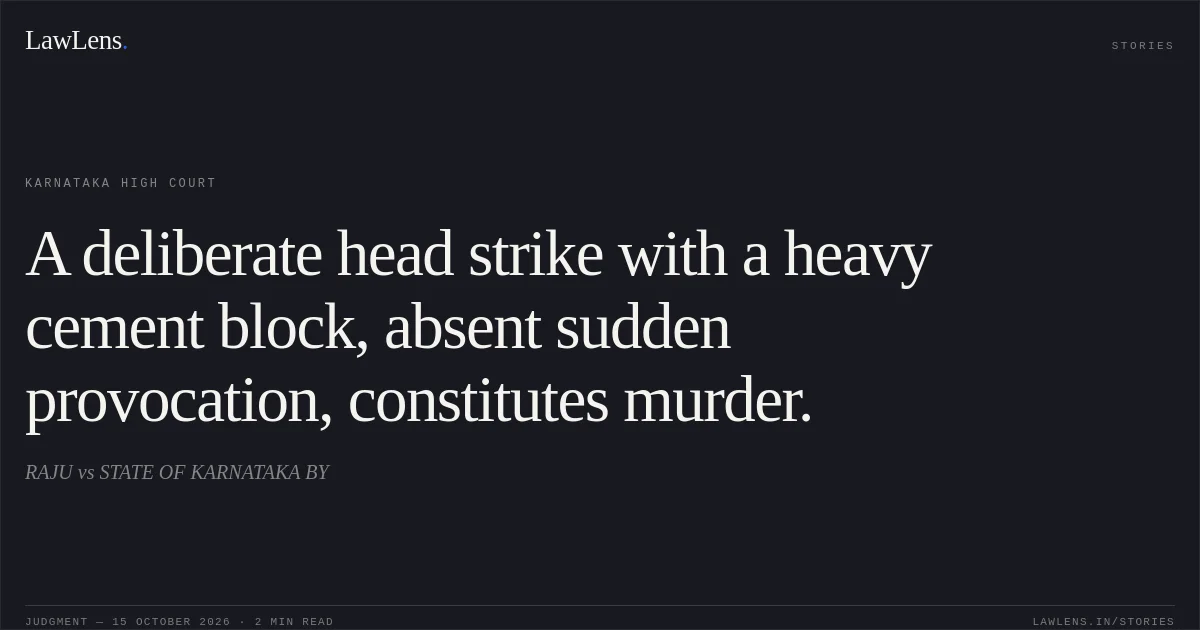
Source reference: p. 12–14It concluded that striking the deceased on the head with the heavy block supported the inference that the appellant intended to cause death and knew the act was likely to cause death; the act therefore fell within Section 300 IPC.
Source reference: p. 12–14Holding
The Court answered the first issue in the affirmative and rejected the appellant’s contention that the incident amounted only to culpable homicide not amounting to murder.
It held that the prosecution had established the charge under Section 302 IPC and that the Sessions Court’s conviction and sentence were in accordance with law.
Source reference: p. 14–15The appeal was dismissed.
Source reference: p. 15Acts & Sections Cited
4 provisions across 2 statutes referred to in this judgment. Each provision opens on LawLens.
Code of Criminal Procedure, 19731
Indian Penal Code, 18603
Original Court PDF
RAJUvsSTATE OF KARNATAKA BY
Click to open original judgment
Original judgment, available to read, download and summarize on LawLens.in


