Facts
The petitioner was appointed as a Constable/Driver on 20 April 2012. A charge-sheet containing four charges was issued to him on 4 August 2023, to which he replied on 14 August 2023.
Source reference: para. 2Although the petitioner challenged the charge-sheet in W.P. No. 24887 of 2023, the respondents proceeded with the enquiry in his absence and concluded it ex parte. The Enquiry Officer submitted a report dated 22 May 2024 finding the charges proved. Respondent No. 4 subsequently imposed the major penalty of removal from service by order dated 6 September 2024.
Source reference: para. 2The petitioner’s departmental appeal was rejected on 24 December 2024, pursuant to this Court’s direction dated 3 December 2024 in W.P. No. 24887 of 2023.
Source reference: para. 2The petitioner challenged both orders, alleging bias, violation of natural justice, and improper appreciation of the evidence.
Source reference: para. 3Issues
Whether the disciplinary proceedings were vitiated by bias because Respondent No. 4 allegedly issued the charge-sheet, appointed the Enquiry Officer, and passed the final order despite being the person against whom allegations had been made?
Source reference: para. 3Whether the departmental enquiry was vitiated by violation of the principles of natural justice because it was conducted and concluded in the petitioner’s absence?
Source reference: paras. 3, 10Whether the High Court, exercising jurisdiction under Article 226 of the Constitution, could reappreciate the evidence or interfere with the disciplinary and appellate authorities’ findings on merits?
Source reference: paras. 6, 8, 11Law Applied
The Court applied the limited scope of judicial review under Article 226 in disciplinary matters, under which the High Court does not act as an appellate authority and ordinarily interferes only for jurisdictional error, procedural impropriety, violation of natural justice, perversity, or findings based on no evidence.
Source reference: paras. 6–8Relying on State of Karnataka v. N. Gangraj, (2020) 3 SCC 423, and State of A.P. v. S. Sree Rama Rao, the Court held that the High Court cannot reappreciate evidence where the enquiry was conducted by a competent authority in accordance with law and the findings are supported by some evidence.
Source reference: para. 7Under Union of India v. P. Gunasekaran, (2015) 2 SCC 610, the High Court shall not reappreciate evidence, examine its adequacy or reliability, correct errors of fact, or interfere with punishment unless it shocks the Court’s conscience.
Source reference: para. 8The Court also relied on Basamma v. Goparappa, 2026 INSC 712, including the principles in Hari Vishnu Kamath v. Syed Ahmad Ishaque, Syed Yakoob v. K.S. Radhakrishnan, and Central Council for Research in Ayurvedic Sciences v. Bikartan Das, that certiorari is supervisory rather than appellate and may issue for jurisdictional error, patent illegality, violation of natural justice, or findings based on no evidence, but not merely because another factual view is possible.
Source reference: para. 9The State also relied on B.C. Chaturvedi v. Union of India, (1995) 6 SCC 749.
Source reference: para. 4Reasoning
The Court held that the petitioner had received the charge-sheet and had submitted a detailed reply, demonstrating knowledge of the allegations and an effective opportunity to defend himself.
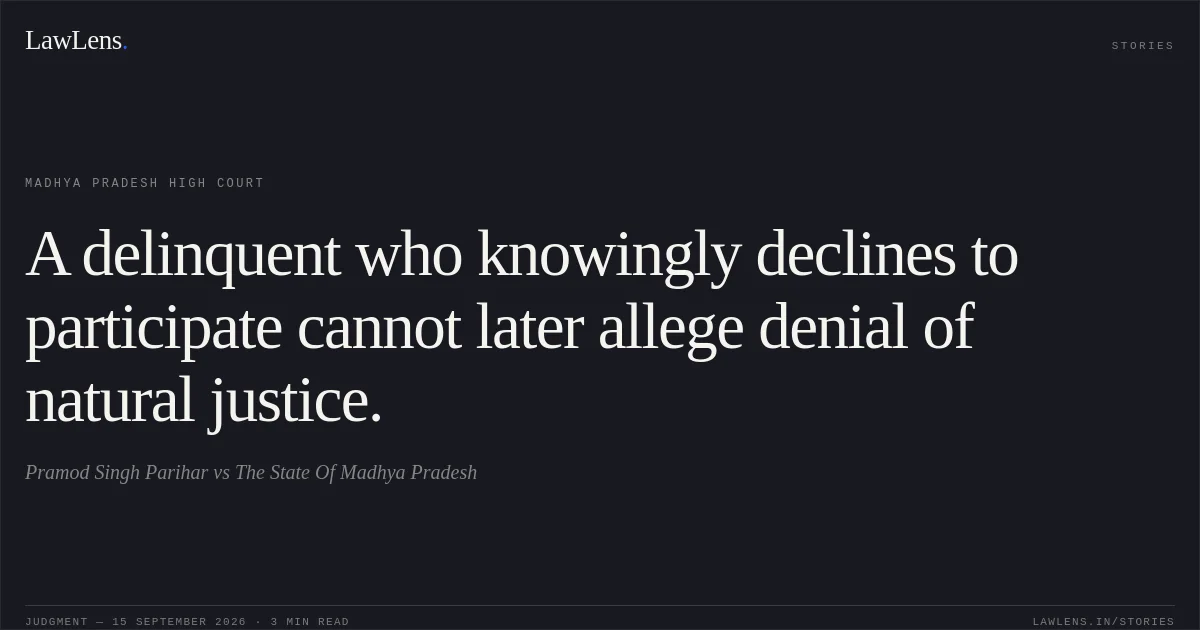
Source reference: para. 10His subsequent failure to participate in the departmental enquiry, despite being aware of the proceedings and having been afforded an opportunity, did not amount to denial of natural justice; consequently, the requirement of audi alteram partem was treated as satisfied.
Source reference: para. 10The Court further found that the disciplinary enquiry had been conducted in accordance with the prescribed procedure and that no procedural irregularity or violation of natural justice was established.
Source reference: para. 10Since the petitioner essentially sought reconsideration of the evidence and the merits of the findings, the Court applied the restricted Article 226 standard and declined to reassess the Enquiry Officer’s, Disciplinary Authority’s, or Appellate Authority’s conclusions in the absence of perversity, jurisdictional error, or other recognised grounds for judicial review.
Source reference: paras. 6, 11Holding
The Court answered the natural-justice and judicial-review issues against the petitioner. It held that the petitioner had been afforded an adequate opportunity to defend himself, that his non-participation did not invalidate the ex parte enquiry, and that no procedural irregularity, perversity, or violation of natural justice was established.
The challenge to the order dated 6 September 2024 removing him from service and the appellate order dated 24 December 2024 was therefore rejected, and the writ petition was dismissed.
Source reference: para. 12Original Court PDF
Pramod Singh PariharvsThe State Of Madhya Pradesh
Click to open original judgment
Original judgment, available to read, download and summarize on LawLens.in