Facts
The petitioner, appointed in 1984 and serving as a Warden at District Jail, Hajipur, was proceeded against after an undertrial prisoner, Mansoor Khan, escaped from the jail hospital ward on 11 November 2011.
Source reference: p. 2–4The petitioner was suspended with effect from 12 December 2011 and a departmental proceeding was initiated against him and other jail employees.
Source reference: p. 2–4A charge memorandum was issued, but no list of witnesses was supplied to the petitioner along with the charges.
Source reference: p. 2–4The Enquiry Officer relied on departmental documents and submitted a report holding the charges proved, although no departmental witnesses were examined or tendered for cross-examination.
Source reference: p. 15–17The disciplinary authority dismissed the petitioner from service by order dated 12 March 2014 and directed that, for the suspension period, he would receive only the subsistence allowance already paid.
Source reference: p. 3–4His statutory appeal was dismissed on 14 July 2014 and communicated on 16 July 2014.
Source reference: p. 3–4Issues
Whether the departmental enquiry was vitiated because the charge memorandum did not contain a list of witnesses and the departmental documents were relied upon without being proved through witnesses or made available for cross-examination?
Source reference: p. 4–5, 17–18Whether the disciplinary authority could deny the petitioner salary for the period of suspension, beyond the subsistence allowance, without issuing a notice under Rule 97(3) of the Bihar Service Code?
Source reference: p. 17–18Whether dismissal from service was disproportionate to the proved misconduct in the circumstances of the case?
Source reference: p. 4–5, 17–18Whether the matter should be remitted for a fresh departmental enquiry, particularly after the petitioner had superannuated in 2021?
Source reference: p. 18–20Law Applied
The Court applied Rules 17(3) and 17(4) of the Bihar CCA Rules, 2005, which require disclosure of the imputations of misconduct and the supporting list of documents and witnesses; Rule 17(14), which requires the departmental evidence to be presented and permits the delinquent employee to cross-examine witnesses; and Rule 97(3) of the Bihar Service Code, which requires notice and consideration before determining the pay and allowances admissible for a period of suspension.
Source reference: p. 5–9Relying on Roop Singh Negi v. Punjab National Bank, (2009) 2 SCC 570, and State of U.P. v. Saroj Kumar Sinha, (2010) 2 SCC 772, the Court held that documents cannot ordinarily be treated as evidence merely by being placed on record and that an Enquiry Officer cannot assume the role of both prosecutor and adjudicator.
Source reference: p. 5–9It also relied on Jai Prakash Saini v. Managing Director, U.P. Cooperative Federation Ltd., 2026 (3) PLJR 125 (SC) for the rule that, where charges are denied, departmental witnesses must be examined and made available for cross-examination, even in a documentary-evidence case.
Source reference: p. 9–11On proportionality, the Court relied on Surekah Domaji Bele v. Executive Engineer, Testing Division, MSEDCL, 2026 SCC OnLine SC 1109, which requires the disciplinary authority to consider the gravity of misconduct, past service, surrounding circumstances, actual loss and whether a lesser penalty would suffice.
Source reference: p. 11–15Finally, Allahabad Bank v. Krishna Narayan Tewary, (2017) 2 SCC 308, and State of Bihar v. Vikash Kumar @ Vikas Kumar, LPA No. 446 of 2024, supported the discretion not to order a fresh enquiry where remand would be unfair, harsh or unnecessary due to the passage of time or supervening circumstances.
Source reference: p. 18–20Reasoning
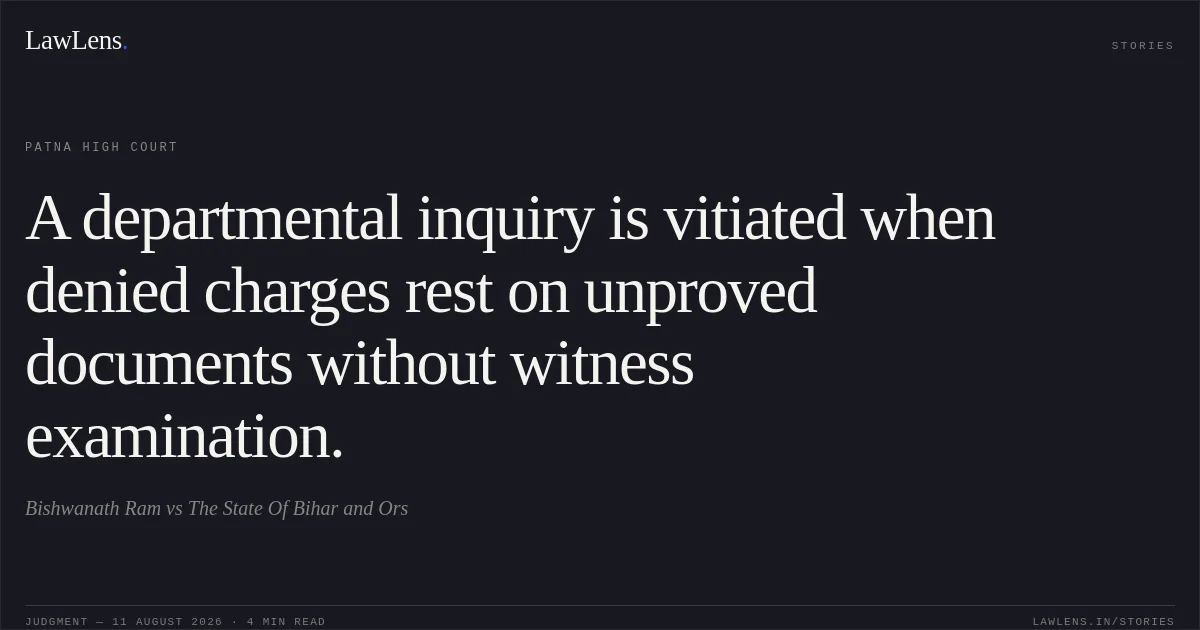
The Court found that the charge memorandum did not include a list of witnesses and that the Enquiry Officer relied on documents without their contents being proved through departmental witnesses.
Source reference: p. 17–18Since no witnesses were examined, the petitioner was denied the opportunity to cross-examine the evidence relied upon against him.
Source reference: p. 17–18The Enquiry Officer thereby effectively assumed the role of the Presenting Officer and adjudicator, contrary to Rules 17(3), 17(4) and 17(14) and the principles of natural justice recognised in Roop Singh Negi, Saroj Kumar Sinha and Jai Prakash Saini.
Source reference: p. 17–18The Court further held that the disciplinary authority could not direct that the petitioner receive no amount for the suspension period beyond subsistence allowance without issuing the notice contemplated by Rule 97(3) of the Bihar Service Code.
Source reference: p. 18It also observed that the misconduct concerned negligence relating to a prisoner’s escape and did not involve corruption, misappropriation, defalcation, moral turpitude or proved financial loss.
Source reference: p. 17–18In view of the petitioner’s long service and the absence of consideration of whether a lesser punishment would meet the ends of justice, dismissal was liable to be reconsidered on proportionality grounds.
Source reference: p. 17–18However, because the petitioner had already retired in 2021 and considerable time had elapsed, the Court considered remand for a fresh enquiry unfair and unnecessary.
Source reference: p. 18–20Holding
The writ petition was allowed.
The dismissal order dated 12 March 2014 and the appellate order dated 14 July 2014, as communicated on 16 July 2014, were quashed insofar as they related to the petitioner.
Source reference: p. 20The Court declined to remit the matter for a fresh enquiry because of the petitioner’s superannuation and the substantial passage of time.
Source reference: p. 18–20The petitioner was held entitled to full salary for the suspension period, after adjustment of the subsistence allowance already paid.
Source reference: p. 20–21The petitioner was held entitled to salary at 50% from the date of dismissal until his retirement, there being no assertion or pleading of gainful employment.
Source reference: p. 20–21The petitioner was held entitled to all post-retiral benefits to which he would have been entitled before the impugned punishment order.
Source reference: p. 20–21The respondents were directed to complete the necessary exercise within four months from receipt or production of the judgment.
Source reference: p. 21Original Court PDF
Bishwanath RamvsThe State Of Bihar and Ors
Click to open original judgment
Original judgment, available to read, download and summarize on LawLens.in