Facts
The petitioner, substantively an Assistant Engineer in the Rural Engineering Services Department, was appointed as General Manager in the Madhya Pradesh Rural Road Development Authority on 29 September 2020.
Source reference: para. 2; para. 8The appointment was initially for two years, with possible annual extensions, subject to satisfactory performance and approval by the competent authority.
Source reference: para. 2; para. 8In a letter to the Authority, the parent Department stated that the petitioner had been working there on deputation since 12 February 2001 and sought his repatriation because experienced senior engineers were needed for departmental schemes.
Source reference: para. 9; para. 13The petitioner challenged the repatriation order dated 22 December 2025, arguing that it was non-speaking, contrary to his appointment terms, and issued despite satisfactory service and selection through a prescribed process.
Source reference: para. 2The State submitted that he had no vested right to remain on deputation and that the parent Department had requested his return.
Source reference: para. 3Issues
Whether the petitioner had a vested or enforceable right to continue in the borrowing Department, including up to age 65, by virtue of his appointment or continued service.
Source reference: para. 10, 12, 15, 18Whether the repatriation order was arbitrary or legally invalid because it gave no reasons or was made without prior notice or hearing.
Source reference: para. 10, 13–14, 18Law Applied
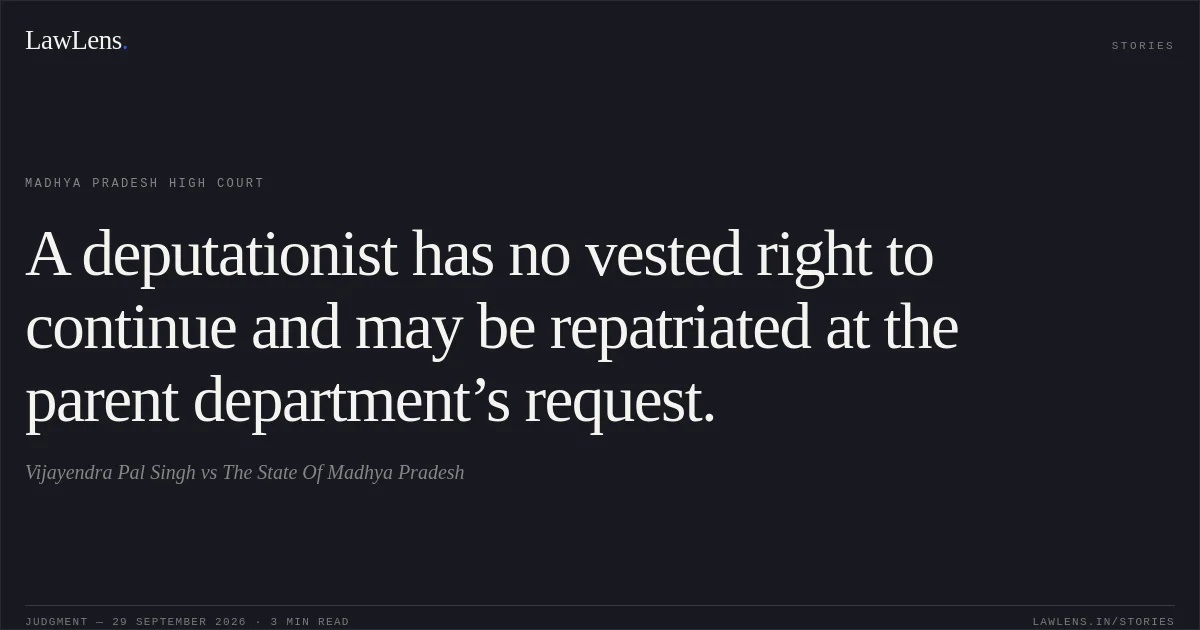
Under Article 226 of the Constitution, a deputationist ordinarily has no vested right to continue on deputation; absent a statutory rule or other enforceable legal basis, the employee may be repatriated to the parent Department at the instance of either Department.
Source reference: para. 6; para. 11Where a deputation tenure is specified, it ordinarily should not be curtailed except on just grounds; even where tenure is unspecified, repatriation may be challenged if mala fide.
Source reference: para. 7A simpliciter repatriation order that carries no stigma, reduces no rank, and causes no adverse civil consequence does not ordinarily require a prior hearing.
Source reference: para. 10A contractual provision permitting extension subject to conditions does not confer an indefeasible right to continue for the maximum possible period.
Source reference: para. 12Reasoning
The Court found no statutory rule or other enforceable basis giving the petitioner a right to remain with the Authority up to age 65.
Source reference: para. 12His 2020 appointment was contractual for an initial two-year period, and the record contained no agreement or extension order establishing the terms on which he continued thereafter.
Source reference: para. 12The parent Department had requested his repatriation because of a shortage of experienced senior engineers and the need to implement its schemes, which the Court accepted as an administrative requirement rather than arbitrariness or mala fides.
Source reference: para. 9, 13The order was a simpliciter repatriation; the petitioner retained his substantive post and the order neither stigmatized him nor reduced his rank.
Source reference: para. 14–16Accordingly, the Court held that a hearing was not required and that satisfactory service, selection through a prescribed process, or prior extensions did not create a right to continue on deputation.
Source reference: para. 14–16The cited interim order in another petition did not establish such a right.
Source reference: para. 17Holding
The Court held that the petitioner had failed to establish a vested or statutory right to continue on deputation, and that no mala fides or statutory violation had been shown.
It found no ground for interference under Article 226, dismissed the petition, and made no order as to costs.
Source reference: para. 19–20Original Court PDF
Vijayendra Pal SinghvsThe State Of Madhya Pradesh
Click to open original judgment
Original judgment, available to read, download and summarize on LawLens.in