Facts
Roshan Lal, the admitted owner of property B-107, Subhadra Colony, executed a Will bequeathing the property to his son Bharat Bhushan.
Source reference: para. 4–7, 31, 61The Will also described a 7′ × 7′ ground-floor shop occupied by his grandson Basant Kumar.
Source reference: para. 4–7, 31, 61Letters of Administration with the Will annexed were granted to Bharat Bhushan, and the grant was not challenged.
Source reference: para. 4–7, 31, 61Bharat Bhushan sued for possession of the property. Basant Kumar claimed that the Will covered only the shop and that the remainder belonged jointly to Roshan Lal’s heirs; he also claimed tenancy rights in the shop. The Trial Court, under Order XII Rule 6 CPC, decreed possession of the property excluding the shop. The defendants appealed.
Source reference: para. 14–21, 30–38Issues
Whether the admitted facts permitted the Court to determine the scope of the Will and grant possession under Order XII Rule 6 CPC, despite the defendants disputing the extent of the bequest
Source reference: para. 58–63Whether the Will bequeathed the entire property at B-107 to Bharat Bhushan or only the 7′ × 7′ shop
Source reference: para. 63–67Law Applied
Order XII Rule 6 CPC permits a discretionary decree where the necessary foundational facts are admitted; the legal consequence need not itself be admitted if no further factual adjudication is required. Admissions may be express or implied and may be gathered from the pleadings or otherwise (*Rajiv Ghosh v. Satya Narayan Jaiswal*).
Source reference: para. 59A Will must be construed as a whole to ascertain the testator’s intention, giving effect to its language; surrounding circumstances may assist but cannot rewrite an unambiguous bequest (*Navneet Lal alias Rangi v. Gokul*; *Bay Berry Apartments (P) Ltd. v. Shobha*).
Source reference: para. 37, 56, 68Section 88 of the Indian Succession Act, 1925, applies where testamentary clauses are irreconcilably inconsistent, in which case the later provision prevails.
Source reference: para. 43–44, 74Reasoning
Roshan Lal’s ownership, execution of the Will, and the final grant of Letters of Administration were admitted; the defendants claimed no independent title apart from their interpretation of the Will. The Court therefore considered that no further factual adjudication was required before construing the Will under Order XII Rule 6 CPC.
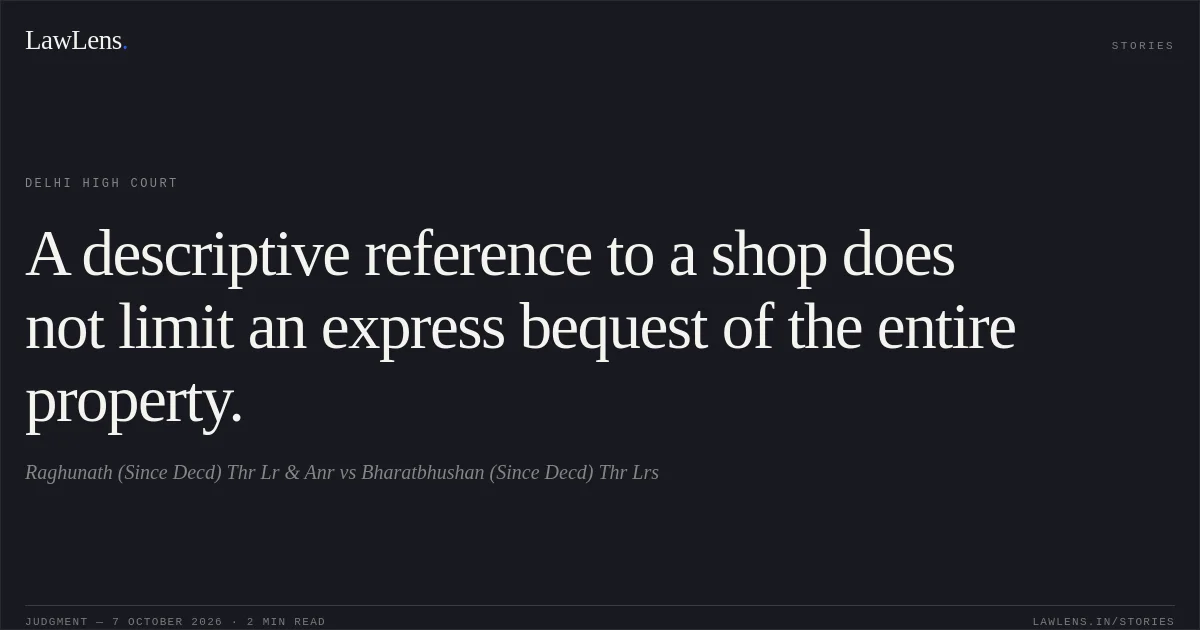
Source reference: para. 61–63The Will identified B-107 as the testator’s self-acquired property, described the shop and its occupation, and then bequeathed “my above said property” to Bharat Bhushan, excluding the other heirs. The Court held that this operative language referred to the entire property, while the shop reference was descriptive.
Source reference: para. 65–70, 74–76The separate allocation of specified percentages in the R.K. Puram flat reinforced that the testator knew how to make a limited disposition.
Source reference: para. 65–70, 74–76Section 88 did not apply because the Will contained no irreconcilable competing bequests.
Source reference: para. 65–70, 74–76The alleged tenancy in the shop was outside the application and remained for determination in the suit.
Source reference: para. 78Holding
The High Court held that the Will bequeathed the entire B-107 property to Bharat Bhushan and that the Trial Court properly granted possession under Order XII Rule 6 CPC, excluding the 7′ × 7′ shop whose alleged tenancy remained open for adjudication.
The appeal was dismissed, and pending applications were disposed of.
Source reference: para. 77–81Acts & Sections Cited
4 provisions across 3 statutes referred to in this judgment. Each provision opens on LawLens.
Code of Civil Procedure, 19082
delhi rent control act, 19581
Indian Succession Act, 19251
Original Court PDF
Raghunath (Since Decd) Thr Lr & AnrvsBharatbhushan (Since Decd) Thr Lrs
Click to open original judgment
Original judgment, available to read, download and summarize on LawLens.in