Facts
The Appellants sought condonation of substantial delays in filing appeals against the common judgment dated 18 August 2022, which directed recomputation of the Respondents’ Special Rehabilitation Package (SRP), with arrears and interest.
Source reference: p. 4–5, para. 2The filing delays ranged from 1,182 to 1,436 days; re-filing delays of 23 and 32 days arose in two appeals.
Source reference: p. 4–5, para. 2The Appellants attributed the delay to internal consideration of the judgment, a decision to challenge the SRP computation, prosecution of a review petition until its dismissal on 25 February 2025, and subsequent approvals and preparation of the appeals, filed on 12 December 2025.
Source reference: p. 5–6, para. 3.2–3.3; p. 15, para. 10The Respondents opposed condonation, relying on the prior dismissal of a delayed review petition, the Appellants’ failure to comply with the judgment, and their conduct in the related contempt proceedings.
Source reference: p. 10–12, paras. 4.2–4.5Issues
Whether the Appellants had shown sufficient cause to condone the delays in filing and re-filing the appeals under Section 5 of the Limitation Act.
Source reference: p. 14, para. 6Whether the prior dismissal of the delayed review petition and the Appellants’ participation in contempt proceedings precluded condonation or demonstrated abuse of process or lack of bona fides.
Source reference: p. 16–17, paras. 12–15Law Applied
Order XLI Rule 3A and Section 151 of the Code of Civil Procedure, 1908, read with Section 5 of the Limitation Act, governed the applications for condonation.
Source reference: p. 4, para. 1The length of delay is not determinative; the central question is whether the explanation is genuine, reasonable, and sufficient. A particularised account of the material periods may justify condonation, while mere invocation of governmental red tape does not; the State receives no automatic preferential treatment.
Source reference: p. 14–15, paras. 7–10The Court applied Collector, Land Acquisition, Anantnag v. Mst. Katiji, (1987) 2 SCC 107, and Sheo Raj Singh v. Union of India, (2023) 10 SCC 531, on a justice-oriented approach and the acceptability of the explanation as the controlling consideration.
Source reference: p. 7–9, paras. 3.6, 3.9; p. 14, para. 8It considered Post Master General v. Living Media Ltd., (2012) 3 SCC 563, and State of Madhya Pradesh v. Bheru Lal, (2020) 10 SCC 654, as requiring a cogent, particularised explanation rather than a general assertion of administrative delay.
Source reference: p. 9–10, para. 4.1; p. 14–15, para. 9A review and an appeal are distinct remedies, and dismissal of a delayed review does not itself bar a subsequent appeal where its delay is independently explained.
Source reference: p. 16–17, paras. 12–13Reasoning
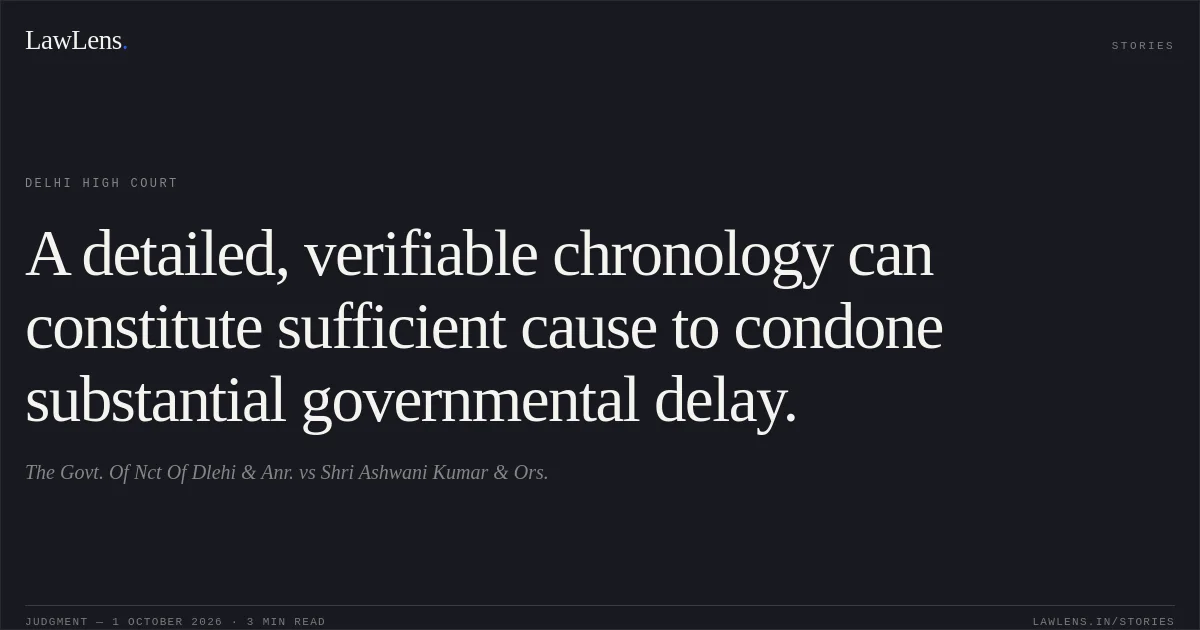
The Court found that the Appellants had provided a continuous, date-specific account of the administrative and legal steps leading to the appeals, including the review proceedings and subsequent approvals; the record did not show that the files had remained dormant or unaccounted for.
Source reference: p. 15–16, para. 10It distinguished the present explanation from the generalised explanations rejected in Post Master General and Bheru Lal.
Source reference: p. 15, para. 10The prior review proceedings did not bar the appeals because the remedies were distinct and the review had been dismissed without determination of the merits; participation in contempt proceedings likewise did not waive the right to challenge the underlying judgment.
Source reference: p. 16–17, paras. 12–15The Court also considered the public-exchequer issue raised by the disputed SRP methodology and observed that the Respondents’ entitlement to interest under the common judgment continued during the appeals, while costs could address the prejudice caused by delay.
Source reference: p. 17–18, paras. 16–17It concluded that the explanation was sufficient and did not establish deliberate inaction or lack of bona fides.
Source reference: p. 18, paras. 18–19Holding
The Court allowed the applications and condoned the delays in filing and re-filing the appeals, subject to costs of ₹15,000 in each application, payable to the Delhi High Court Bar Clerks’ Association within four weeks.
The connected appeals were listed for hearing on 8 December 2026.
Source reference: p. 20, para. 25Acts & Sections Cited
2 provisions across 2 statutes referred to in this judgment. Each provision opens on LawLens.
Limitation Act, 19631
Code of Civil Procedure, 19081
Original Court PDF
The Govt. Of Nct Of Dlehi & Anr.vsShri Ashwani Kumar & Ors.
Click to open original judgment
Original judgment, available to read, download and summarize on LawLens.in