Facts
The petitioner, a developer, entered into two development agreements with Bombay Veerashaiva Co-operative Housing Society Ltd. dated 27 March 1987 and 20 August 1987 for development of two parcels of land.
Source reference: para. 3Under the agreements, the petitioner was required to construct flats constituting approximately 60% of the permissible construction for the Society’s members and was permitted to develop and sell the remaining 40% of the construction, including flats and shops, to proposed incoming members.
Source reference: paras. 4, 17The original agreements were allegedly lost during the monsoon, following which the petitioner lodged a police complaint and submitted photocopies of the agreements for adjudication in September 2008.
Source reference: para. 4The Collector of Stamps, Borivali, by orders dated 30 October 2009, treated the documents as conveyances and determined stamp duty of Rs. 5,11,300 and Rs. 11,39,400, respectively, together with 2% penalty.
Source reference: para. 2The petitioner’s appeals were dismissed by the Chief Controlling Revenue Authority on 18 December 2010.
Source reference: paras. 2, 6During the proceedings, the petitioner deposited the differential stamp duty pursuant to the interim order dated 16 June 2011.
Source reference: para. 7Issues
Whether the two development agreements were liable to be treated as “conveyances” for the purpose of stamp duty under the Maharashtra Stamp Act, 1958, notwithstanding their description as development or construction agreements?
Source reference: paras. 14–19Whether the petitioner’s authority to develop and sell the 40% component constituted mere agency or permissive authority, rather than the creation or transfer of rights and interests having the trappings of a conveyance?
Source reference: paras. 17–21, 24Whether Article 5(g-a) of the Maharashtra Stamp Act, introduced with effect from 7 February 1990, could be applied to agreements executed in 1987?
Source reference: paras. 9.2, 13Whether the principles concerning contractual rights of developers and third-party purchasers in Vaidehi Akash Housing Pvt. Ltd. v. New D.N. Nagar Co-operative Housing Society Union Ltd. affected the determination of stamp duty payable on the instruments?
Source reference: para. 20Law Applied
The Court applied Sections 2(g) and 2(l) of the Maharashtra Stamp Act, 1958: “conveyance” includes every instrument, while “instrument” broadly includes every document by which any right or liability is created, transferred, limited, extended, extinguished or recorded.
Source reference: paras. 15–16It applied Article 25, including Explanation I, which treats an agreement whereby possession or rights in property are transferred or agreed to be transferred as a conveyance, and Article 5(h), applicable to instruments falling within “any other case”.
Source reference: para. 14The Court accepted that stamp duty is imposed on the instrument, not merely on the underlying transaction, as stated in Chief Controlling Revenue Authority v. Reliance Industries Ltd., but held that the nature and substance of the instrument may be examined where the transaction is embodied in that instrument.
Source reference: para. 22It distinguished Prabha Laxman Ghate v. Sub-Registrar and Collector of Stamps because the Authority had itself accepted that Article 5(g-a), effective from 7 February 1990, was inapplicable to the 1987 documents.
Source reference: para. 13It also distinguished Vaidehi Akash Housing Pvt. Ltd. v. New D.N. Nagar Co-operative Housing Society Union Ltd., which concerned inter se contractual rights and termination of a development agreement, rather than classification of an instrument for stamp-duty purposes.
Source reference: para. 20The Court further considered the indicia identified in Suhas Damodar Sathe v. State of Maharashtra for determining whether a document transfers rights and interests in property.
Source reference: para. 21Reasoning
The Court held that the agreements, read as a whole, did more than authorise construction. Clauses 4 to 7 gave the petitioner the right to develop, construct and sell the 40% component to purchasers of its choice and to receive the consideration independently, while the Society received construction costs for the 60% component and a fixed payment for permitting the petitioner to use and sell the remaining component.
Source reference: paras. 17–18These provisions demonstrated that the petitioner had substantial control and independent authority over the 40% construction, and that the Society had parted with definite rights and interests in the property. The arrangement therefore had the “trappings of a conveyance” under Sections 2(g) and 2(l) and Article 25, notwithstanding the document’s nomenclature.
Source reference: paras. 14–19The Court rejected the argument that the petitioner acted merely as the Society’s agent. The power to sell the flats and shops for consideration determined by the petitioner, coupled with the petitioner’s obligation to make payment to the Society for the 40% component, indicated an independent proprietary interest rather than a bare construction agency.
Source reference: paras. 17–19The requirement that purchasers become incoming members of the Society was treated as a safeguard concerning the Society’s internal structure and not as negating the petitioner’s control over the saleable inventory.
Source reference: para. 24The Court found no need to decide the applicability of Article 5(g-a), since the Revenue Authority had expressly held that the provision, introduced after execution of the agreements, did not apply.
Source reference: para. 13It also held that authorities concerning termination, specific performance or contractual rights between developers and purchasers could not control the separate question of classification for stamp duty.
Source reference: para. 20On the materials before it, the Revenue Authority’s view was considered a permissible and probable view, with no perversity warranting interference under writ jurisdiction.
Source reference: para. 25Holding
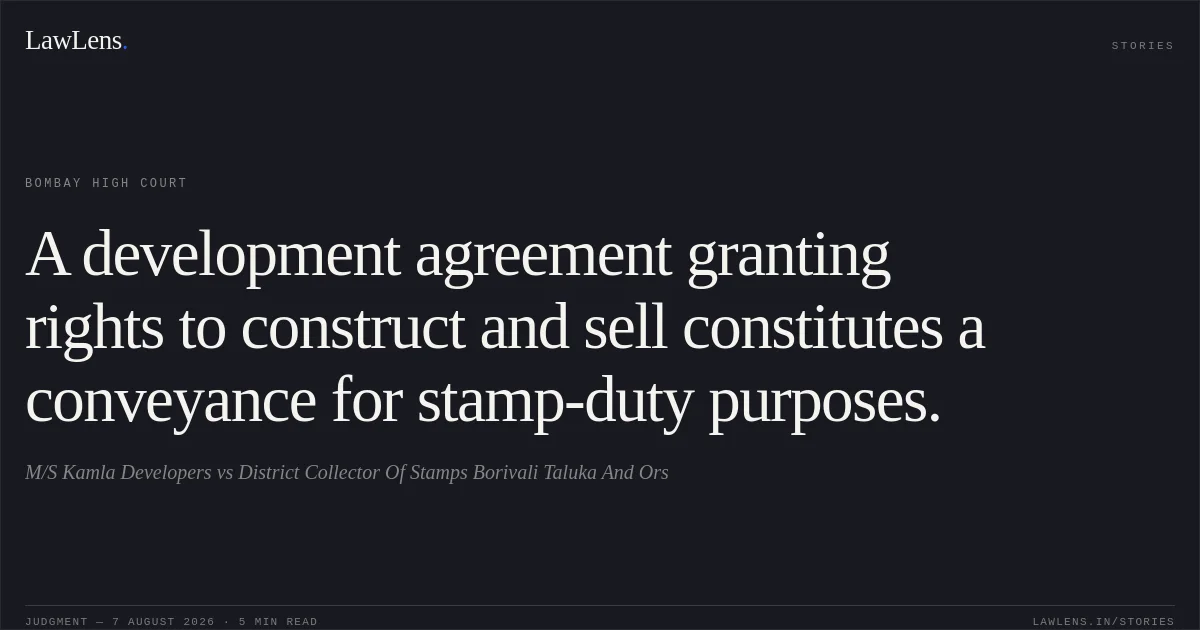
The Court answered the principal issue against the petitioner and upheld the classification of both development agreements as conveyances chargeable to stamp duty under the Maharashtra Stamp Act, 1958.
The orders dated 30 October 2009 of the Collector of Stamps and the appellate orders dated 18 December 2010 were sustained.
Source reference: para. 26Writ Petition Nos. 542 of 2011 and 544 of 2011 were dismissed, the Rules were discharged, and there was no order as to costs.
Source reference: para. 26The Registry was directed to release the amount deposited by the petitioner, together with accrued interest, to the District Collector of Stamps for adjustment against the recoverable stamp duty.
Source reference: para. 27No separate interest was to be charged on the deposited amounts from the date of deposit.
Source reference: para. 27Acts & Sections Cited
1 provisions across 1 statute referred to in this judgment. Linked provisions open on LawLens.
Bombay Stamp Act, 19581
Original Court PDF
M/S Kamla DevelopersvsDistrict Collector Of Stamps Borivali Taluka And Ors
Click to open original judgment
Original judgment, available to read, download and summarize on LawLens.in