Facts
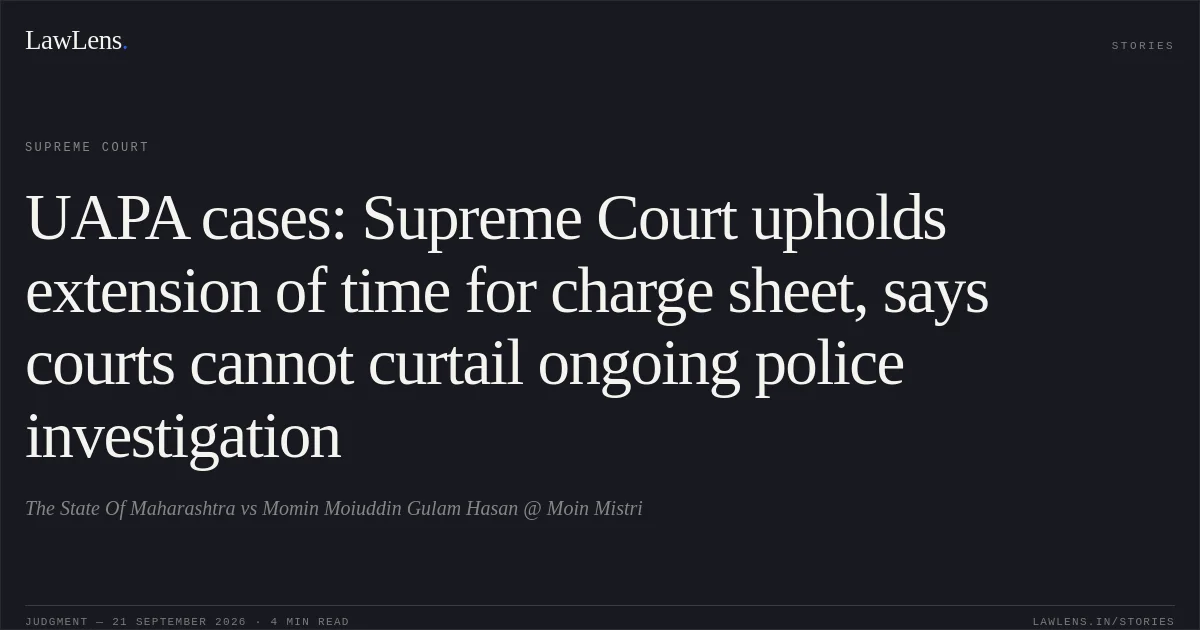
An FIR was registered by the Maharashtra Anti-Terrorism Squad on 21 September 2022 for offences under Sections 120B, 121A and 153A IPC and Section 13(1)(b) of the UAPA.
Source reference: pp. 2–3The respondents were arrested on 22 September 2022 and remained in custody during the investigation.
Source reference: pp. 2–3Since the investigation was not completed within the initial ninety-day period, the Special Judge granted a thirty-day extension under Section 43-D(2)(b) of the UAPA on 17 December 2022, followed by a further fifteen-day extension on 18 January 2023.
Source reference: pp. 3, 21–23The respondents’ default-bail application filed on 20 January 2023 was rejected as premature because the extended period would expire on 2 February 2023.
Source reference: p. 3A charge sheet was filed on 2 February 2023.
Source reference: p. 4The Bombay High Court held that the second extension was invalid, principally because the investigation was allegedly complete and the remaining sanction under Section 45 of the UAPA was not a valid ground for extending time; it consequently granted default bail.
Source reference: pp. 5–8The State challenged that decision before the Supreme Court.
Source reference: no citationIssues
Whether the Special Judge’s order dated 18 January 2023 granting a further fifteen-day extension for filing the charge sheet under Section 43-D(2)(b) of the UAPA was legal and valid?
Source reference: pp. 4–8, 23–26Whether the respondents acquired an indefeasible right to default bail under Section 167(2) CrPC read with Section 43-D(2) of the UAPA upon expiry of the initial or extended period for filing the charge sheet?
Source reference: pp. 7–9, 17–18Whether the High Court could conclude that the investigation was complete and thereby curtail the investigating agency’s power to continue its investigation?
Source reference: pp. 30–34Law Applied
Section 167(2) CrPC, read with Section 43-D(2) of the UAPA, creates an indefeasible right to default bail when the investigation is not completed and the charge sheet is not filed within the statutory or validly extended period, provided the accused applies for bail and is prepared to furnish it.
Source reference: pp. 13–18Under Section 43-D(2)(b) UAPA, the Court may extend the ninety-day period up to 180 days if satisfied with the Public Prosecutor’s report indicating the progress of the investigation and specific reasons for continued detention.
Source reference: pp. 15–18Sanction under Section 45 UAPA is required for taking cognizance, not ordinarily for filing a charge sheet; therefore, a charge sheet filed without sanction is not necessarily incomplete.
Source reference: pp. 26–31However, the completion of investigation and filing of a complete final report remain within the investigating agency’s statutory domain, and courts should not ordinarily dictate when investigation must end, subject to exceptional cases or statutory restrictions.
Source reference: pp. 31–34The Court relied, inter alia, on Bikramjit Singh v. State of Punjab, Sanjay Dutt v. State through C.B.I., State of Maharashtra v. Surendra Pundlik Gadling, State of NCT of Delhi v. Raj Kumar @ Lovepreet @ Lovely, Judgebir Singh v. National Investigation Agency, and Suresh Kumar Bhikamchand Jain v. State of Maharashtra.
Source reference: pp. 7–9, 22–31Reasoning
The Supreme Court held that the High Court had improperly treated the isolated statement that sufficient material existed to file a charge sheet as an admission that the investigation was complete.
Source reference: pp. 23–27Read as a whole, the second extension application showed that voice samples were still being examined, financial transactions and bank accounts were being verified, electronic data was still under analysis, and further material concerning connected cases and offences was being collected.
Source reference: pp. 25–26Analysis of forensic data and tracing the financial links allegedly connecting the accused with terrorist activities were substantive parts of the investigation, not matters that could necessarily be deferred until after filing the charge sheet.
Source reference: pp. 32–34Although the High Court correctly recognised that sanction under Section 45 UAPA concerns cognizance and is not a prerequisite for filing a charge sheet, that issue was not decisive because the second extension was sought principally to complete the remaining investigative work, rather than merely to await sanction.
Source reference: pp. 26–29, 34The Special Judge had therefore acted within the statutory framework in granting further time, and no default-bail right accrued on 19 January 2023.
Source reference: no citationHolding
The Supreme Court allowed the appeal and set aside the Bombay High Court’s judgment dated 15 July 2024.
It held that the Special Judge’s order dated 18 January 2023 granting a further fifteen-day extension under Section 43-D(2)(b) UAPA was legal and valid, and that the respondents’ default-bail application dated 20 January 2023 was liable to be dismissed.
Source reference: p. 35Respondent No. 1 was directed to surrender within thirty days, with liberty to seek regular bail in accordance with law.
Source reference: p. 35Acts & Sections Cited
20 provisions across 4 statutes referred to in this judgment. Each provision opens on LawLens.
Indian Penal Code, 18603
Unlawful Activities (Prevention) Act, 19677
Code of Criminal Procedure, 1973
Arms Act, 19591
Original Court PDF
The State Of MaharashtravsMomin Moiuddin Gulam Hasan @ Moin Mistri
Click to open original judgment
Original judgment, available to read, download and summarize on LawLens.in