Facts
Respondent No. 1, the applicant’s uncle and neighbour, initiated proceedings under Section 133 Cr.P.C., alleging that the applicant and her father were keeping approximately 15–20 dogs in a residential locality in connection with an animal-welfare NGO, thereby causing nuisance and danger to residents and users of a common public way.
Source reference: para. 2The Sub-Divisional Magistrate rejected the application on 09.07.2024, principally observing that the parties had a pending civil dispute and that the matter did not fall within Section 133 Cr.P.C.
Source reference: para. 2Respondent No. 1 challenged that order in Criminal Revision No. 135/2024. On 28.03.2025, the II Additional Sessions Judge, Rewa, allowed the revision, set aside the SDM’s order, and remanded the matter for fresh consideration after granting both parties an opportunity of hearing.
Source reference: para. 3The applicant challenged the remand order under Section 482 Cr.P.C., contending that the proceedings were founded on a private dispute and that no public nuisance was established.
Source reference: para. 4Issues
1. Whether proceedings under Section 133 Cr.P.C. were non-maintainable because the dispute arose against the background of a pending private civil dispute and allegedly concerned privately owned property?
Source reference: paras. 4, 8–92. Whether the allegations regarding the keeping of numerous dogs in a residential locality disclosed a possible public nuisance requiring consideration by the competent Magistrate?
Source reference: paras. 5, 8–93. Whether the revisional Court’s order remanding the matter for fresh consideration warranted interference under the High Court’s inherent jurisdiction under Section 482 Cr.P.C.?
Source reference: paras. 3, 10–12Law Applied
Section 133 Cr.P.C. empowers the competent Magistrate to take preventive action where jurisdictional facts disclose a public nuisance affecting members of the public.
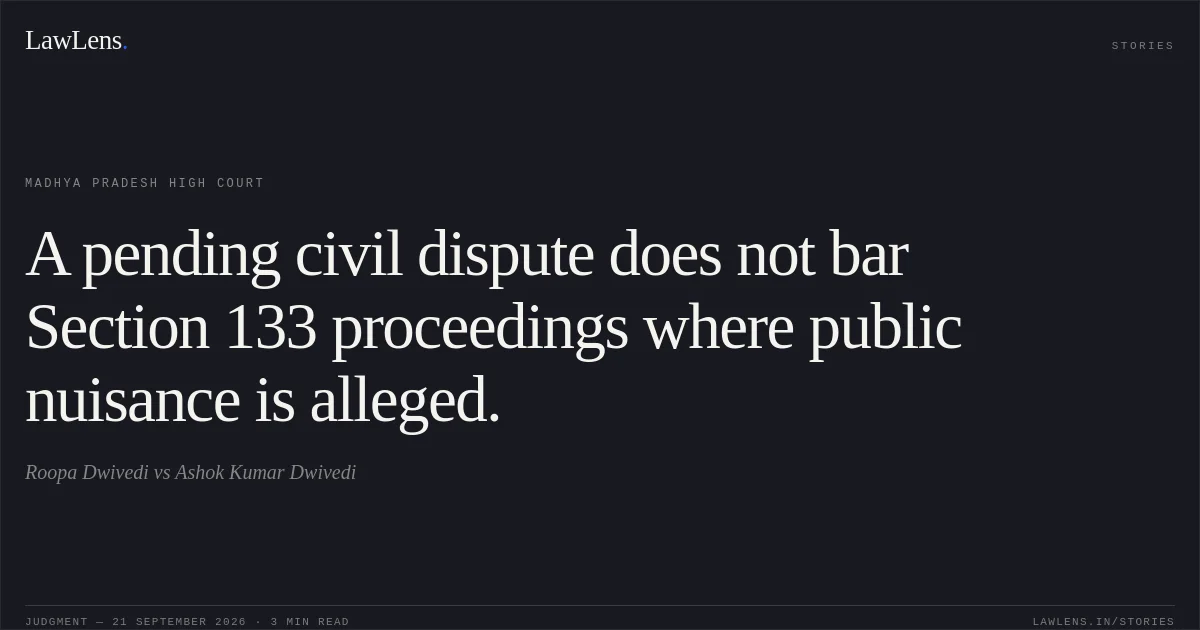
Source reference: no citationThe existence of a civil dispute does not, by itself, bar proceedings under Section 133 Cr.P.C. where the allegations independently concern public nuisance.
Source reference: para. 9In Municipal Council, Ratlam v. Vardhichand, (1980) 4 SCC 162, the Supreme Court recognized that Section 133 Cr.P.C. is attracted when public nuisance affecting the community is disclosed.
Source reference: para. 9The High Court’s inherent jurisdiction under Section 482 Cr.P.C. is not ordinarily exercised to undertake factual adjudication or re-appreciation of disputed material, particularly where the impugned order is only procedural and directs reconsideration after hearing both sides.
Source reference: paras. 8, 10–12Reasoning
The Court held that the allegations were not confined to a private property dispute. The asserted keeping of a substantial number of dogs in a residential locality, coupled with alleged nuisance, danger to residents, dog-bite incidents, and obstruction or risk to persons using the public way, constituted matters requiring factual examination for determining whether a public nuisance existed.
Source reference: para. 8The pending civil litigation was treated as only a relevant circumstance and not as a legal bar to Section 133 proceedings.
Source reference: para. 9Since the revisional Court had not recorded a final finding that the applicant caused public nuisance, but had merely directed the SDM to reconsider the matter after properly hearing both parties, the remand did not cause failure of justice or amount to abuse of process.
Source reference: para. 10Determination of the number of dogs, their manner of maintenance, the alleged dog-bite incidents, and the effect on local residents involved disputed factual questions that could not be adjudicated under Section 482 Cr.P.C.
Source reference: para. 11The Court therefore found no patent illegality or jurisdictional error in the revisional order.
Source reference: para. 12Holding
The High Court dismissed the petition under Section 482 Cr.P.C. and upheld the revisional Court’s order dated 28.03.2025 remanding the matter to the SDM, Huzur, District Rewa, for fresh consideration after affording both parties an opportunity of hearing.
The SDM was directed to independently examine the maintainability of the proceedings and all other objections on the basis of the available material and evidence, without being influenced by observations made in the High Court’s order.
Source reference: para. 13Acts & Sections Cited
3 provisions across 2 statutes referred to in this judgment. Each provision opens on LawLens.
Code of Criminal Procedure, 19732
Bharatiya Nagarik Suraksha Sanhita, 20231
Original Court PDF
Roopa DwivedivsAshok Kumar Dwivedi
Click to open original judgment
Original judgment, available to read, download and summarize on LawLens.in