Facts
Jakhar Travels instituted proceedings under Section 18 of the Rajasthan Rent Control Act, 2001, seeking protection against interference with its alleged possession of the premises and apprehended forcible dispossession. Its claim was based on a registered rent deed.
Source reference: paras. 2–2.1; pp. 2–3During the proceedings, Pappu Ram, claiming authority from the respondent, sought impleadment under Order I Rule 10 CPC read with Section 21 of the Act; the application was rejected by the Rent Tribunal.
Source reference: paras. 2–2.1; pp. 2–3The Rent Tribunal allowed the petition on 25.02.2025 and granted an injunction restraining the respondent from interfering with the petitioner’s occupation or evicting it except in accordance with law.
Source reference: para. 2.2; p. 3Bhanwar Lal Choudhary, who was not a party to the original proceedings, appealed under Section 19(6) of the Act. He relied on a registered sale deed dated 07.02.2025 and asserted that the decree directly affected his interest in the premises.
Source reference: paras. 2.3–2.4; pp. 3–4Before the Appellate Rent Tribunal, he also contended that possession had never been delivered to Jakhar Travels under the alleged rent agreement. He relied on a bank statement showing return of the tendered amount, photographs, a notice, an FIR and a pen drive depicting an incident at the premises.
Source reference: para. 2.5; pp. 4–5The Appellate Tribunal found that the Rent Tribunal had failed to properly consider this material, allowed the appeal and set aside the decree dated 25.02.2025.
Source reference: para. 2.6; p. 5Jakhar Travels challenged that decision under Article 227 of the Constitution.
Source reference: para. 1; p. 1Issues
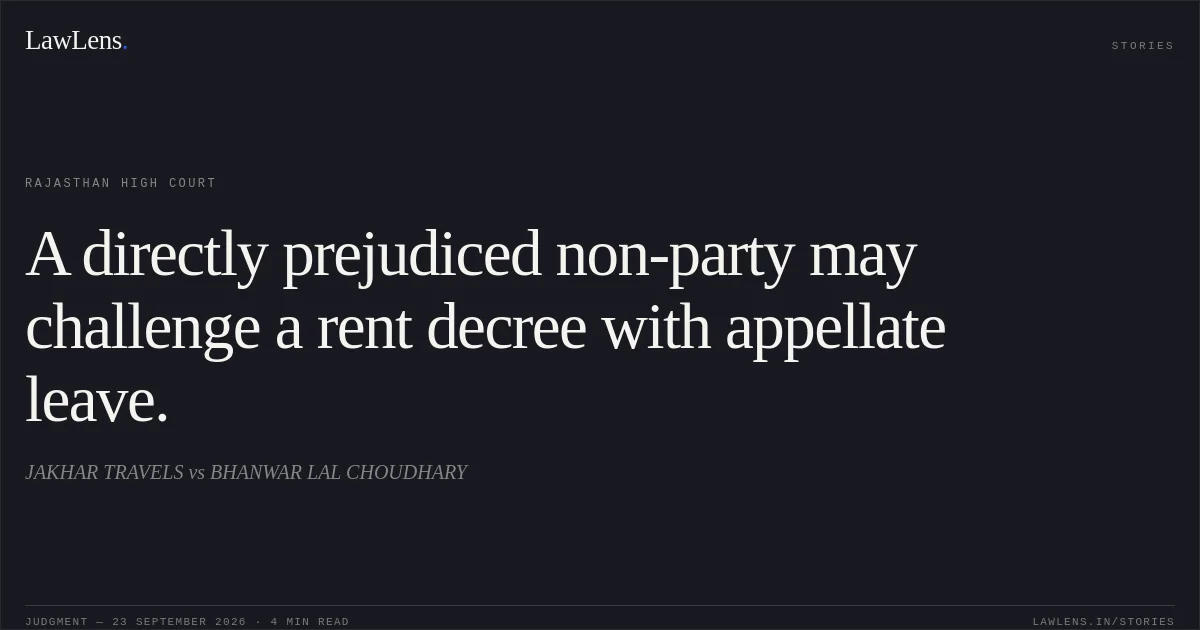
Whether a person who was not impleaded before the Rent Tribunal could maintain an appeal under Section 19(6) of the Rajasthan Rent Control Act, 2001, where he claimed that the judgment directly and adversely affected his legally cognizable interest in the premises?
Source reference: paras. 6–6.2; pp. 8–9Whether the Appellate Rent Tribunal was justified in interfering with the Rent Tribunal’s finding that the petitioner was in possession pursuant to the registered rent agreement?
Source reference: paras. 6.3–6.12; pp. 9–14Whether the Appellate Tribunal’s judgment disclosed a jurisdictional error, patent illegality or manifest perversity warranting interference under Article 227 of the Constitution?
Source reference: paras. 6.13, 7.1–7.5; pp. 14–17Law Applied
The Court applied Section 18 of the Rajasthan Rent Control Act, 2001, under which protection against dispossession presupposes an existing possession capable of being disturbed.
Source reference: paras. 6.3–6.7; pp. 9–12It applied Section 19(6) of the Act concerning appellate jurisdiction and held that non-impleadment in the original proceedings does not invariably bar an appeal where the proposed appellant demonstrates a genuine and substantial grievance arising from direct prejudice to a legally cognizable right; however, a stranger with only a remote or speculative interest cannot intervene.
Source reference: paras. 6–6.2; pp. 8–9The Court also referred to Order I Rule 10 CPC in the procedural history concerning impleadment.
Source reference: para. 2.1; p. 2Under Article 227 of the Constitution, the High Court exercises supervisory, not second-appellate, jurisdiction and may interfere only for jurisdictional error, patent illegality, manifest perversity, flagrant disregard of law or procedure, or exceptional failure of justice.
Source reference: paras. 6.13, 7.1–7.2; pp. 14–16The Court further applied the principle that execution of a rent agreement does not, by itself, conclusively establish actual delivery or continued physical possession.
Source reference: paras. 6.4–6.11; pp. 9–14Reasoning
The Court held that Bhanwar Lal’s registered sale deed and specific assertion that the decree affected his rights in the very premises constituted a genuine and substantial grievance. His non-party status therefore did not, by itself, defeat his right to maintain the appeal, and the Appellate Tribunal acted within jurisdiction in granting him leave.
Source reference: paras. 6–6.2; pp. 8–9On possession, the Court found that the relief under Section 18 depended upon proof of actual existing possession, not merely upon execution of a rent deed.
Source reference: paras. 6.3–6.12; pp. 9–14The Appellate Tribunal had properly considered the contrary material, including the returned payment, photographs showing another entity operating from the premises, the notice, FIR and pen drive, and reasonably concluded that possession may never have been delivered to Jakhar Travels.
Source reference: paras. 6.3–6.12; pp. 9–14Since that conclusion was supported by relevant evidence and was not perverse, interference under Article 227 would amount to impermissible reappreciation of evidence and conversion of supervisory jurisdiction into a second appeal.
Source reference: paras. 7.1–7.5; pp. 15–17The Court expressly refrained from finally adjudicating title, the validity of the sale deed, the enforceability of the tenancy or the competing possession claims.
Source reference: para. 7.4; p. 16Holding
The High Court dismissed the writ petition under Article 227 and affirmed the Appellate Rent Tribunal’s judgment dated 16.05.2025, which had allowed Bhanwar Lal Choudhary’s appeal under Section 19(6) and set aside the Rent Tribunal’s decree dated 25.02.2025.
It held that the appeal was maintainable because the appellant demonstrated a direct and substantial prejudice, and that the Appellate Tribunal was justified in finding that actual possession had not been established merely through the registered rent deed.
Source reference: paras. 6.1–6.12; pp. 8–14The Court clarified that its order did not finally determine title, the legal effect of the sale deed, the validity or enforceability of the alleged tenancy, or the parties’ competing possession claims; those issues remained open for adjudication by the competent forum.
Source reference: para. 8.1; p. 18The stay petition was also dismissed.
Source reference: para. 9; p. 18Acts & Sections Cited
3 provisions across 1 statute referred to in this judgment. Each provision opens on LawLens.
rajasthan rent control act, 20013
Original Court PDF
JAKHAR TRAVELSvsBHANWAR LAL CHOUDHARY
Click to open original judgment
Original judgment, available to read, download and summarize on LawLens.in
![Notional service must be reckoned for consequential retirement benefits when severance is limited to pre-notional service.. RAJASEKHARAN B vs D/o Post. CAT - ['Ernakulam']. LawLens](/stories/thumbnails/notional-service-must-be-reckoned-for-consequential-retirement-benefits-when-severance-is-aa1961b944944dbea20e6e3d73025883.webp)
![Authorities must verify parity and grant retrospective pay benefits where the case is identical to settled precedent.. DEVENDRA SINGH SHEKHAWAT vs M/O FINANCE, D/O REVENUE. CAT - ['Jaipur']. LawLens](/stories/thumbnails/authorities-must-verify-parity-and-grant-retrospective-pay-benefits-where-the-case-is-iden-2e3cc02e0628453198c66a82b7a85f67.webp)