Facts
The appellant married Tabassum on 15 September 2004, and they had two sons. Tabassum died on 3 December 2008, within four years of the marriage, at the matrimonial home in Ambad, Azad Nagar.
Source reference: paras. 2–5Her father, PW-1, alleged that he had paid ₹10,000, gold ornaments and household articles at the marriage and that the appellant subsequently subjected Tabassum to cruelty and demanded further sums of ₹1,000, ₹2,000 and finally ₹2,000 shortly before her death.
Source reference: paras. 4, 7–8The inquest reports and post-mortem examination found no injuries apart from a ligature mark. The post-mortem doctor opined that death resulted from asphyxia of suicidal nature.
Source reference: paras. 5, 16The appellant was charged under Sections 498A and 304B of the Indian Penal Code and was convicted by the Additional District and Sessions Judge, Asansol, receiving three months’ imprisonment under Section 498A and life imprisonment under Section 304B.
Source reference: paras. 1, 6, 23Issues
1. Whether the prosecution proved beyond reasonable doubt that the appellant subjected the deceased to cruelty or harassment in connection with a dowry demand, thereby attracting Section 498A IPC?
Source reference: paras. 26–34, 392. Whether the prosecution established the essential ingredients of dowry death under Section 304B IPC, particularly that the deceased was subjected to dowry-related cruelty or harassment “soon before her death”?
Source reference: paras. 27, 36–403. Whether the medical and other circumstantial evidence established that the appellant caused or was responsible for the deceased’s death?
Source reference: paras. 24–25, 35–38Law Applied
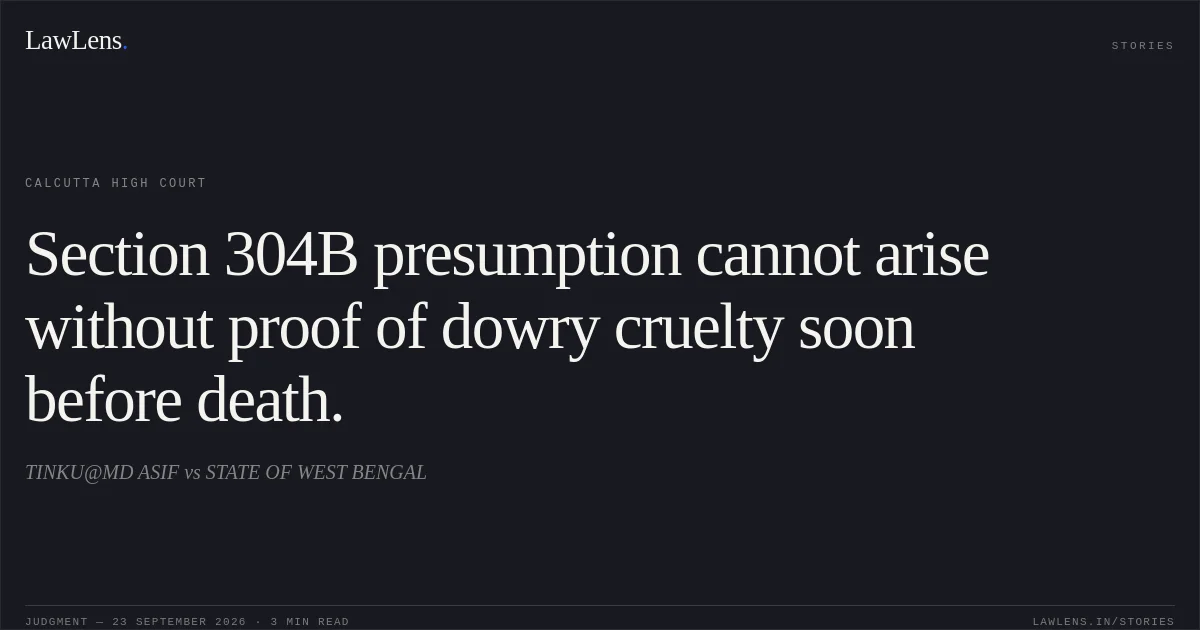
The Court applied Sections 498A and 304B IPC, along with Section 113B of the Indian Evidence Act, 1872. Section 304B requires proof that a woman died otherwise than under normal circumstances within seven years of marriage and that, soon before her death, she was subjected to cruelty or harassment for, or in connection with, a dowry demand; only upon proof of these foundational facts does the presumption under Section 113B arise.
Source reference: para. 27The Court relied on Abdul Sayeed v. State of Madhya Pradesh, (2010) 10 SCC 259, for the principle that a material and unexplained inconsistency between ocular and medical evidence may constitute a fundamental defect in the prosecution case.
Source reference: para. 24It also relied on M. Srinivasulu v. State of Andhra Pradesh, (2007) 12 SCC 443, which holds that “soon before” is a relative expression but requires evidence of proximate cruelty or harassment and that the prosecution must first establish the statutory foundational facts before the presumption operates.
Source reference: para. 27In a circumstantial-evidence case, the “last seen” circumstance is only one link in the chain and cannot by itself establish guilt.
Source reference: paras. 36–38Reasoning
The allegations of payment of dowry were unsupported by documentary or reliable corroborative evidence; the Nikahnama did not record the alleged payment, no bank or postal records were produced, and the testimony of PW-1 and PW-3 was inconsistent and generalised.
Source reference: paras. 11–12, 28–30The deceased and the appellant had frequently stayed at PW-1’s house, and the evidence showed that the deceased was unhappy primarily because of the appellant’s poverty and inadequate earnings, rather than establishing legally cognisable dowry harassment.
Source reference: paras. 26, 32–33, 41The witnesses also failed to provide consistent dates or details of the alleged demands, while several witnesses had not disclosed the material allegations to the Investigating Officer.
Source reference: paras. 13–18, 31, 34The medical evidence disclosed no bodily injuries or signs of physical struggle, and the post-mortem doctor described the death as suicidal asphyxia. No ligature or other incriminating article was recovered, and the circumstances of the asphyxiation remained unexplained.
Source reference: paras. 24–25, 35The Court held that the prosecution evidence was inconsistent with the medical evidence and that the mere circumstance that the appellant was allegedly present in the house did not establish that he strangled the deceased or intended to cause her death.
Source reference: paras. 35–38Since the prosecution did not prove proximate dowry-related cruelty, the statutory presumption under Section 113B could not be invoked.
Source reference: para. 27Holding
The Court held that the prosecution failed to prove the ingredients of Sections 498A and 304B IPC beyond reasonable doubt. In particular, it failed to establish dowry-related cruelty or harassment soon before the deceased’s death and failed to prove that the appellant caused or was responsible for her death.
The conviction and sentences dated 20 and 21 June 2012 were set aside, and CRA 410 of 2012 was allowed.
Source reference: para. 42CRAN 3 of 2026 and connected applications were disposed of accordingly; the appellant’s bail bond was discharged, subject to his executing a bond under Section 481 of the BNSS for six months.
Source reference: para. 42Acts & Sections Cited
2 provisions across 2 statutes referred to in this judgment. Each provision opens on LawLens.
Code of Criminal Procedure, 19731
Bharatiya Nagarik Suraksha Sanhita, 20231
Original Court PDF
TINKU@MD ASIFvsSTATE OF WEST BENGAL
Click to open original judgment
Original judgment, available to read, download and summarize on LawLens.in