Facts
The appellant challenged the order dated 10 July 2023 in W.P. No. 29268 of 2022 concerning appointment to the post of Village Assistant.
Source reference: p.2, para.2The litigation was the third round of proceedings. Earlier, the appellant’s W.P. No. 16747 of 2020, raising similar grounds, was dismissed on 3 February 2021.
Source reference: p.2, para.2Thereafter, he filed W.P. No. 1009 of 2022, which he withdrew with liberty to approach the appropriate authority.
Source reference: p.2, para.2His subsequent representation dated 30 April 2022 was rejected, following which he filed W.P. No. 29268 of 2022.
Source reference: p.2, para.2The Writ Court found that the post was earmarked for SC/ST women, particularly destitute widows, and that an advertisement for filling the vacancy had been issued on 10 October 2022.
Source reference: p.2, para.3; p.3, para.4The appellant preferred the present writ appeal under Clause 15 of the Letters Patent.
Source reference: no citationIssues
Whether the appellant could claim appointment to the post of Village Assistant despite the earlier litigation having attained finality and the post being reserved for a specified category under the applicable recruitment process?
Source reference: p.3, paras.4–5Whether the appellant had a vested right to appointment merely because the vacancy existed or because he had previously pursued legal proceedings concerning the post?
Source reference: p.3, para.5Whether the order of the Writ Court dismissing W.P. No. 29268 of 2022 warranted interference in appeal?
Source reference: p.1; p.3, para.6Law Applied
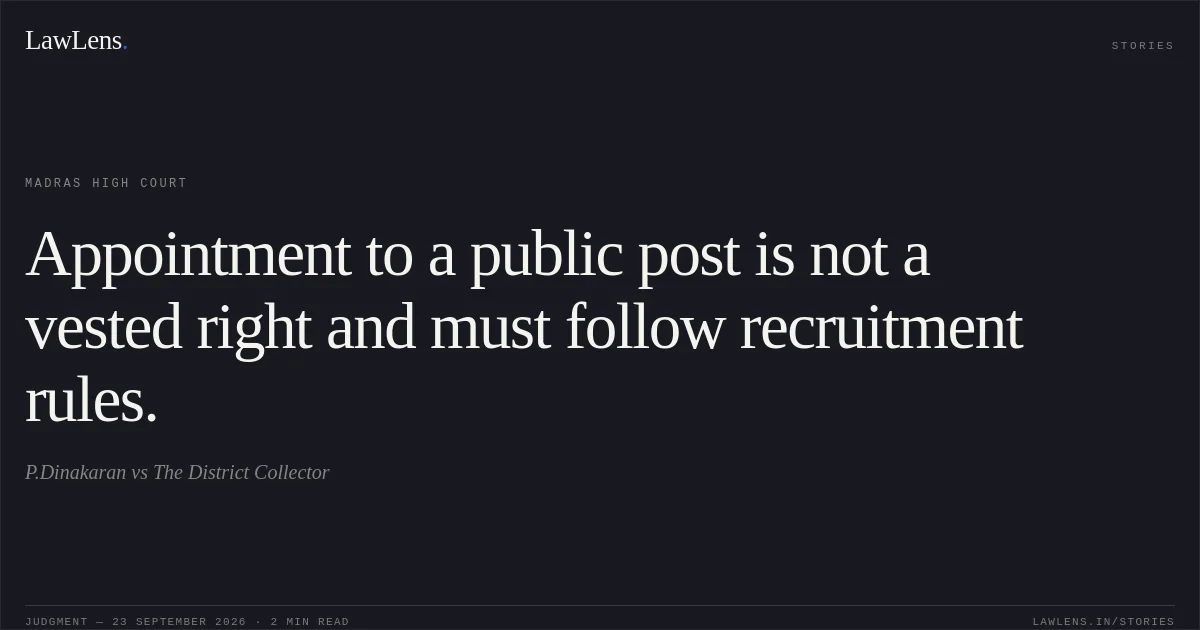
The Court applied the principle that appointment to a public post must be made strictly in accordance with the recruitment rules in force and applicable reservation or classification requirements.
Source reference: p.3, para.5It further applied the doctrine of finality of litigation, holding that an unsuccessful litigant cannot repeatedly reopen substantially identical claims after the earlier proceedings have concluded.
Source reference: p.2, para.3; p.3, para.5The Court also affirmed the settled principle that mere existence of a vacancy, participation in proceedings, or consideration of a claim does not confer a vested or indefeasible right to appointment.
Source reference: p.3, para.5Reasoning
The Court noted that the appellant’s challenge arose in a third round of litigation involving substantially similar grounds.
Source reference: p.2, para.2His earlier writ petition had been dismissed, and the subsequent writ petition had been withdrawn after obtaining liberty to approach the competent authority; the representation thereafter was rejected.
Source reference: p.2, para.2The Writ Court had also found that the post was earmarked for SC/ST women, particularly destitute widows, and that an advertisement had been issued to fill the vacancy in accordance with that classification.
Source reference: p.2, para.3; p.3, para.4Applying the principles of finality and the absence of any vested right to public appointment, the Division Bench held that the appellant could not secure appointment merely by continuing litigation.
Source reference: p.3, para.5Any appointment had to conform to the recruitment rules and the prescribed eligibility and reservation requirements.
Source reference: p.3, para.5Holding
The Division Bench held that the appellant was not entitled to appointment and that the earlier litigation and rejection of his representation precluded the relief sought.
It found no ground to interfere with the order dated 10 July 2023 passed in W.P. No. 29268 of 2022 and dismissed the writ appeal.
Source reference: p.3, para.6No costs were awarded, and any connected miscellaneous petitions were closed.
Source reference: p.3, para.6Original Court PDF
P.DinakaranvsThe District Collector
Click to open original judgment
Original judgment, available to read, download and summarize on LawLens.in