Facts
The Petitioner and Respondent No. 1 entered into a Letter of Engagement dated 1 April 2022 under which the Respondent was to provide marketing, promotion, branding and business-referral services. Clause 5 contained an indemnity obligation in respect of losses, liabilities, claims or damages caused by the Respondent’s breach or default.
Source reference: p.2, paras. 1–2Between July and December 2023, the Respondent raised invoices aggregating to ₹63,05,99,252.90, inclusive of GST, which the Petitioner paid and on which it availed input tax credit.
Source reference: p.2, para. 3The GST authorities subsequently alleged that the Respondent had failed to deposit the collected GST with the Government and required reversal of the input tax credit with interest and penalty.
Source reference: p.2, para. 4The Petitioner claimed that its parent company consequently reversed ₹12,78,12,546.
Source reference: pp.2–3, para. 5Invoking the arbitration clause in Clause 6, the Petitioner issued a notice dated 5 May 2025 under Section 21 of the Arbitration and Conciliation Act, 1996.
Source reference: p.3, para. 6The Respondent disputed arbitrability, contending that the dispute arose from GST authorities’ retrospective cancellation of registration and reversal of input tax credit. It also argued that the contractual requirement of prior mutual negotiation had not been complied with.
Source reference: p.3, paras. 7–8The Petitioner accordingly sought appointment of a sole arbitrator under Section 11(6), as well as interim protective relief under Section 9 in O.M.P.(I) (COMM.) 512/2025.
Source reference: pp.1, 5–6, paras. 1, 25Issues
Whether a prima facie valid arbitration agreement existed between the parties so as to warrant appointment of a sole arbitrator under Section 11(6) of the Act?
Source reference: p.4, paras. 10–14Whether the Petitioner’s claim arising from the GST-related loss and reversal of input tax credit was ex facie non-arbitrable or fell outside the arbitration clause?
Source reference: p.4, para. 12Whether the alleged non-compliance with the pre-arbitration requirement of mutual negotiation and discussions prevented reference of the disputes to arbitration?
Source reference: p.3, paras. 6–8; p.4, paras. 13–14Whether the Section 9 proceedings should be treated as an application under Section 17 after constitution of the arbitral tribunal?
Source reference: p.7, paras. 26–29Law Applied
At the Section 11 stage, the Court’s enquiry is limited to determining the prima facie existence of an arbitration agreement under Section 11(6) of the Arbitration and Conciliation Act, 1996.
Source reference: p.4, para. 10Relying on SBI General Insurance Co. Ltd. v. Krish Spinning, 2024 SCC OnLine SC 1754, the Court reiterated this limited-jurisdiction principle.
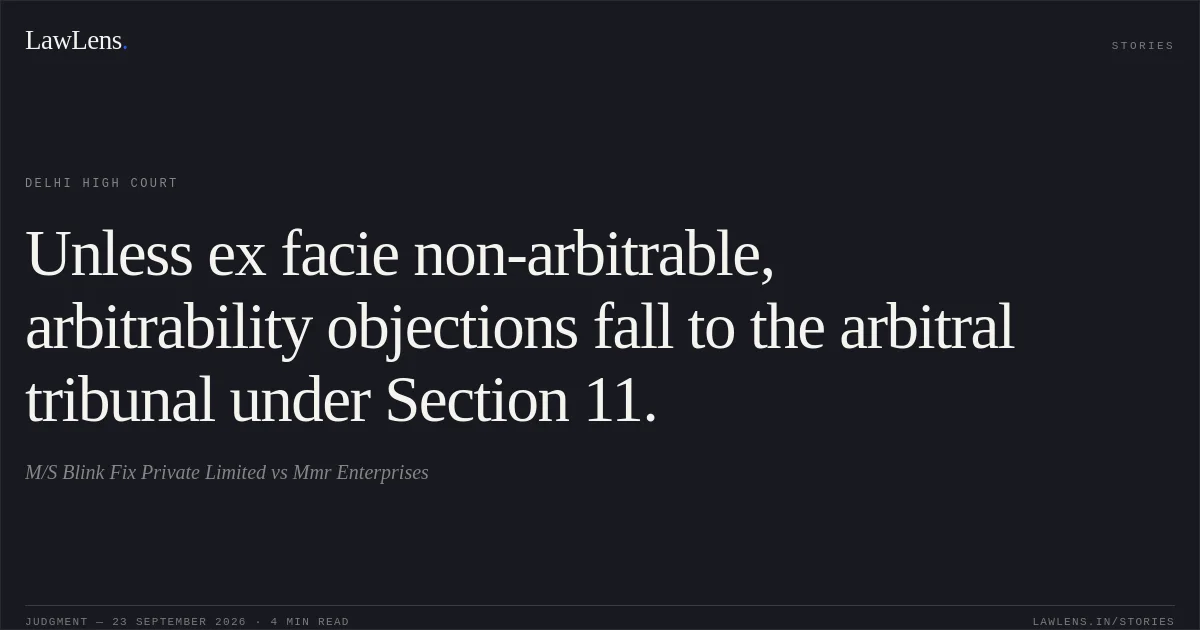
Source reference: p.4, para. 10Relying further on VGP Marine Kingdom (P) Ltd. v. Kay Ellen Arnold, (2023) 1 SCC 597, the Court held that the arbitral tribunal is ordinarily the primary authority to determine arbitrability and jurisdiction, unless the dispute is ex facie non-arbitrable.
Source reference: p.4, para. 12The Court also applied Clause 6 of the Letter of Engagement, which provided for arbitration of disputes not resolved through mutual negotiation within 30 days.
Source reference: p.3, para. 6Upon reference to arbitration, a Section 9 application may be treated as an application under Section 17 for consideration by the arbitral tribunal.
Source reference: p.7, paras. 26–27Reasoning
The existence of the arbitration agreement in Clause 6 was undisputed. The Petitioner’s claim was founded on the contractual indemnity clause and alleged losses resulting from the Respondent’s failure to discharge its GST-related obligations.
Source reference: p.4, paras. 11–12The Court held that the Respondent’s objections concerning the effect of GST proceedings and the scope of the indemnity clause did not establish that the dispute was ex facie non-arbitrable.
Source reference: p.4, para. 12Those questions, including whether the claim fell within the arbitration agreement and indemnity clause, were matters for the arbitral tribunal under the competence-competence principle.
Source reference: p.4, para. 12The Court also found no infirmity in the Section 21 notice, which referred to the arbitration clause and proposed an arbitrator for the Respondent’s approval.
Source reference: p.5, para. 13Having constituted the tribunal, the Court directed that the Section 9 reliefs be considered by the tribunal under Section 17, while preserving the parties’ right to raise all jurisdictional, arbitrability and substantive objections.
Source reference: p.7, paras. 26–28Holding
The Court allowed the Section 11 petition and appointed Mr. Alok Agarwal, former Additional District and Sessions Judge, Delhi, as the sole arbitrator.
The arbitration was directed to be conducted under the rules and aegis of the Delhi International Arbitration Centre, subject to the arbitrator furnishing the statutory disclosures under Section 12(2).
Source reference: pp.5–6, paras. 19–20The parties were granted four weeks to explore an amicable settlement, and the arbitrator was directed to enter upon the reference after six weeks if the dispute remained unresolved.
Source reference: p.5, paras. 16–18The Respondents remained at liberty to raise all objections regarding arbitrability and jurisdiction before the arbitrator, uninfluenced by the Court’s prima facie observations.
Source reference: p.6, paras. 21–22The Section 9 petition seeking deposit, freezing of accounts and restraint against alienation of assets was disposed of by treating it as an application under Section 17, to be considered by the learned Sole Arbitrator after entering upon the reference.
Source reference: p.7, paras. 25–29Acts & Sections Cited
5 provisions across 1 statute referred to in this judgment. Each provision opens on LawLens.
Arbitration and Conciliation Act, 19965
Original Court PDF
M/S Blink Fix Private LimitedvsMmr Enterprises
Click to open original judgment
Original judgment, available to read, download and summarize on LawLens.in