Facts
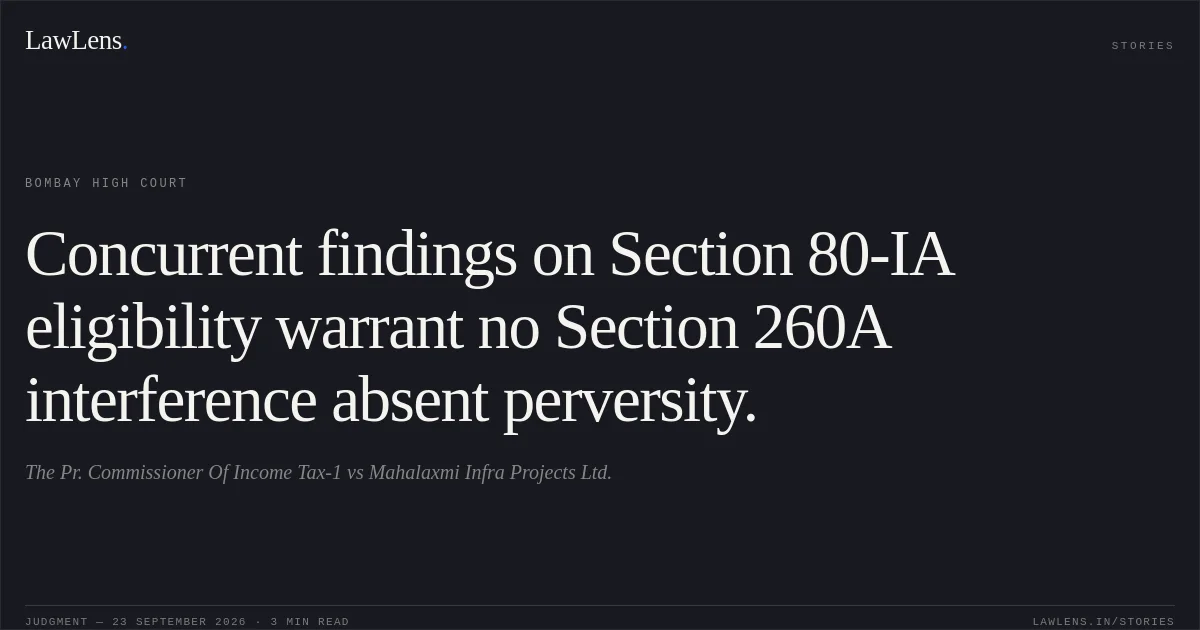
The Respondent-Assessee was engaged in construction of roads and other infrastructure works and claimed a deduction under Section 80-IA(4) of the Income Tax Act, 1961, for Assessment Year 2011–12.
Source reference: pp. 2–3, paras. 2–3The Assessing Officer disallowed the deduction, holding that the Assessee was merely a contractor and did not satisfy the statutory requirement of developing, operating and maintaining an infrastructure facility.
Source reference: pp. 2–3, paras. 2–3The Commissioner of Income Tax (Appeals) allowed the Assessee’s claim, and the Income Tax Appellate Tribunal affirmed that decision.
Source reference: pp. 2–3, paras. 2–3The Department challenged the Tribunal’s order under Section 260A of the Act.
Source reference: pp. 2–3, paras. 2–3Issues
Whether the Assessee was entitled to deduction under Section 80-IA(1) of the Income Tax Act on the basis that it was engaged in developing, operating and maintaining infrastructure facilities.
Source reference: p. 3, para. 4(A)Whether the Tribunal’s reliance on its earlier order dated 9 December 2015 was arbitrary or perverse because the facts of that case allegedly differed from the present case.
Source reference: p. 3, para. 4(B)Whether the Department’s appeal raised any substantial question of law warranting admission under Section 260A of the Income Tax Act.
Source reference: pp. 3–7, paras. 5–8Law Applied
Section 260A of the Income Tax Act permits a High Court to entertain an appeal only where the case involves a “substantial question of law”; it does not confer general appellate jurisdiction to reappreciate evidence or review concurrent findings of fact.
Source reference: pp. 6–8, paras. 5–8In Sir Chunilal V. Mehta & Sons Ltd. v. Century Spinning & Manufacturing Co. Ltd., as reiterated in Vijay Kumar Talwar v. CIT, a substantial question of law must be debatable, materially affect the parties’ rights, and either remain unsettled or involve a difficult question requiring alternative legal views; a settled legal issue involving only application of established principles is not substantial.
Source reference: pp. 3–4, para. 5Santosh Hazari v. Purushottam Tiwari further requires that the question arise from the findings of fact and be necessary for deciding the case.
Source reference: pp. 4–5, para. 5Under Hero Vinoth v. Seshammal, interference with concurrent factual findings is justified only in recognised circumstances such as reliance on no evidence, ignoring material evidence, applying an erroneous legal test, or drawing legally impermissible inferences.
Source reference: p. 6, para. 5Reasoning
The Court held that the first proposed question essentially sought reconsideration of the factual determination whether the Assessee’s activities qualified as development of an infrastructure facility under Section 80-IA(4).
Source reference: p. 7, para. 6That issue had been examined by both the CIT(A) and the Tribunal, which concurrently found in favour of the Assessee.
Source reference: p. 7, para. 6The Department failed to show that those findings were perverse, unsupported by evidence, or based on an incorrect legal test.
Source reference: p. 7, para. 6The Tribunal’s reliance on its earlier order did not, by itself, make the decision arbitrary or perverse, particularly because that earlier order had been affirmed by the High Court.
Source reference: p. 7, para. 7The Court also noted that a coordinate Bench had dismissed the Department’s appeal concerning the same Assessee and subject matter for a different assessment year, holding that no substantial question of law arose.
Source reference: p. 8, para. 9Consequently, the present appeal could not be used as a further round of factual scrutiny.
Source reference: p. 8, para. 9Holding
The Court answered the matter against the Department, holding that the proposed questions did not give rise to any substantial question of law under Section 260A of the Income Tax Act.
The concurrent findings allowing the Assessee’s deduction under Section 80-IA(4) were not shown to be perverse or legally erroneous.
Source reference: pp. 7–10, paras. 8–12The Income Tax Appeal was accordingly dismissed.
Source reference: pp. 7–10, paras. 8–12The Court additionally directed that a copy of the order be sent to the Principal Chief Commissioner of Income Tax and expressed concern regarding the routine filing of appeals under Section 260A without genuinely substantial questions of law.
Source reference: pp. 7–10, paras. 8–12Acts & Sections Cited
3 provisions across 1 statute referred to in this judgment. Linked provisions open on LawLens.
Income Tax Act, 19613
Original Court PDF
The Pr. Commissioner Of Income Tax-1vsMahalaxmi Infra Projects Ltd.
Click to open original judgment
Original judgment, available to read, download and summarize on LawLens.in
![Erroneous online declaration of supplementary passing justifies denial of first-attempt merit preference.. Badan Singh Jatav vs D/o Post. CAT - ['Jaipur']. LawLens](/stories/thumbnails/erroneous-online-declaration-of-supplementary-passing-justifies-denial-of-first-attempt-me-6a94f967ae7e46218d42529024394b57.webp)