Facts
The petitioner, defendant No.6 in O.S. No.4/2016, claimed to be a bona fide purchaser under a registered sale deed dated 21 January 2013 executed in her favour by defendant No.5, acting as the GPA holder of defendant Nos.1, 2 and 4.
Source reference: paras. 2–3The plaintiffs sought partition and separate possession of their alleged one-fourth share and a declaration that the sale deed was not binding on their share.
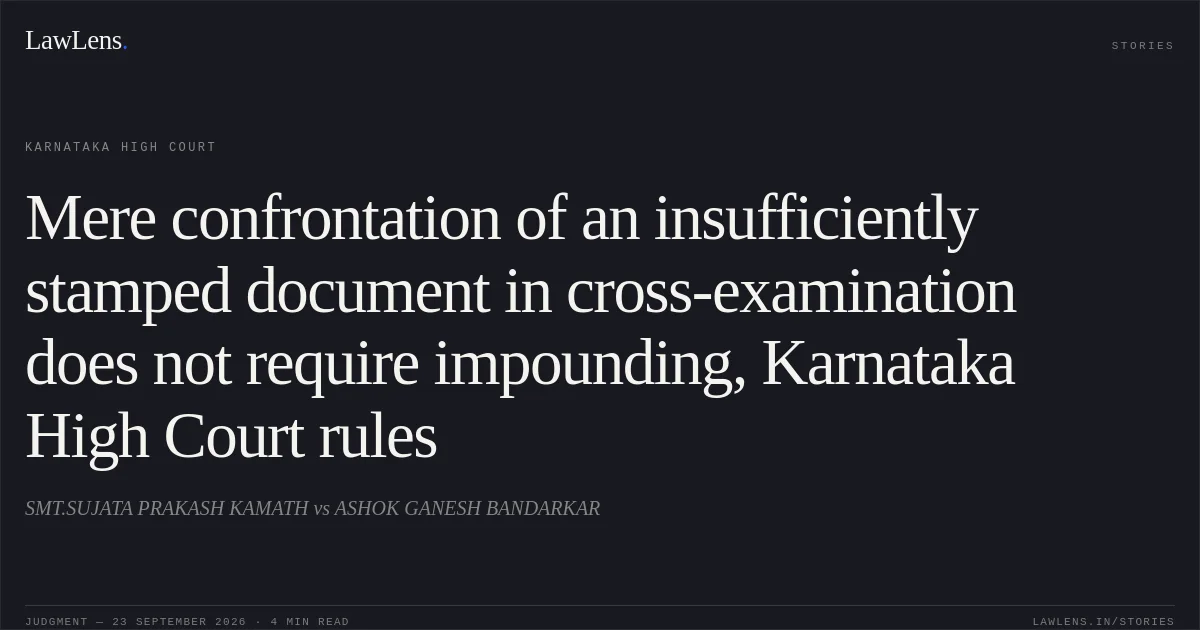
Source reference: paras. 2–3During the cross-examination of defendant No.2, one of the alleged principals, the petitioner confronted him with a General Power of Attorney dated 4 November 2012, which he admitted.
Source reference: paras. 1, 3–4On an objection raised by co-defendants, the Trial Court impounded the GPA on the ground that it was insufficiently stamped and directed payment of deficit stamp duty and penalty.
Source reference: paras. 1, 3–4The petitioner challenged the Trial Court’s orders dated 4 September 2018 and 12 July 2019 under Articles 226 and 227 of the Constitution.
Source reference: p. 2; para. 1Issues
1. Whether mere production and confrontation of an insufficiently stamped GPA to a witness during cross-examination amounts to tendering or admitting the instrument as substantive evidence, thereby attracting Sections 33 and 34 of the Karnataka Stamp Act, 1957.
Source reference: paras. 4–5, 12–152. Whether the Trial Court could suo motu impound the GPA merely because it came into the Court’s view during cross-examination, when it remained in the party’s custody and was not tendered as substantive evidence.
Source reference: paras. 29–323. Whether the GPA, having culminated in and merged with a duly stamped and registered sale deed, could independently be subjected to stamp duty and penalty in the circumstances of the case.
Source reference: para. 45(XIV)Law Applied
The Court applied Order VII Rule 14(4) and Order VIII Rule 1-A(4) of the Code of Civil Procedure, which exempt documents produced for cross-examination or for refreshing a witness’s memory from the ordinary requirement of prior production with the pleadings.
Source reference: paras. 6–7It distinguished confrontation, identification, marking and formal admission in evidence, noting that Order XIII Rule 4 concerns documents judicially admitted in evidence.
Source reference: paras. 16, 33–34Sections 33 and 34 of the Karnataka Stamp Act, 1957 require an insufficiently stamped instrument to be examined and, where appropriate, impounded when it is tendered as substantive evidence; Sections 35 and 37 govern the consequences of admission and impounding.
Source reference: paras. 17–18, 22–24Section 145 of the Indian Evidence Act, 1872 permits a witness to be confronted with prior written statements, while Section 155 concerns impeachment of credibility.
Source reference: paras. 11–12The Court relied on Javer Chand v. Pukhraj Surana, AIR 1961 SC 1655, and Ram Rattan v. Bajrang Lal, AIR 1978 SC 1393, for the distinction between tendering a document, tentative marking and judicial determination of admissibility; G.M. Shahul Hameed v. Jayanthi R. Hegde, 2024 INSC 493, for the proposition that judicial determination—not mere mechanical marking—controls admissibility consequences under the Stamp Act; Suman v. Vinayak, W.P. No. 60926/2011, regarding the statutory sequence for impounding; and Nagamma v. Rudrayya, W.P. No. 105278/2018, for the principle that an agreement or authority instrument culminating in a duly stamped and registered sale deed cannot ordinarily be subjected to independent stamp duty after merger in the subsequent instrument.
Source reference: paras. 20–24, 45(IX)–(XIV)Reasoning
The Court held that the GPA was brought before the Trial Court only as an instrument of cross-examination, to obtain an admission from defendant No.2 regarding the authority allegedly conferred on defendant No.5, and not to prove the GPA itself as substantive documentary evidence.
Source reference: paras. 35–40Under Order VII Rule 14(4) and Order VIII Rule 1-A(4), such use during cross-examination does not amount to formal admission of the document or proof of the transaction recorded in it.
Source reference: paras. 6–10The Court emphasized that confrontation may establish the witness’s response, contradiction or admission, but the document does not thereby become substantive evidence of the transaction.
Source reference: paras. 11–15Since the petitioner’s asserted title flowed from the subsequent registered sale deed, and she was not independently seeking relief on the strength of the GPA, the Trial Court erred in treating its mere confrontation as tendering the instrument in evidence.
Source reference: paras. 36–44The Court further noted that the GPA had culminated in the duly stamped and registered sale deed, providing additional support against its independent impounding in the circumstances.
Source reference: para. 45(XIV)The Court clarified, however, that if the petitioner later sought to rely on the GPA itself to establish the authority, transaction or rights arising from it, the Trial Court would have to determine its admissibility and apply the Stamp Act.
Source reference: paras. 27–28, 43Holding
The writ petition was allowed in part.
The order dated 12 July 2019 was set aside insofar as it impounded the GPA dated 4 November 2012 and directed the petitioner to pay deficit stamp duty and penalty.
Source reference: para. 46(ii)The Court held that mere confrontation of the GPA to defendant No.2 during cross-examination, for the purpose of eliciting an admission regarding defendant No.5’s authority, did not amount to tendering or admitting it as substantive evidence.
Source reference: para. 46(iii)The Trial Court was directed to proceed with O.S. No.4/2016 expeditiously from the stage at which the proceedings stood, and pending interlocutory applications were disposed of accordingly.
Source reference: paras. 46(iv)–(v)Acts & Sections Cited
4 provisions across 1 statute referred to in this judgment. Each provision opens on LawLens.
KARNATAKA STAMP ACT, 19574
Original Court PDF
SMT.SUJATA PRAKASH KAMATHvsASHOK GANESH BANDARKAR
Click to open original judgment
Original judgment, available to read, download and summarize on LawLens.in