Facts
Rajbeer, along with Prem and Naresh, was convicted under Sections 148 and 302 read with Section 34 IPC by the Sessions Court, Haridwar, on 29 January 2003. His criminal appeal was dismissed by the High Court on 24 May 2012, and the Supreme Court dismissed his further appeal on 3 August 2012.
Source reference: paras. 1–2In 2025, Rajbeer raised a claim of juvenility, asserting that he was born on 10 July 1981 and was therefore 14 years, 6 months and 22 days old on the date of the incident, 1 February 1996.
Source reference: para. 3Pursuant to the High Court’s directions, the Registrar (Judicial) conducted an inquiry, examined the relevant school and official records, and concluded that Rajbeer’s date of birth was 10 July 1981.
Source reference: paras. 4–5, p. 3The State accepted the inquiry report and did not dispute the claimed date of birth.
Source reference: para. 8, p. 3Issues
Whether Rajbeer’s claim of juvenility could be raised and determined after his conviction, dismissal of his appeal, and dismissal of his Special Leave Appeal
Source reference: paras. 9–11, pp. 3–4Whether Rajbeer was a juvenile on the date of commission of the offence, having regard to the Registrar (Judicial)’s inquiry and report
Source reference: paras. 12–13, pp. 4–5Whether, after declaring Rajbeer a juvenile, the Court could sustain his conviction but quash the sentences imposed upon him
Source reference: paras. 14–18, pp. 5–8Law Applied
Section 2(h) of the Juvenile Justice Act, 1986 defined a juvenile boy as a person below sixteen years of age on the date of the incident.
Source reference: para. 9, p. 3Section 7A of the Juvenile Justice (Care and Protection of Children) Act, 2000 permits a claim of juvenility to be raised before any court at any stage, including after final disposal of the case, and requires the court to conduct an inquiry into age; once juvenility is established, the sentence imposed by the criminal court has no effect.
Source reference: para. 10, pp. 3–4In Hari Ram v. State of Rajasthan, (2009) 13 SCC 211, the Supreme Court held that persons below eighteen years on the date of the offence committed before 1 April 2001 are entitled to the benefit of the 2000 Act, even where juvenility is claimed after conviction.
Source reference: para. 15, p. 7Relying on Raju v. State of Haryana, (2019) 14 SCC 401, the Court held that an inquiry conducted by the Registrar (Judicial), when directed and subsequently judicially affirmed by the Court, constitutes an inquiry by the Court itself.
Source reference: para. 12, pp. 4–5Following Pawan Kumar v. State of Uttar Pradesh, (2023) 15 SCC 683, the Court applied the principle that the conviction may be sustained where it is supported by the evidence, but the sentence must be quashed because a juvenile cannot be subjected to the sentence imposed on an adult offender under the 2000 Act.
Source reference: para. 14, pp. 5–7Reasoning
The incident occurred on 1 February 1996, when the 1986 Act was formally applicable; however, the claim was adjudicated under the 2000 Act because Section 7A expressly permits a plea of juvenility at any stage and Hari Ram makes the beneficial provisions of the 2000 Act applicable to persons below eighteen on the date of the offence.
Source reference: paras. 9–11, 15–16, pp. 3–4, 7The Registrar (Judicial) conducted a detailed inquiry into the school and official records and found Rajbeer’s date of birth to be 10 July 1981. The High Court independently considered and accepted that report, thereby determining that Rajbeer was 14 years, 6 months and 22 days old on the date of the offence.
Source reference: paras. 5, 12–13, pp. 3–5Since the evidence supporting the conviction was common to Rajbeer and his co-accused, the Court followed Pawan Kumar and declined to disturb the conviction.
Source reference: paras. 14, 17–19, pp. 5–8Nevertheless, the sentence could not legally operate against a person declared juvenile, and Rajbeer had already undergone more than fourteen years’ imprisonment, well beyond the maximum three-year period recognised under the applicable juvenile justice provisions.
Source reference: paras. 14, 17–19, pp. 5–8Holding
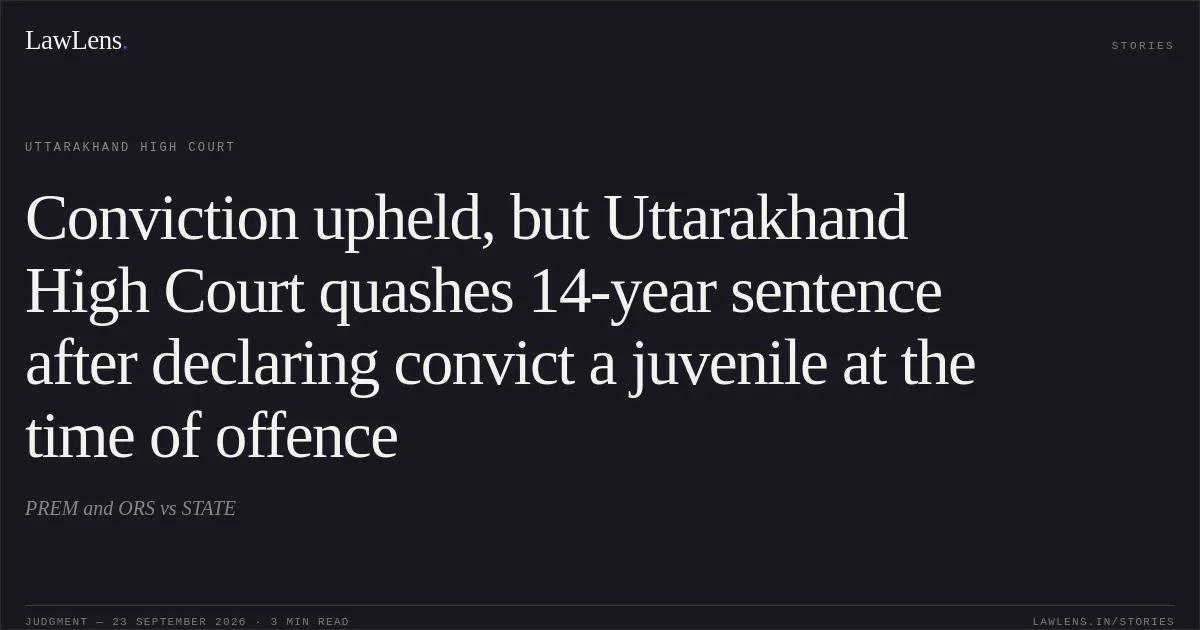
The Court allowed Rajbeer’s claim of juvenility and declared that he was a juvenile in conflict with law on 1 February 1996.
His conviction under Sections 148 and 302 read with Section 34 IPC was sustained, but all sentences imposed upon him were quashed because such sentences could not be imposed on a juvenile under the Juvenile Justice Act, 2000.
Source reference: paras. 17–18, p. 8As Rajbeer had already undergone more than the maximum permissible period of detention, the Court directed his immediate release, unless he was required in any other case.
Source reference: paras. 19–20, p. 8Acts & Sections Cited
4 provisions across 1 statute referred to in this judgment. Each provision opens on LawLens.
Indian Penal Code, 18604
Original Court PDF
PREM and ORSvsSTATE
Click to open original judgment
Original judgment, available to read, download and summarize on LawLens.in