Facts
The petitioner sought layout approval for land measuring 2 acres 12 cents, equivalent to 8,570 sq. m., in Iluppakudi Village, Madurai District.
Source reference: paras. 4–9Her earlier application resulted in a road pattern dated 19.02.2026 requiring reservation and transfer of the OSR/park area to the local body by registered gift deed.
Source reference: paras. 4–9A subsequent application dated 03.06.2026 was returned through proceedings dated 27.07.2026, which reiterated the OSR requirement.
Source reference: paras. 4–9The respondents argued that the present land was adjoining another extent of 2 acres 40 cents, both parcels having been purchased by the petitioner on 08.10.2025.
Source reference: paras. 19–23Since the adjoining parcel had obtained layout approval on 29.11.2025, the respondents treated the two parcels as one composite development exceeding 10,000 sq. m., thereby making physical OSR reservation mandatory.
Source reference: paras. 19–23Issues
1. Whether the communication dated 27.07.2026 was amenable to judicial review notwithstanding the respondents’ contention that it merely returned the file at the petitioner’s request?
Source reference: para. 25(i)2. Whether the petitioner’s extent of 8,570 sq. m. had to be assessed independently or aggregated with the adjoining extent earlier approved in the vendor’s name for determining the applicable OSR requirement?
Source reference: para. 25(ii)3. Whether the insistence upon physical OSR reservation and execution of a gift deed violated the Tamil Nadu Combined Development and Building Rules, 2019, natural justice, Article 14, or Article 300-A of the Constitution?
Source reference: para. 25(iii)4. Whether the petitioner was entitled to a direction for layout approval upon payment of guideline value in lieu of physical OSR reservation?
Source reference: para. 25(iv)Law Applied
The Court applied Rules 41(1) and 47(6) of the Tamil Nadu Combined Development and Building Rules, 2019.
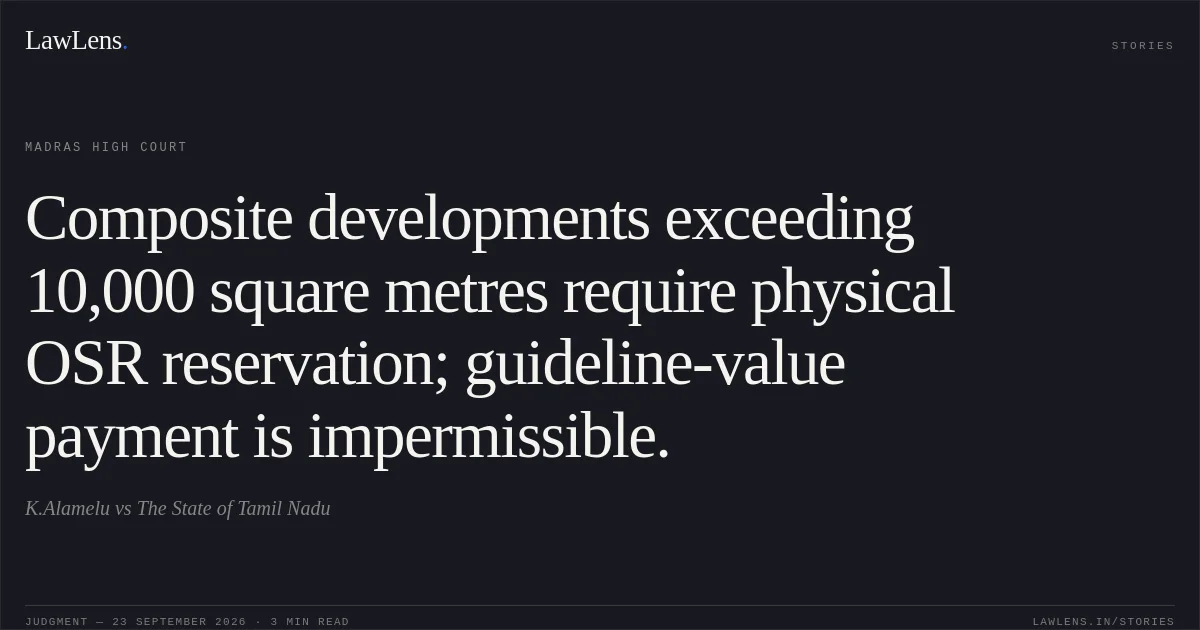
Source reference: para. 26Under these provisions, no OSR reservation is required for the first 3,000 sq. m.; for layouts between 3,000 and 10,000 sq. m., 10% reservation is required but payment of the guideline value of equivalent land is permitted as an alternative; and for developments above 10,000 sq. m., physical reservation and transfer of the OSR land by gift deed are mandatory, with no monetary substitute permissible.
Source reference: para. 26The Court held that the statutory alternative cannot be invoked by artificially fragmenting one integrated development into separate applications below the threshold.
Source reference: paras. 29–30However, mere common ownership alone does not justify aggregation; relevant connecting factors such as contiguity, common acquisition, common access or design, temporal proximity, common development purpose, and evidence of fragmentation must be considered.
Source reference: para. 31Administrative circulars may guide implementation and valuation but cannot override the express statutory prohibition applicable to developments exceeding 10,000 sq. m.
Source reference: para. 36The Court also applied the principles that natural justice generally requires a meaningful opportunity to respond, rather than an oral hearing in every planning matter, and that Article 300-A permits regulation of property through valid statutory authority.
Source reference: paras. 37–38, 41–42Reasoning
The Court held that the communication dated 27.07.2026 was reviewable because, although it returned the file at the petitioner’s request, it substantively reiterated the OSR condition imposed by the road pattern dated 19.02.2026.
Source reference: para. 27On the substantive issue, the Court found compelling connecting factors: the parcels were adjoining, both had been purchased by the petitioner on the same date, the vendor obtained approval for the adjoining parcel after title had passed to the petitioner, and the petitioner subsequently pursued development of the remaining extent.
Source reference: para. 32These circumstances justified treating the parcels as one composite development rather than separate layouts.
Source reference: para. 32Since the combined extent exceeded 10,000 sq. m., the mandatory physical-reservation requirement under Rules 41(1)(c) and 47(6) applied, and payment of guideline value was unavailable.
Source reference: para. 34The Court further held that the OSR condition was neither arbitrary nor beyond jurisdiction, that the petitioner had suffered no actionable denial of natural justice, and that the requirement was imposed under statutory authority and therefore did not violate Articles 14 or 300-A.
Source reference: paras. 35–42Holding
The Court upheld the road pattern dated 19.02.2026 and the consequential communication dated 27.07.2026.
It held that the adjoining parcels could validly be treated as a composite development exceeding 10,000 sq. m.; consequently, physical OSR reservation and transfer of the reserved land to the local body by registered gift deed were mandatory, and payment of guideline value could not be accepted in lieu thereof.
Source reference: paras. 44–45The prayer for a direction to grant layout approval was rejected because statutory compliance remained outstanding.
Source reference: para. 43The writ petition was dismissed without costs, and the connected miscellaneous petitions were closed.
Source reference: para. 47Original Court PDF
K.AlameluvsThe State of Tamil Nadu
Click to open original judgment
Original judgment, available to read, download and summarize on LawLens.in