Facts
The petitioner claimed ownership of Khasra No. 924 at Village Partala, District Jabalpur, on which approximately 50 old and valuable trees were allegedly standing. Respondent No. 5 allegedly cut and removed the trees without the petitioner’s knowledge, consent, or permission. The petitioner asserted that the alleged acts disclosed cognizable offences under Sections 303(1) and 303(2) of the Bharatiya Nyaya Sanhita, 2023, Section 18 of the Madhya Pradesh Vrikshon Ka Pariraksha (Nagariya Kshetra) Adhiniyam, and Sections 26 and 33 of the Indian Forest Act, 1927. Complaints were submitted to the Station House Officer, Police Station Barela, and the Superintendent of Police, Jabalpur, but no FIR was registered or effective action taken. The petitioner therefore invoked Section 528 of the BNSS, 2023/Section 482 of the CrPC seeking directions to the police authorities to decide the complaints and register an FIR.
Source reference: paras. 1–2; pp. 1–2The State opposed the petition on the ground that the petitioner had an efficacious alternative remedy before the competent Magistrate under Sections 156(3), 200 and 202 of the CrPC.
Source reference: para. 3; p. 2Issues
1. Whether the High Court should exercise its inherent jurisdiction under Section 528 of the BNSS, 2023/Section 482 of the CrPC to direct the police to register an FIR and investigate when the petitioner has not availed the statutory remedy before the Magistrate?
Source reference: paras. 3–5, 8–10; pp. 2–152. Whether the petitioner should be relegated to the remedies under the corresponding provisions of the CrPC/BNSS, including approaching the Superintendent of Police and thereafter the Magistrate under Section 156(3) of the CrPC/Section 175 of the BNSS?
Source reference: paras. 5–8, 10–11; pp. 3–16Law Applied
The Court applied the principle that where information discloses a cognizable offence, registration of an FIR is mandatory under Lalita Kumari v. Government of Uttar Pradesh, (2014) 2 SCC 1, subject to the statutory remedies available for non-registration.
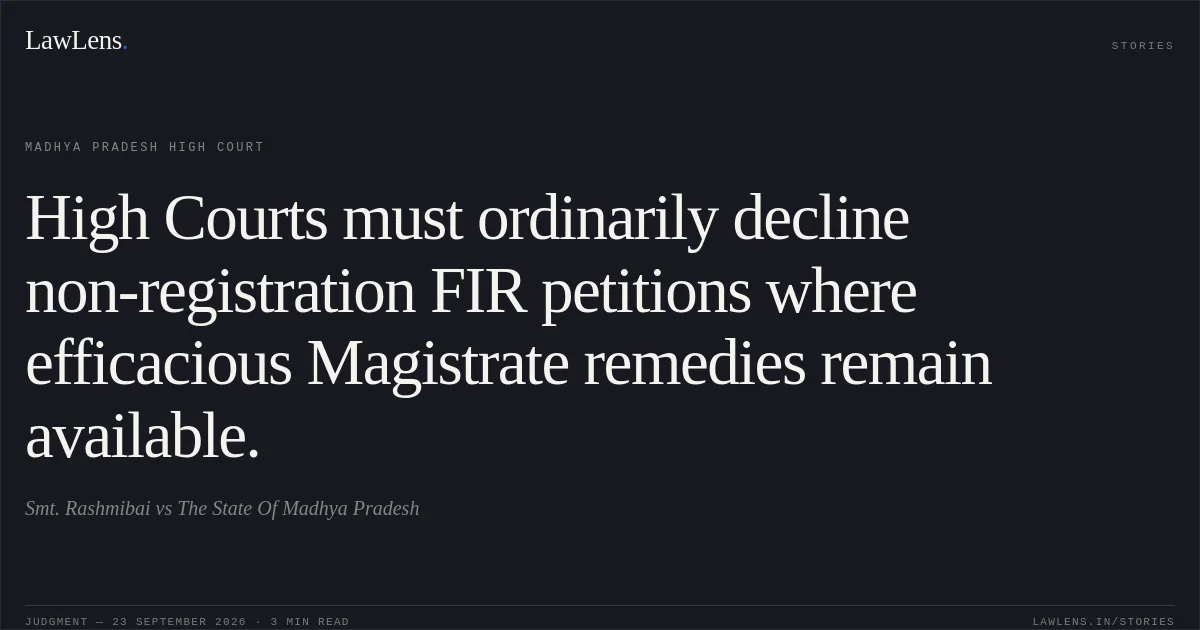
Source reference: paras. 5–8; pp. 3–15Under Section 154(3) of the CrPC, corresponding to Section 173 of the BNSS, an aggrieved person may approach the Superintendent of Police; thereafter, Section 156(3) of the CrPC, corresponding to Section 175 of the BNSS, empowers the Magistrate to direct registration of an FIR and ensure a proper investigation. The Court relied principally on Sakiri Vasu v. State of U.P., (2008) 2 SCC 409, which held that the Magistrate possesses wide supervisory powers under Section 156(3) and that the High Court should ordinarily discourage petitions under Article 226 or Section 482 concerning non-registration or improper investigation. The same principle was reaffirmed in Sudhir Bhaskarrao Tambe v. Hemant Yashwant Dhage, (2016) 6 SCC 277, M. Subramaniam v. S. Janaki, Criminal Appeal No. 102 of 2011, decided on 20 March 2020, Shweta Bhadoriya v. State of M.P., (2017) 1 MPLJ (Cri) 338, and Ashwini Kumar Upadhyay v. Union of India, 2026 LiveLaw (SC) 437. The petitioner also had the alternative remedy of filing a complaint under Section 200 of the CrPC, corresponding to Section 223 of the BNSS.
Source reference: paras. 5–8; pp. 3–15Reasoning
Although the allegations concerning unauthorized removal of trees could potentially disclose cognizable offences, the Court held that the immediate grievance was non-registration of an FIR and failure to investigate, for which the CrPC/BNSS provide a complete statutory mechanism. The petitioner had approached the police authorities but had directly invoked the High Court’s inherent jurisdiction without pursuing the remedy before the Magistrate under Section 156(3) of the CrPC/Section 175 of the BNSS.
Source reference: paras. 5–10; pp. 3–15Applying Sakiri Vasu and the subsequent authorities, the Court found that the Magistrate was competent to direct registration of an FIR, order a proper investigation, and monitor the investigation where necessary. The availability of that efficacious alternative remedy warranted refusal to exercise the High Court’s inherent jurisdiction.
Source reference: paras. 5–10; pp. 3–15Holding
The High Court declined to entertain the petition because the petitioner had not availed the efficacious statutory remedies under the CrPC/BNSS.
The petition was accordingly dismissed. However, the petitioner was granted liberty to approach the competent Magistrate under the applicable provisions of the CrPC/BNSS for redressal of the grievance, including seeking appropriate directions regarding registration of the FIR and investigation.
Source reference: paras. 10–11; p. 16Acts & Sections Cited
22 provisions across 4 statutes referred to in this judgment. Each provision opens on LawLens.
Bharatiya Nagarik Suraksha Sanhita, 20238
Code of Criminal Procedure, 1973
Bharatiya Nyaya Sanhita, 20231
Indian Forest Act, 19272
Original Court PDF
Smt. RashmibaivsThe State Of Madhya Pradesh
Click to open original judgment
Original judgment, available to read, download and summarize on LawLens.in