Facts
The petitioners had executed documents titled “Revenue Share Agreements” with the respective property owners for conducting commercial businesses in identified premises.
Source reference: paras. 4, 28–33The agreements provided for immediate delivery of possession, use of the premises for an initial period of nine years with a further six-year renewal period, payment calculated as a percentage of turnover subject to a minimum amount, restrictions on termination, and uninterrupted use of the premises.
Source reference: paras. 4, 28–33The agreements were adjudicated and stamped under Article 5(h)(A)(iv)(b) of the Maharashtra Stamp Act, 1958, and were thereafter registered.
Source reference: paras. 4, 28–33Following an audit objection, the authorities took the view that the documents were, in substance, leases for fifteen years and ought to have been assessed under Article 36(iii) of the Act.
Source reference: paras. 11–19In respect of one document, the authority determined an alleged deficit stamp duty of Rs.8,14,809 and directed payment within ten days.
Source reference: paras. 11–19The petitions under Article 227 of the Constitution challenged the order dated 14 October 2016 passed by the Chief Controlling Revenue Authority, Maharashtra State, Pune, holding that the documents were chargeable as leases under Article 36.
Source reference: paras. 1–4, 9Issues
Whether the documents described as “Revenue Share Agreements” were, in substance and effect, leases creating a present right to possess and use the identified premises, or merely agreements creating contractual rights and obligations chargeable under Article 5(h)(A)(iv)(b) of the Maharashtra Stamp Act, 1958?
Source reference: paras. 20–27, 47–48Whether the stamp duty on the documents was properly assessable under Article 36 of the Maharashtra Stamp Act, 1958, rather than under the residuary provision in Article 5(h)(A)(iv)(b)?
Source reference: paras. 43–49Whether the subsequent non-commencement of business, cancellation of the agreements, or the clause disclaiming the creation of a leasehold interest altered the character of the documents for stamp-duty purposes?
Source reference: paras. 38–42, 50–53Law Applied
The Court applied Article 227 of the Constitution in considering whether interference with the impugned orders was warranted.
Source reference: paras. 2, 54Under the Maharashtra Stamp Act, 1958, Article 5(h)(A)(iv)(b) applies residually to an instrument creating an obligation, right or interest having monetary value only where the instrument is not covered by another article; Article 36 specifically governs leases.
Source reference: para. 43The Court relied principally on State of Maharashtra v. Atur India (P) Ltd., (1994) 2 SCC 497, which distinguishes a lease from an agreement for lease: a lease conveys an estate in land, creates a present tenancy or possessory interest, and must be identified from the intention of the parties and the instrument read as a whole.
Source reference: paras. 22–27, 35–37, 46The nomenclature of an instrument is not determinative; its true legal effect, including whether it effects a present demise, governs its classification and stamp duty.
Source reference: paras. 21, 24, 40, 46Reasoning
The Court read the agreements as a whole and found that they did more than create reciprocal contractual obligations.
Source reference: paras. 28–31, 34The agreements contemplated immediate delivery of vacant and peaceful possession, granted the petitioners the right to use the premises for a fixed and substantial period, required the owners to permit uninterrupted commercial use, and restricted termination or recovery of possession during the agreed term.
Source reference: paras. 28–31, 34The turnover-based consideration and refundable security deposit did not negate the existence of a lease; they merely described the method of calculating consideration and securing performance.
Source reference: paras. 32–33Although one clause stated that no tenancy or leasehold interest was intended, that clause could not override the operative provisions that created present possession and enjoyment of the premises.
Source reference: paras. 38–40Since the instruments were, in substance, leases, Article 36 was the specific applicable provision and the residuary Article 5 provision could not be invoked.
Source reference: paras. 43, 47–49The subsequent failure to commence business and the later cancellation of the agreements were events subsequent to execution and did not alter the nature of the rights created by the original instruments for determining stamp duty.
Source reference: paras. 41–42, 50–53Holding
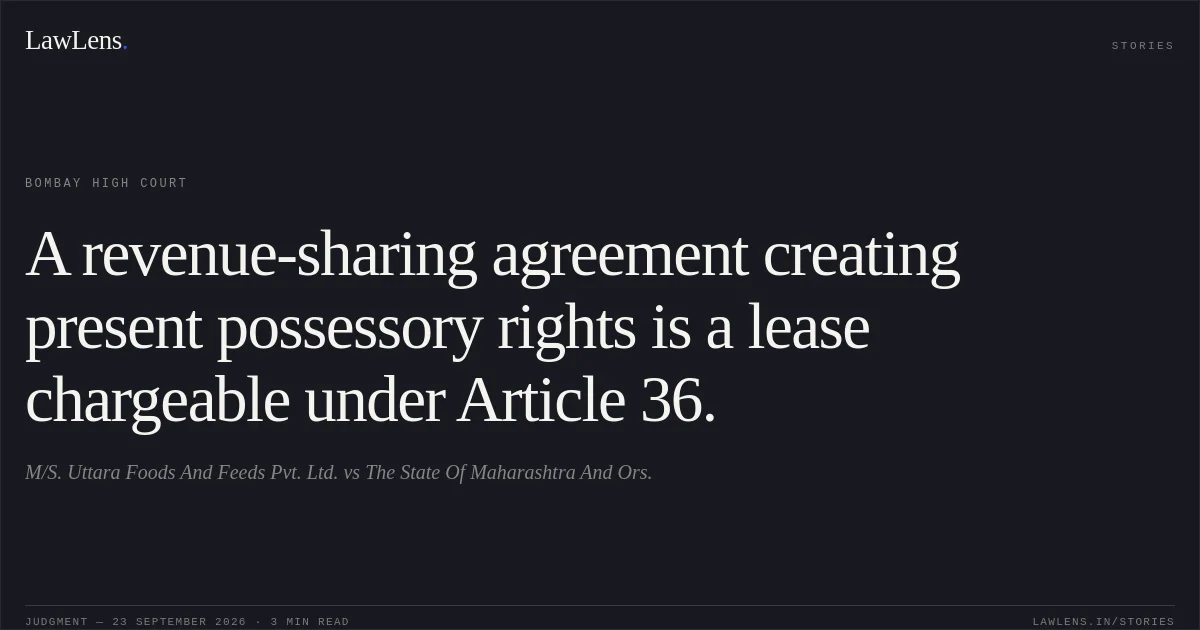
The Court held that the “Revenue Share Agreements” were, in substance and effect, leases because they created present and continuing rights of possession and enjoyment of the identified premises for the agreed period.
They were therefore chargeable to stamp duty under Article 36 of the Maharashtra Stamp Act, 1958, and not under Article 5(h)(A)(iv)(b).
Source reference: paras. 47–54The challenges to the orders of the Chief Controlling Revenue Authority were rejected, and all four writ petitions—W.P. Nos. 4110 of 2017, 4109 of 2017 and W.P. (St.) Nos. 7952 and 7954 of 2017—were dismissed.
Source reference: para. 55Any ad-interim relief was continued for four weeks from the date of judgment.
Source reference: paras. 56–57Acts & Sections Cited
3 provisions across 1 statute referred to in this judgment. Each provision opens on LawLens.
Bombay Stamp Act, 19583
Original Court PDF
M/S. Uttara Foods And Feeds Pvt. Ltd.vsThe State Of Maharashtra And Ors.
Click to open original judgment
Original judgment, available to read, download and summarize on LawLens.in