Facts
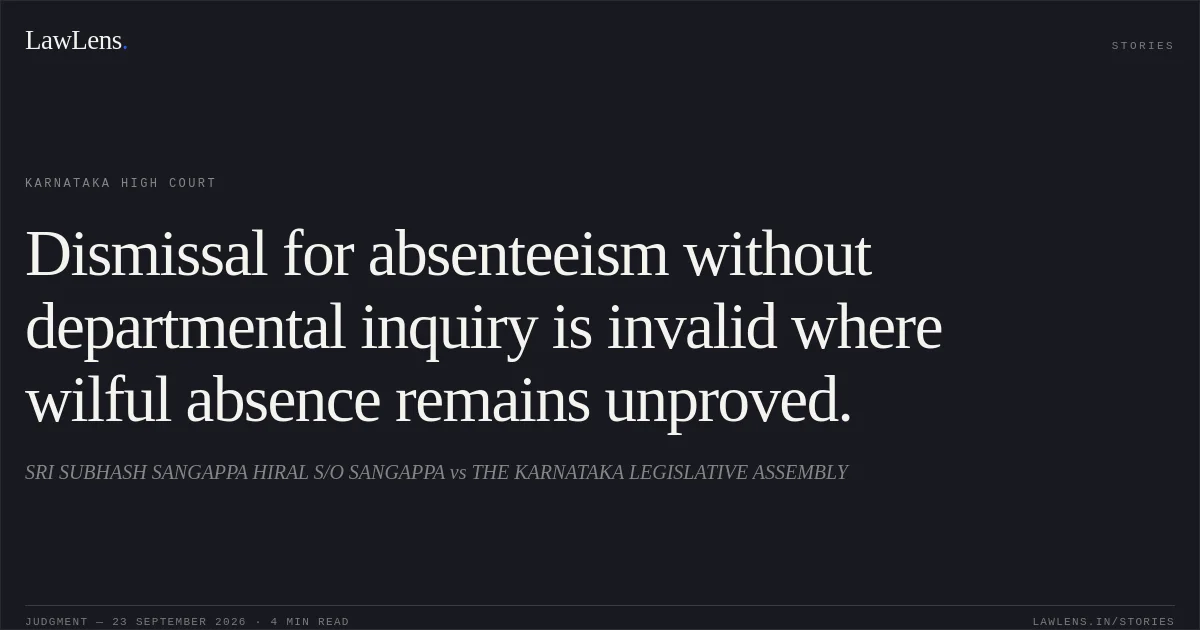
The petitioner was appointed as a Dalayat in the Karnataka Legislative Assembly on 18 November 2009 under Rule 6(ii) of the Karnataka Legislative Assembly (Selection and Service Condition) Rules, 2003, and his probation was declared on 8 December 2011.
Source reference: para. 2.1–2.2He was alleged to have remained absent without authorisation for 119 days from 3 October 2019 to 29 January 2020 and for 374 days from 6 March 2020 to 14 March 2021.
Source reference: para. 2.4In response to the notice dated 19 May 2020, the petitioner admitted the absence but explained that he had suffered serious health problems, had been hospitalised, was unable to bear the cost of treatment, and had consequently returned to his native place.
Source reference: para. 2.3–2.4The second respondent dismissed him from service without conducting a departmental enquiry, reasoning that his admission of unauthorised absence rendered an enquiry unnecessary and that the medical documents did not satisfactorily establish the nature or severity of his illness.
Source reference: para. 2.5–2.6The petitioner challenged the dismissal under Articles 226 and 227 of the Constitution, seeking quashing of the order, reinstatement, treatment of the dismissal period as duty, and consequential monetary and service benefits.
Source reference: prayer clause; paras. 1–2Issues
1. Whether the disciplinary authority could impose the major penalty of dismissal for alleged unauthorised absence without conducting the departmental enquiry mandated by Rule 11 of the Karnataka Civil Service (Classification, Control and Appeal) Rules, 1957?
Source reference: paras. 2.6, 10, 19–202. Whether the petitioner’s admitted absence necessarily constituted wilful absenteeism and misconduct, despite his explanation that the absence resulted from illness and hospitalisation?
Source reference: paras. 7–11, 15–173. Whether dismissal from service was disproportionate to the misconduct alleged in the facts and circumstances of the case?
Source reference: paras. 12–13, 18, 20Law Applied
The Court applied Rule 11 of the Karnataka Civil Service (Classification, Control and Appeal) Rules, 1957, which requires an enquiry before imposing major penalties, including dismissal, removal or reduction in rank, and prescribes the procedure for framing charges, receiving the employee’s defence, recording evidence and returning findings.
Source reference: para. 19It relied on Krushnakant B. Parmar v. Union of India, (2012) 3 SCC 178, for the principle that unauthorised absence is not automatically wilful absence; the disciplinary authority must establish that the absence was deliberate and wilful, particularly where illness, accident or hospitalisation may constitute compelling circumstances.
Source reference: paras. 7–8It further relied on Reena Rani v. State of Haryana, (2012) 10 SCC 215, and the principles in Union of India v. Tulsiram Patel, that dispensing with a departmental enquiry requires legally sustainable reasons and cannot rest on the disciplinary authority’s ipse dixit.
Source reference: para. 9The Court also applied the principles of natural justice and audi alteram partem, as well as the doctrine of proportionality, under which a constitutional court may interfere where the punishment is shockingly disproportionate to the misconduct.
Source reference: paras. 12–14, 20Reasoning
The Court held that the petitioner’s admission established, at most, that he had remained absent without prior permission; it did not conclusively establish that the absence was wilful.
Source reference: paras. 2.4, 4, 10–13His explanation attributed the absence to illness, hospitalisation, financial hardship and the absence of family support at Bengaluru, and the medical documents and photograph produced before the Court prima facie supported that explanation.
Source reference: paras. 2.4, 4, 10–13Whether those circumstances genuinely prevented him from reporting for duty, and whether his conduct amounted to wilful absenteeism, required determination through the procedure prescribed by Rule 11.
Source reference: paras. 10–11, 19–20The disciplinary authority therefore erred in treating the admission of unauthorised absence as dispensing with the need for an enquiry.
Source reference: paras. 10–11, 19–20The Court further found that the dismissal was imposed in haste, without affording the petitioner a proper opportunity to contest the allegation or establish that the absence was involuntary.
Source reference: paras. 15–18, 20This violated natural justice and the statutory disciplinary procedure.
Source reference: paras. 15–18, 20Although the petitioner’s failure to obtain prior permission constituted some misconduct, the circumstances did not justify the extreme penalty of dismissal, particularly when the alleged absence was not shown to be wilful.
Source reference: paras. 15–18, 20Holding
The writ petition was allowed.
The dismissal order dated 5 July 2023 was quashed and set aside.
Source reference: para. 21(i)–(ii)The matter was remanded to the second respondent to conduct a proper enquiry into the allegation of absenteeism under Rule 11 of the 1957 Rules, after granting the petitioner a reasonable opportunity of defence and considering the observations of the Court.
Source reference: para. 21(iii), (v)The respondents were directed to reinstate the petitioner and permit him to rejoin duty pending the disciplinary decision.
Source reference: para. 21(iv)The entire process was directed to be completed within nine months from the date of the order.
Source reference: para. 21(vi)Original Court PDF
SRI SUBHASH SANGAPPA HIRAL S/O SANGAPPAvsTHE KARNATAKA LEGISLATIVE ASSEMBLY
Click to open original judgment
Original judgment, available to read, download and summarize on LawLens.in