Facts
M/s. MJR Steels Pvt. Ltd., of which the appellant was a director, traded in steel products and claimed to have purchased 57 consignments of M.S. items from M/s. Vinny Technocrats Pvt. Ltd. (VTPL), then sold goods to other purchasers and passed on CENVAT credit.
Source reference: p. 2–5Departmental investigation found no relevant goods or manufacturing infrastructure at VTPL and concluded that the transactions were paper transactions.
Source reference: p. 2–5The adjudicating authority imposed a penalty of ₹39,83,810 on the appellant under Rule 26(2) of the Central Excise Rules, 2002.
Source reference: p. 2–5After an earlier order was set aside and the matter remanded, the Commissioner again imposed the penalty in the de novo order dated 26 December 2017.
Source reference: p. 2–5The appellant appealed against that penalty.
Source reference: p. 2–5Issues
Whether the penalty imposed on the appellant under Rule 26(2) was sustainable where no show-cause notice had been issued to MJR Steels and the appellant was not its authorised signatory.
Source reference: p. 5–6, 9Whether the appellant’s conduct attracted Rule 26(2), and whether the truck owners’ statements could be relied on without following Section 9D of the Central Excise Act, 1944.
Source reference: p. 6–7, 10–14Law Applied
Rule 26(2) of the Central Excise Rules, 2002 permits a penalty where a person issues an excise-duty invoice without delivery of the goods, abets the making of such an invoice, or issues or abets another document on which a person is likely to claim or has claimed an ineligible benefit, including CENVAT credit.
Source reference: p. 6Under Section 9D(1) of the Central Excise Act, 1944, an investigation statement may be relied on in adjudication only in the circumstances specified in clause (a), or after the statutory procedure in clause (b) is followed, including examination of its maker and the adjudicating authority’s decision to admit the statement in evidence.
Source reference: p. 7–13The Tribunal relied on *Ambika International v. Union of India*, 2018 (361) E.L.T. 90 (P&H), on compliance with Section 9D, and *Sampad Narayan Mukherjee v. Union of India*, 2019 (366) E.L.T. 280 (Cal.), on the analogous procedure under Section 138B of the Customs Act.
Source reference: p. 7–13Reasoning
The Tribunal found that the appellant was a director but not the company’s authorised signatory, and that no show-cause notice had been issued to MJR Steels.
Source reference: p. 5–6, 9It held the penalty proceedings against him, in those circumstances, legally unsustainable.
Source reference: p. 5–6, 9It also found no finding that the appellant had issued invoices without supplying goods, or evidence that he had connived in or abetted such conduct; the supplier’s lack of manufacturing infrastructure alone did not establish that MJR Steels received no goods and passed on credit through paper transactions.
Source reference: p. 10–11, 14The purchaser companies’ credit reversals did not establish the appellant’s guilt.
Source reference: p. 7, 11–13Further, the truck owners’ statements could not be relied on because the adjudicating authority had not followed Section 9D’s mandatory procedure.
Source reference: p. 7, 11–13Holding
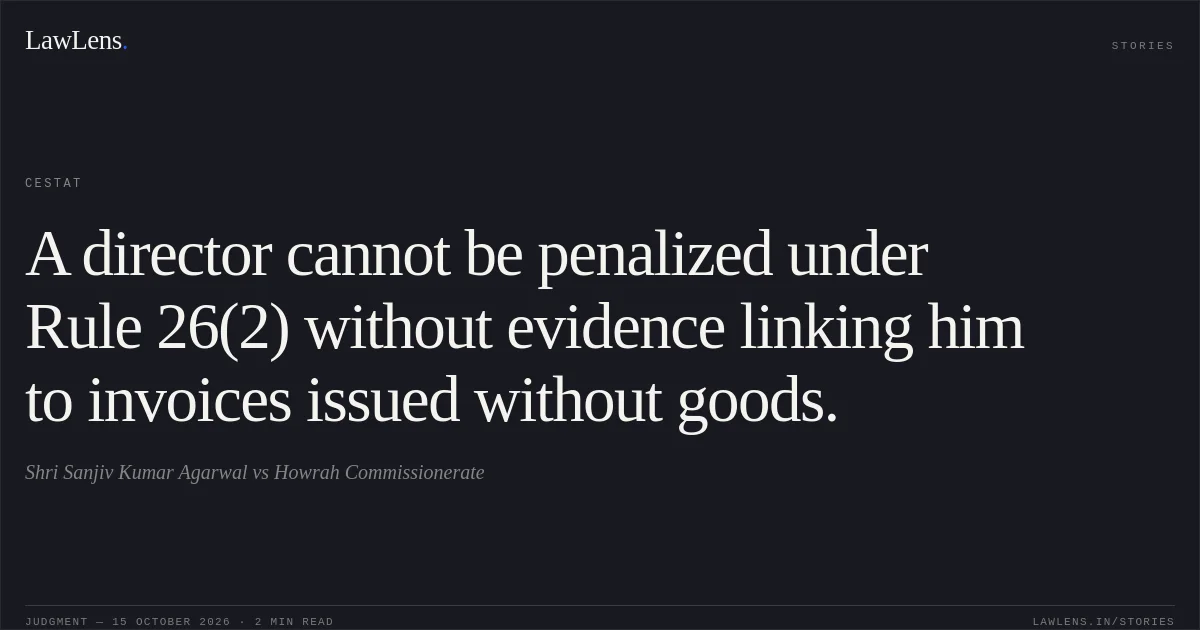
The Tribunal held that the penalty imposed on the appellant under Rule 26(2) was not legally sustainable.
It set aside the penalty of ₹39,83,810 and allowed the appeal with consequential relief, if any, as per law.
Source reference: p. 12–13Acts & Sections Cited
2 provisions across 1 statute referred to in this judgment. Each provision opens on LawLens.
Central Excise Act, 19442
Original Court PDF
Shri Sanjiv Kumar AgarwalvsHowrah Commissionerate
Click to open original judgment
Original judgment, available to read, download and summarize on LawLens.in


