01Facts
Khushi Food Limited was arraigned as accused No. 1 in Criminal Complaint No. 110464 of 2018 under the Negotiable Instruments Act, 1881, concerning dishonour of cheques issued towards outstanding payment for starch powder supplied by the complainant.
pp. 1, paras 1, 3–4The applicant, Jyoti Rajendra Sharma, was arrayed as accused No. 3 on the allegation that she was a whole-time Director of the company and was involved in its day-to-day affairs as a Director and authorised signatory.
p. 1 · ¶ 1 · p. 4 · ¶ 4The cheque was signed by accused No. 2, not by the applicant.
p. 2 · ¶ 2.1 · p. 4 · ¶ 4The complainant alleged that accused Nos. 2 to 4 were Directors managing the company’s day-to-day affairs and that they had placed the purchase order for the company.
pp. 3, paras 2–3Following proceedings before the NCLT, the company acknowledged the outstanding dues and cheques were issued pursuant to the settlement; those cheques were subsequently dishonoured, leading to the prosecution.
p. 4 · ¶ 4The applicant sought quashing of the complaint, contending that she was neither the Managing Director nor Joint Managing Director, had not signed the cheque, and was not responsible for its issuance.
p. 2 · ¶ 2.102Issues
i.Whether the complaint contained sufficient averments under Section 141 of the Negotiable Instruments Act, 1881, to invoke vicarious liability against the applicant as a Director allegedly responsible for the company’s day-to-day affairs.
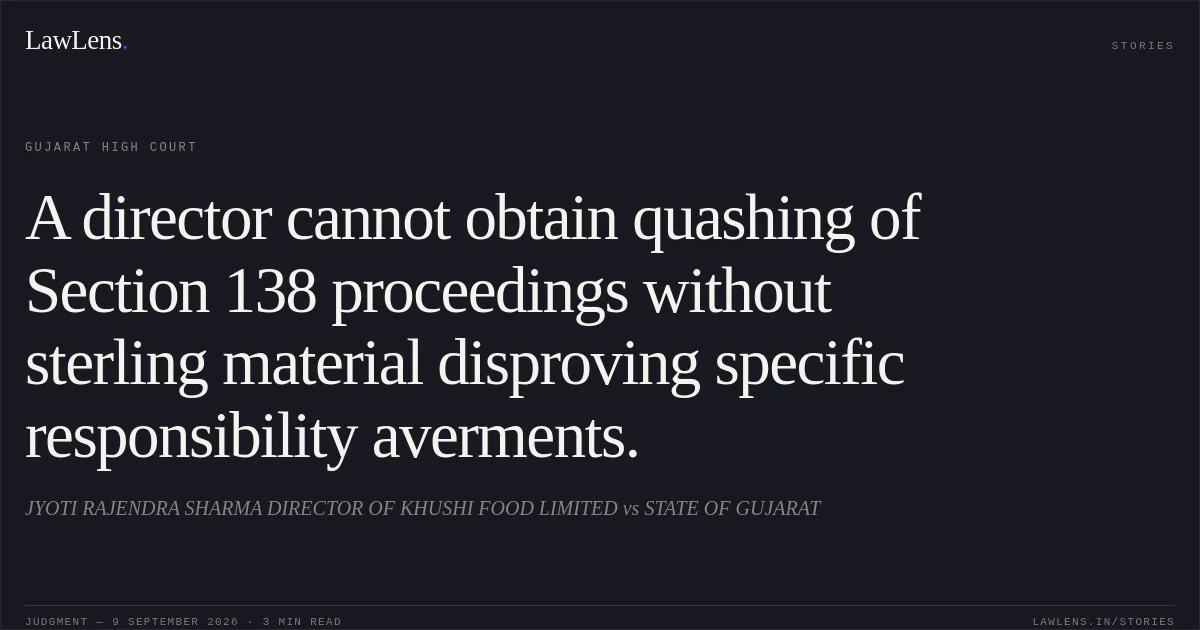
pp. 3, paras 3–4 · p. 12 · ¶ 6ii.Whether the applicant had produced sterling, incontrovertible material demonstrating that she was not involved in the company’s affairs so as to warrant quashing of the complaint at the threshold.
p. 12 · ¶ 6 · p. 13 · ¶ 7iii.Whether the applicant’s non-signatory status and her alleged status as neither Managing Director nor Joint Managing Director were sufficient grounds for quashing the proceedings.
p. 2 · ¶ 2.1 · pp. 13, paras 7–803Law Applied
Section 141 of the Negotiable Instruments Act, 1881 imposes vicarious criminal liability on persons who, at the time of the offence, were in charge of and responsible for the conduct of the company’s business; mere directorship, without the necessary factual averments, is insufficient.
pp. 5–11, paras 9–21The Court relied on S.M.S. Pharmaceuticals Ltd. v. Neeta Bhalla, Pooja Ravinder Devidasani v. State of Maharashtra, National Small Industries Corpn. Ltd. v. Harmeet Singh Paintal, Sabitha Ramamurthy v. R.B.S. Channabasavaradhya, K.K. Ahuja v. V.K. Vora, State of NCT of Delhi v. Rajiv Khurana, and Ashoke Mal Bafna v. Upper India Publishing House Pvt. Ltd., which require specific averments explaining how the accused Director was responsible for the company’s business.
pp. 5–11At the same time, under Gunmala Sales Pvt. Ltd. v. Anu Mehta, once the complaint contains the basic averment that the Director was in charge of and responsible for the company’s affairs, quashing is justified only where the Director produces sterling and incontrovertible material showing that continuation of the prosecution would amount to abuse of process.
p. 12 · ¶ 6The principles relied upon by the applicant from Susela Padmavathy Amma v. Bharti Airtel Ltd., Unique Dehydrates Ltd. v. State of Gujarat, and P.J. Agro Tech Ltd. v. Water Base Ltd. were held to apply on different factual circumstances.
pp. 2, 12–13, paras 2.1, 8Provisions in the judgment · 4 · Linked ones open on LawLens
Negotiable Instruments Act, 1881 Section 138Section 141Section 142
Code of Criminal Procedure, 1973 Section 482
04Reasoning
The Court accepted that mere designation as a Director does not automatically establish responsibility for the company’s day-to-day affairs.
However, the complaint specifically alleged that the applicant and the other Directors were managing the company’s day-to-day business and were responsible for its affairs as Directors and authorised signatories.
p. 4 · ¶ 4The company’s master data also indicated that the applicant was a whole-time Director.
p. 4 · ¶ 4Although the applicant had not signed the cheque and claimed that she was not a Managing or Joint Managing Director, those circumstances did not by themselves displace the specific allegations in the complaint at the quashing stage.
p. 2 · ¶ 2.1 · p. 13 · ¶ 7Applying Gunmala Sales, the Court held that the applicant had not produced any independent, sterling or incontrovertible material establishing that she had no involvement in the company’s affairs.
p. 12 · ¶ 6 · p. 13 · ¶ 7Whether she was in fact responsible for the conduct of the business was therefore a matter to be tested in the proceedings, and not a basis for threshold quashing.
p. 12 · ¶ 6 · p. 13 · ¶ 705Holding
The Court held that the complaint contained sufficient basic averments to prima facie attract Section 141 of the Negotiable Instruments Act against the applicant and that her non-signatory status did not, by itself, warrant quashing.
pp. 13, paras 7–8As the applicant failed to present sterling and incontrovertible material demonstrating her lack of involvement in the company’s affairs, no case for interference was made out.
p. 13 · ¶ 8Both applications were accordingly dismissed.
p. 14 · ¶ 9Original Court PDF
JYOTI RAJENDRA SHARMA DIRECTOR OF KHUSHI FOOD LIMITEDvsSTATE OF GUJARAT
Click to open original judgment
Original judgment, available to read, download and summarize on LawLens.in