01Facts
On 29 May 1999, a collision occurred between a truck and a Maruti car. The car’s driver, Vishnubhai Patel, his wife, Kokilaben Patel, and their son, Nikhil, died at the spot; their surviving son, Vaibhav, instituted claim proceedings for compensation for the deaths of his parents and brother.
¶ 1The Claims Tribunal found the truck driver 80% negligent and Vishnubhai, the car driver, 20% negligent. It awarded ₹8,63,974 for Vishnubhai’s death, based on an annual income of ₹1,33,371, and ₹15,98,000 for Kokilaben’s death, based on an annual income of ₹1,82,885.
¶ 2The insurer appealed against the award relating to Kokilaben and the finding of 80% negligence against the truck driver, while the claimant appealed against the 20% negligence attributed to Vishnubhai and the alleged inadequacy of compensation.
¶ 3–502Issues
i.Whether the Tribunal was justified in attributing 20% contributory negligence to Vishnubhai, the driver of the Maruti car, and limiting the truck owner/insurer’s liability to 80%?
¶ 6–8ii.Whether the compensation awarded for Vishnubhai’s death required enhancement by applying future prospects and the correct multiplier?
¶ 9–12iii.Whether the compensation awarded for Kokilaben’s death required reassessment on the basis of her income-tax return, future prospects and the appropriate multiplier?
¶ 13–19iv.Whether the insurer of the truck alone was liable to satisfy the compensation awarded?
¶ 11–12, 20–2103Law Applied
The Court applied the principles governing motor accident compensation under the Motor Vehicles Act, including assessment of dependency loss, deduction towards personal expenses, selection of the age-based multiplier, and apportionment of liability according to negligence.
It relied on National Insurance Co. Ltd. v. Pranay Sethi, (2017) 16 SCC 680, for addition of future prospects and determination of conventional heads of compensation such as consortium, loss of estate and funeral expenses.
¶ 10, 17The Court also applied the evidentiary principle that negligence must be assessed from the available material, including eyewitness evidence, admissions or suggestions in cross-examination, and the filing of a police charge-sheet against the truck driver.
¶ 704Reasoning
The Court held that the Tribunal had no adequate basis to attribute 20% negligence to Vishnubhai merely because the road was wide enough for both vehicles to pass.
¶ 6The truck driver, who was an eyewitness, was not examined by the insurer, whereas Vaibhav was examined and the insurer itself suggested that the truck driver was responsible. Further, the charge-sheet was filed only against the truck driver. These circumstances established that the accident was essentially caused by the truck driver’s negligence, and the finding of contributory negligence against Vishnubhai was therefore unsustainable.
¶ 7–8For Vishnubhai, the Court accepted the annual income of ₹1,33,371 based on his income-tax returns, added 40% towards future prospects, deducted one-third towards personal expenses, and applied a multiplier of 15, corresponding to his age of approximately 38 years. The resulting compensation was calculated at ₹19,58,200.
¶ 10For Kokilaben, the Court accepted her income as ₹2,10,482, as disclosed in the income-tax return, declined to deduct the comparatively minor income-tax amount in the circumstances, added 40% future prospects, deducted one-third for personal expenses, and applied a multiplier of 16 for her age of 33 years. The compensation was consequently calculated at ₹32,34,200.
¶ 14–1905Holding
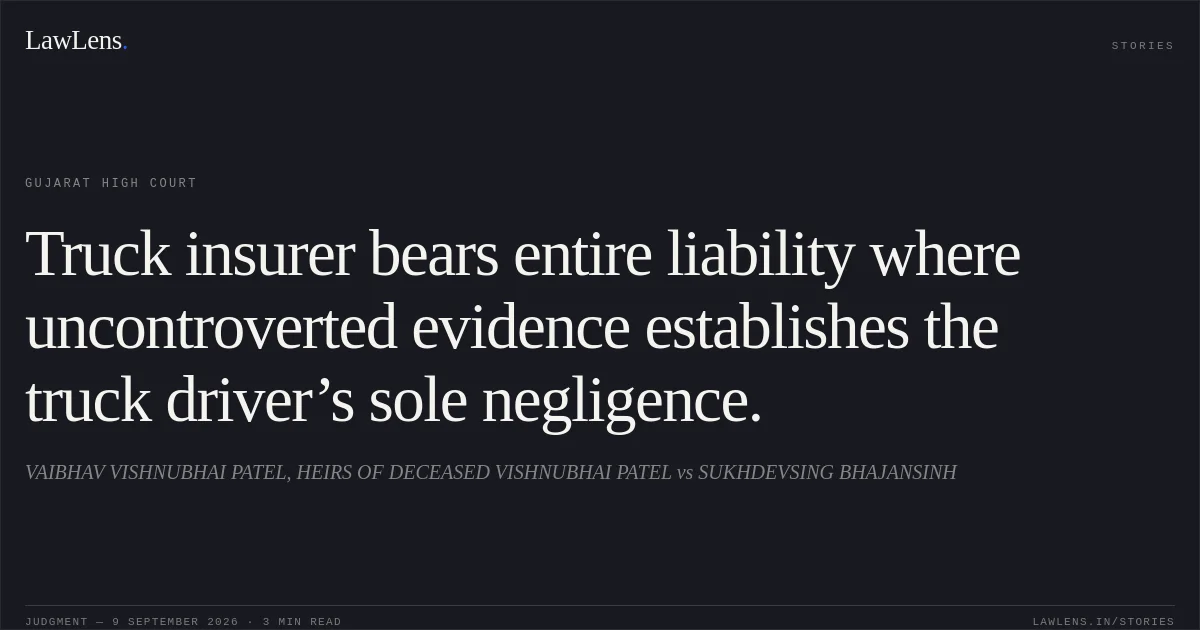
The Court set aside the finding that Vishnubhai was 20% negligent and held that the truck driver was solely responsible for the accident; accordingly, the truck’s insurer alone was liable.
¶ 8, 12The insurer’s appeal, First Appeal No. 3262 of 2010, was dismissed, while the claimants’ appeals, First Appeal Nos. 1023 of 2011 and 1025 of 2011, were allowed in part.
¶ 20The compensation for Vishnubhai was recalculated at ₹19,58,200 and that for Kokilaben at ₹32,34,200.
¶ 10, 19The tabulation records additional amounts of ₹10,94,226 for Vishnubhai and ₹16,36,200 for Kokilaben; however, paragraph 11 separately states that the Vishnubhai appeal was enhanced by ₹8,63,974, creating an apparent numerical inconsistency in the judgment.
¶ 10–11The enhanced amounts were directed to be deposited within ten weeks with interest at 9% per annum from the date of filing of the claim petition until payment.
¶ 21Original Court PDF
VAIBHAV VISHNUBHAI PATEL, HEIRS OF DECEASED VISHNUBHAI PATELvsSUKHDEVSING BHAJANSINH
Click to open original judgment
Original judgment, available to read, download and summarize on LawLens.in