Facts
The petitioner was engaged as a daily-rated Mate by the Odisha Forest Development Corporation and was terminated in 1983. The Industrial Tribunal declared the termination illegal and directed reinstatement with back wages; the petitioner later rejoined.
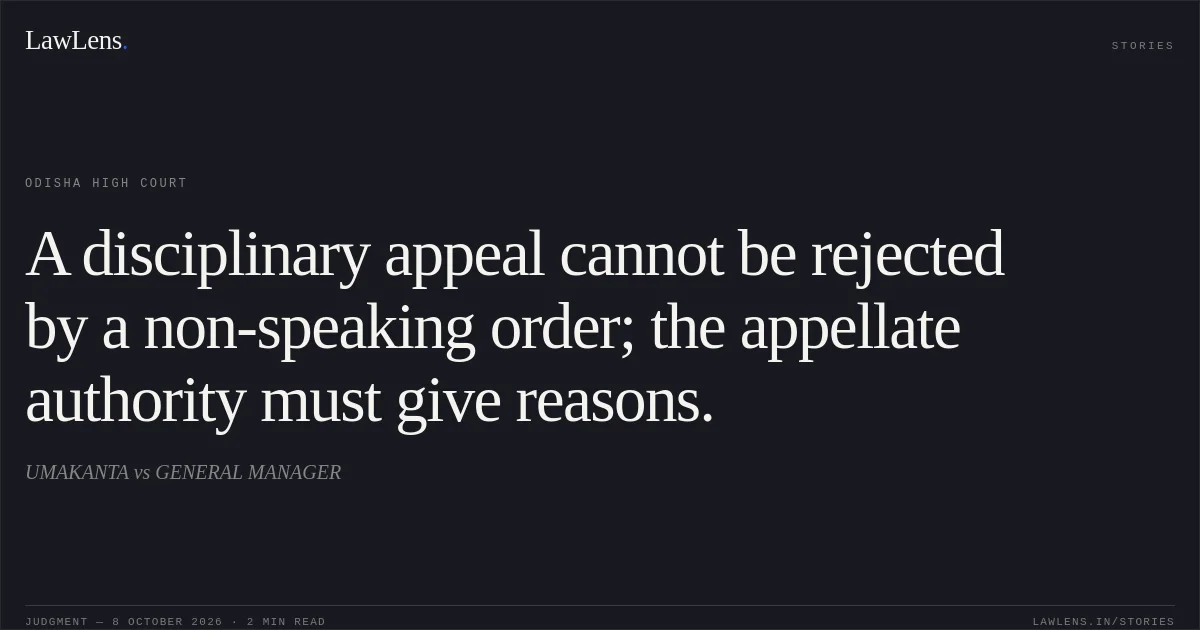
Source reference: pp. 2–8The Corporation subsequently initiated disciplinary proceedings concerning alleged unauthorised absence, disobedience and misconduct. After an enquiry, the disciplinary authority, by order dated 31 July 1996, treated periods of absence as “no work, no pay” and held that the petitioner’s services were no longer required. The petitioner’s appeal was rejected by a non-speaking order dated 26 May 1997. He challenged both orders, also seeking regularisation and consequential service benefits.
Source reference: pp. 2–8, 18–19, 29–33Issues
1. Whether the appellate authority’s non-speaking rejection of the petitioner’s appeal could stand, particularly when the appeal raised the issue that the enquiry report had not been supplied before the disciplinary order was passed.
Source reference: pp. 18–19, 32–332. Whether the petitioner was entitled, in this writ petition, to have the disciplinary order set aside and to obtain regularisation and consequential benefits.
Source reference: pp. 2, 23–24, 33–34Law Applied
Rules 121–125 of the Corporation’s Service Rules govern disciplinary penalties and procedure. Rule 121 distinguishes minor and major penalties; Rule 124 prescribes the procedure for major penalties and, under Rule 124(15)(b), requires the competent disciplinary authority to communicate its decision along with a copy of the enquiry report when the enquiry was conducted by another authority. Rule 125 addresses minor penalties.
Source reference: pp. 8–18, 32–33The Court also relied on 2013 (Supp. 1) OLR 736 and 2012 (1) OLR 87 for the principle that orders should disclose reasons, since reasons enable the affected party to understand the decision and facilitate proper administration of justice.
Source reference: pp. 19–20, 33Reasoning
The Court noted that the petitioner had raised in his appeal the failure to provide him with the enquiry report before the major penalty was imposed. It also found that the appellate authority had rejected the appeal without reasons, despite that contention.
Source reference: pp. 32–34Applying the principle that administrative decisions affecting a party should be reasoned, the Court held that the appeal required fresh consideration. It did not itself determine the merits of the disciplinary charges, the petitioner’s regularisation claim, or the validity of the disciplinary order; instead, it directed the appellate authority to reconsider the appeal after hearing the petitioner.
Source reference: pp. 32–34Holding
The writ petition was allowed and disposed of. The Court quashed the appellate order dated 26 May 1997 and remitted the appeal to the appellate authority for a fresh decision, after giving the petitioner an opportunity of hearing and considering the grounds in his appeal, preferably within four months of receipt of the judgment.
The Court did not grant the petitioner’s requested regularisation or consequential benefits, nor did it quash the disciplinary order.
Source reference: pp. 33–34Original Court PDF
UMAKANTAvsGENERAL MANAGER
Click to open original judgment
Original judgment, available to read, download and summarize on LawLens.in