Facts
The petitioner, a Sub-Inspector serving with the Himachal Road Transport Corporation (HRTC), was placed under suspension with immediate effect by the Manager (Technical), HRTC, Sundernagar, under Rule 10(1) of the Central Civil Services (Classification, Control and Appeal) Rules, 1965 (“CCS (CCA) Rules”).
Source reference: p.2A charge memorandum was thereafter issued to him under Rule 14, and the Manager (Technical) appointed an Inquiry Officer and Presenting Officer to conduct the disciplinary inquiry.
Source reference: p.2The petitioner challenged the suspension order and charge memorandum, principally contending that the Manager (Technical) was not competent to initiate proceedings or appoint an Inquiry Officer because the Divisional Manager was the disciplinary authority competent to impose major penalties under clauses (v) to (ix) of Rule 11.
Source reference: pp.2–4HRTC opposed the petition, relying on Rule 13(2) of the CCS (CCA) Rules and its office instructions dated 23 March 1996.
Source reference: pp.5–6Issues
1. Whether the Manager (Technical), HRTC, although not competent to impose major penalties under Rule 11(v)–(ix), was competent to institute disciplinary proceedings and issue a charge memorandum proposing such penalties under Rule 13(2) of the CCS (CCA) Rules
Source reference: pp.2–72. Whether the Manager (Technical) was competent to appoint the Inquiry Officer and Presenting Officer in the disciplinary proceedings initiated against the petitioner
Source reference: pp.2, 73. Whether the suspension order and charge memorandum were liable to be quashed on the ground of want of competency
Source reference: pp.2, 7Law Applied
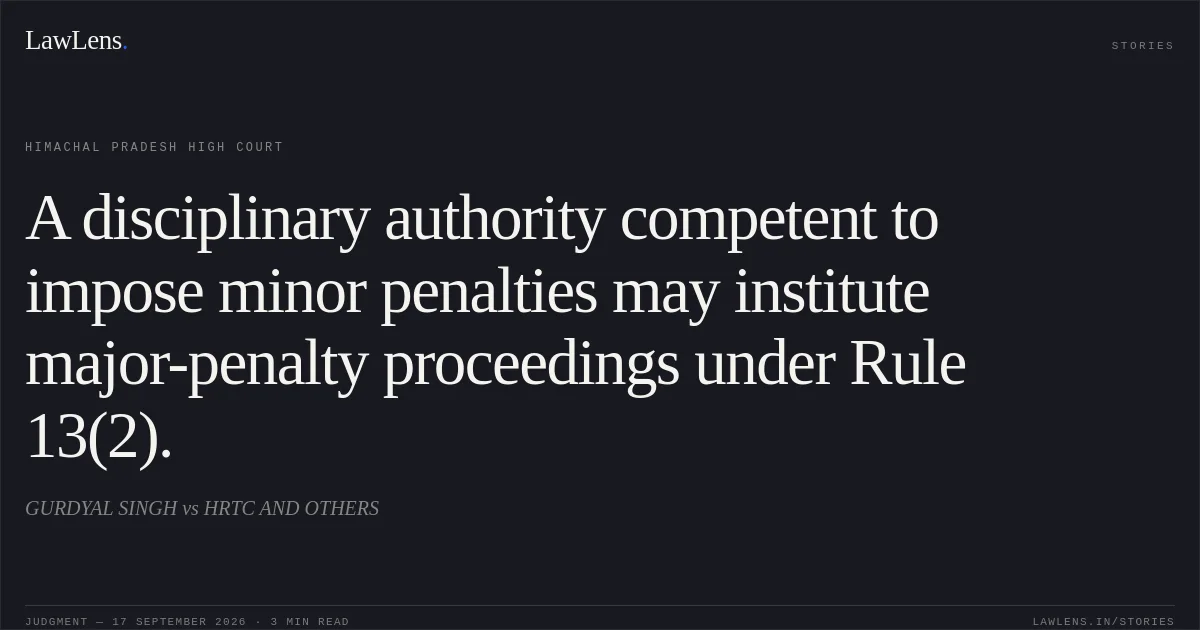
The Court applied Rule 13(2) of the CCS (CCA) Rules, which permits a disciplinary authority competent to impose any minor penalty under Rule 11(i)–(iv) to institute disciplinary proceedings for imposition of major penalties under Rule 11(v)–(ix), even though it is not competent to impose those major penalties itself.
Source reference: pp.5–6Rule 14(2) permits the disciplinary authority to inquire into the charges itself or appoint an authority to inquire into their truth.
Source reference: p.2The Court also relied on the Government of India clarification dated 28 July 1987, under which an authority competent to impose minor penalties may initiate and process proceedings for a major penalty and may impose a minor penalty after the inquiry if that penalty is considered sufficient.
Source reference: pp.6–7The HRTC’s office instructions dated 23 March 1996 and the schedule of disciplinary powers were also considered.
Source reference: pp.3–5Reasoning
The Court distinguished between the authority competent to institute disciplinary proceedings and the authority competent ultimately to impose a major penalty.
Source reference: no citationAlthough the schedule identified the Divisional Manager as competent to impose major penalties on the petitioner, the Manager (Technical) was undisputedly competent to impose minor penalties under Rule 11(i)–(iv).
Source reference: pp.3–4, 7Consequently, Rule 13(2) expressly empowered the Manager (Technical) to initiate proceedings and issue a charge memorandum even where the proposed punishment could fall within Rule 11(v)–(ix).
Source reference: pp.5–7Since the Manager (Technical) was competent to institute the proceedings, the appointment of the Inquiry Officer and Presenting Officer was also valid under Rule 14(2).
Source reference: pp.2, 7The petitioner’s reliance on Rule 14(2) did not alter this conclusion because that provision had to be read together with the enabling authority conferred by Rule 13(2).
Source reference: no citationHolding
The Court held that the Manager (Technical) was competent to issue the charge memorandum proposing major penalties and to appoint the Inquiry Officer and Presenting Officer, notwithstanding that the Divisional Manager was the authority competent to impose major penalties.
The challenge to the suspension order and charge memorandum therefore failed.
Source reference: p.7The writ petition was dismissed, and all pending miscellaneous applications were also disposed of.
Source reference: p.7Original Court PDF
GURDYAL SINGHvsHRTC AND OTHERS
Click to open original judgment
Original judgment, available to read, download and summarize on LawLens.in