Facts
The petitioner, a police officer, served as Sub-Divisional Police Officer, Jehanabad, from 13 August 2015 to 3 January 2017.
Source reference: pp. 2–3An adverse report was submitted alleging improper supervision of six criminal cases, followed by reports from the Deputy Inspector General and Inspector General of Police framing substantially similar allegations.
Source reference: pp. 2–3A departmental proceeding was thereafter instituted under the Bihar Government Servants (Classification, Control & Appeal) Rules, 2005 (“Bihar CCA Rules”) and the charge memo, along with documentary materials, was served upon him.
Source reference: p. 4The Enquiry Officer found the charges to be only partially proved and opined that the petitioner should receive the benefit of doubt.
Source reference: p. 5After considering the proceedings, the authority imposed the penalties of censure with effect from the allegation year and withholding of two increments without cumulative effect.
Source reference: p. 6The petitioner’s departmental appeal/review was rejected by order dated 20 March 2023.
Source reference: p. 7Issues
Whether the departmental proceeding was vitiated because the charge memo did not contain a list of witnesses and the supporting exhibits were allegedly not supplied to the petitioner?
Source reference: pp. 4–5, 8–9Whether the Disciplinary Authority’s disagreement with the Enquiry Officer’s report was legally sustainable despite the petitioner’s contention that the disagreement memorandum lacked specific reasons?
Source reference: pp. 6–8Whether the punishment orders and the reviewing authority’s order were liable to be quashed for non-consideration of the petitioner’s defence and violation of natural justice or procedural requirements?
Source reference: pp. 6–8, 10–11Law Applied
The Court applied Rule 17 of the Bihar Government Servants (Classification, Control & Appeal) Rules, 2005, governing departmental proceedings, including the framing and service of charges, consideration of the delinquent employee’s defence, enquiry, and imposition of penalty.
Source reference: pp. 8–9It applied the principle that judicial review of disciplinary proceedings is limited and ordinarily extends to examining procedural fairness, violation of natural justice, jurisdictional error, and perversity, rather than reappreciating the evidence or substituting the Court’s view for that of the disciplinary authority.
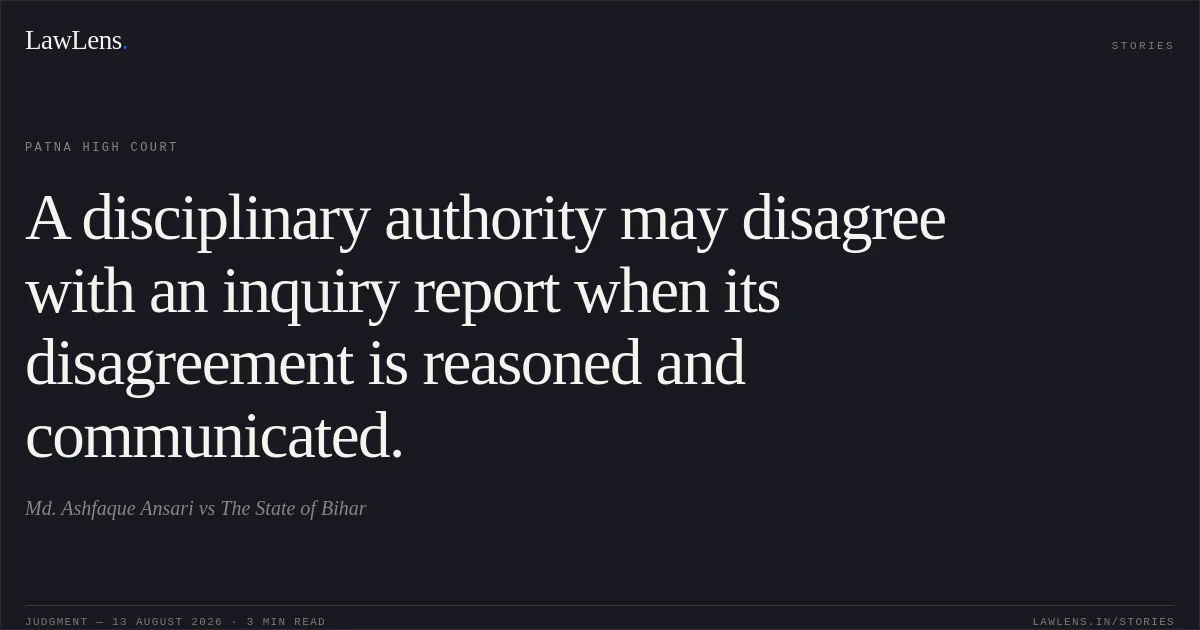
Source reference: p. 7The Court further held that a Disciplinary Authority may disagree with the Enquiry Officer’s findings, provided the disagreement is supported by specific reasons and the delinquent employee is given an opportunity to respond.
Source reference: pp. 7–8Reasoning
The Court found that the material relied upon to establish the charges consisted of eight documentary documents, all of which had been supplied to the petitioner; therefore, the absence of a separate list of oral witnesses did not invalidate the proceeding.
Source reference: p. 9On examination of the disagreement memorandum dated 5 April 2022, the Court found that the authority had separately recorded its points of disagreement and had provided reasons for departing from the enquiry report.
Source reference: p. 10The petitioner was also given an opportunity to submit a second show-cause reply, in which he raised his factual and procedural objections.
Source reference: pp. 6–7, 10The Court further held that the proceeding, though initially initiated with the possibility of a major penalty under Rule 17, could validly culminate in the imposition of a minor penalty when the charges were found only partially proved.
Source reference: p. 10It also found that the reviewing authority had addressed the petitioner’s objections, particularly in paragraph 8 of the review order.
Source reference: p. 10Holding
The High Court held that the charge memo and departmental proceeding were not legally defective, that the disagreement memorandum contained adequate reasons, and that the petitioner had received sufficient opportunity to defend himself.
The Court found no violation of natural justice, procedural irregularity, or other ground warranting judicial interference with the disciplinary or review orders.
Source reference: pp. 9–11The writ petition was accordingly dismissed, and the punishment of censure and withholding of two increments without cumulative effect, along with the review order, was allowed to stand.
Source reference: p. 11Original Court PDF
Md. Ashfaque AnsarivsThe State of Bihar
Click to open original judgment
Original judgment, available to read, download and summarize on LawLens.in