Facts
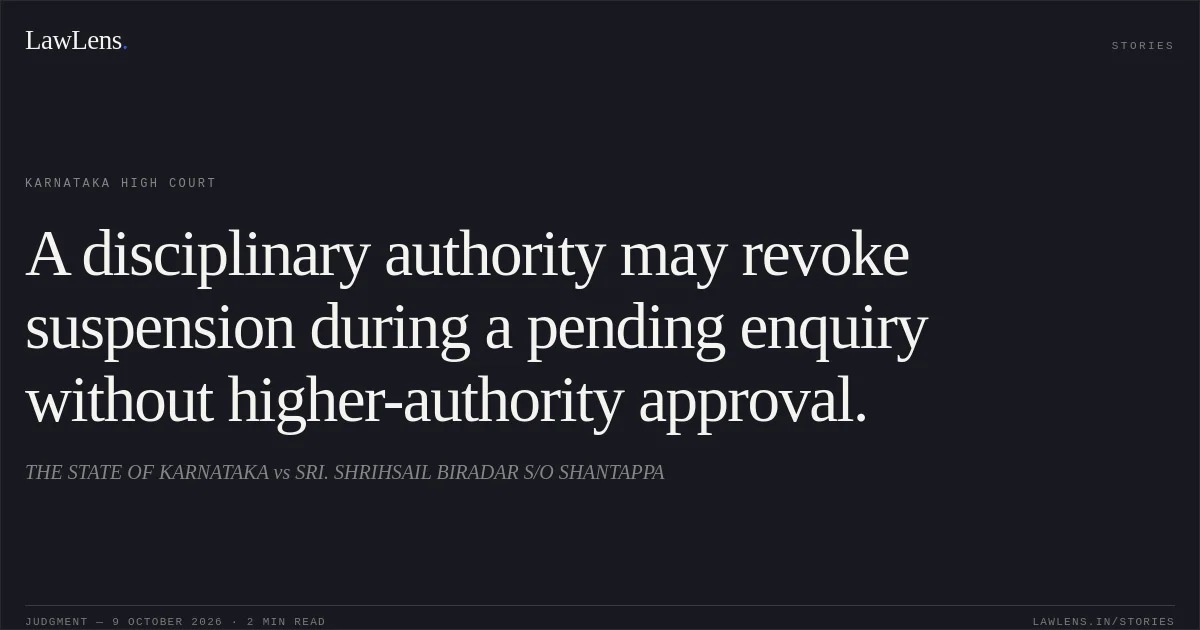
The respondent, a Deputy Director of Public Instructions and disciplinary authority for Second Division Assistants, reinstated an SDA, S.S. Kamanakeri, while a departmental enquiry against him was pending.
Source reference: p. 3–4, paras 3–8The respondent had sought guidance from higher authorities but received no reply; the reinstatement later formed the basis of disciplinary proceedings against the respondent, resulting in a penalty of reduction in pay.
Source reference: p. 3–4, paras 3–8The Karnataka State Administrative Tribunal set aside the penalty order and directed payment of consequential benefits, finding the enquiry officer’s conclusions perverse in light of the evidence.
Source reference: pp. 13–14; Tribunal order reproduced at para. 9The State challenged the Tribunal’s order before the High Court.
Source reference: p. 14, paras 10–11Issues
Whether the respondent, as the disciplinary authority, could revoke the SDA’s suspension and reinstate him during the pendency of the departmental enquiry without express approval from higher authorities.
Source reference: p. 14, paras 10–14Whether the Tribunal’s decision setting aside the penalty imposed on the respondent warranted interference by the High Court.
Source reference: p. 15, paras 15–16Law Applied
The High Court exercised its jurisdiction under Articles 226 and 227 of the Constitution in reviewing the Tribunal’s order.
Source reference: p. 15, paras 13–14It held that suspension pending enquiry does not, by itself, create an absolute bar against revocation of suspension once a charge sheet has been issued; the competent disciplinary authority may revoke suspension where it has the power to do so.
Source reference: p. 15, paras 13–14The Tribunal’s reproduced reasoning also relied on Kuldeep Singh v. Commissioner of Police, (1999) 2 SCC 10, and M.V. Bijlani v. Union of India, (2006) 5 SCC 88, for the principles that disciplinary findings must have evidentiary support and may be interfered with where they are perverse or rest on irrelevant considerations.
Source reference: pp. 5–7; Tribunal order reproduced at para. 9Reasoning
The State’s challenge rested on the assertion that the respondent could not revoke Kamanakeri’s suspension without express approval from higher authorities.
Source reference: p. 14, paras 10–14The High Court rejected that contention because the respondent was the disciplinary authority for the SDA and had the power to revoke the suspension; the pending enquiry did not legally prevent reinstatement.
Source reference: p. 14, paras 10–14The Court found no basis to disturb the Tribunal’s order setting aside the penalty and concluded that the State’s challenge lacked merit.
Source reference: p. 15, paras 15–16Holding
The High Court held that the respondent, as disciplinary authority, could revoke the suspension and reinstate the SDA during the pending enquiry.
Finding no error in the Tribunal’s order, it rejected the State’s writ petition.
Source reference: p. 15, paras 14–16Original Court PDF
THE STATE OF KARNATAKAvsSRI. SHRIHSAIL BIRADAR S/O SHANTAPPA
Click to open original judgment
Original judgment, available to read, download and summarize on LawLens.in
![Authorities must consider employees’ claims under cited precedents, subject to similarity and applicable rules.. Anwar Ul Hassan Chesti vs D/o Health And Medical Education Ut Of Jammu & Kashmir. CAT - ['Srinagar']. LawLens](/stories/thumbnails/authorities-must-consider-employees-claims-under-cited-precedents-subject-to-similarity-an-ea3a30d13510422ca1f750e161753fd2.webp)