Facts
The applicant, a Head Constable in the Delhi Police, was subjected to a Departmental Enquiry (DE) following a 2010 sting operation alleging he accepted a bribe of ₹1000/- for illegal soil extraction
Source reference: para 3.1Concurrent criminal proceedings under the Prevention of Corruption Act resulted in his acquittal on March 11, 2015, due to witnesses turning hostile
Source reference: para 3.7, 6.8In the DE, the Inquiry Officer (IO) concluded the charges were "not proved" as the complainant (PW-11) resiled from his statement
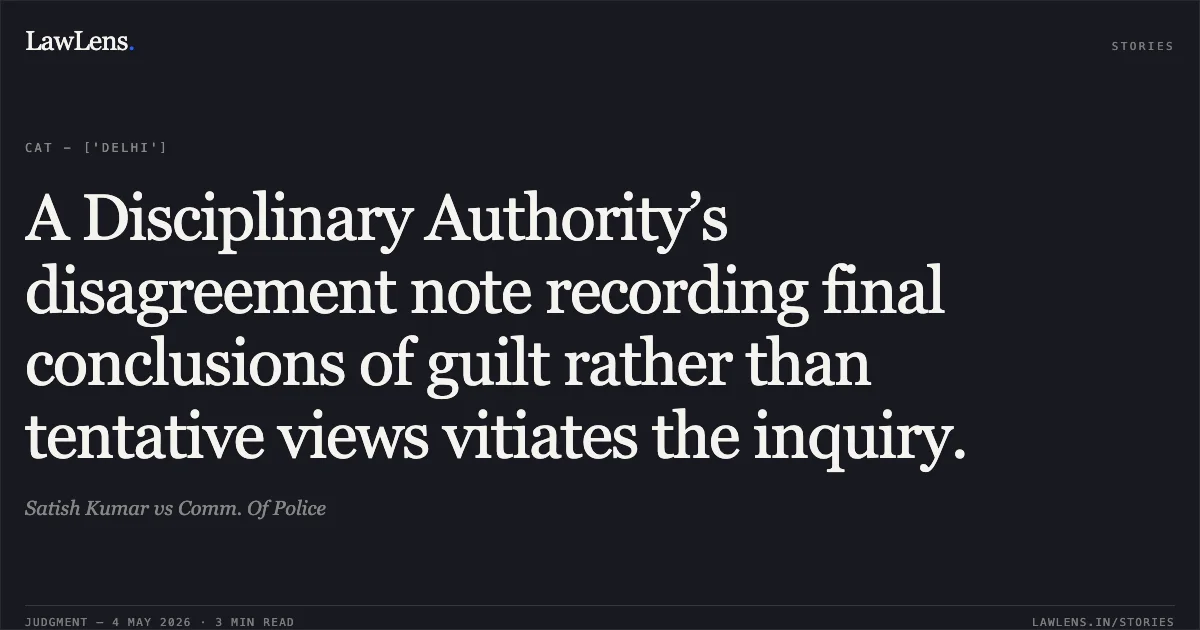
Source reference: para 3.6, 6.8However, the Disciplinary Authority (DA) issued a disagreement note on November 23, 2015, stating the applicant was "guilty" based on CD evidence and Section 161 Cr.P.C. statements
Source reference: para 6.1The DA subsequently imposed a penalty of withholding one increment with cumulative effect and treated the suspension period as "not spent on duty", which was upheld by the Appellate Authority
Source reference: para 6.5, 6.6Issues
1. Whether the disagreement note issued by the Disciplinary Authority was legally sustainable or vitiated by pre-judgment and a predetermined mindset
Source reference: para 2, 6.22. Whether the findings of guilt in the departmental proceedings could be sustained when the material witnesses turned hostile and the CD evidence was not conclusively proved
Source reference: para 6.8Law Applied
The court primarily applied the principles of Administrative Law regarding Departmental Enquiries and the Delhi Police (Punishment Appeal) Rules, 1980.
Source reference: no citationThe court relied on the doctrine that a disagreement note must represent a "tentative" view and not a final conclusion to avoid violating principles of natural justice
Source reference: para 3, 6.2The court cited the Supreme Court decision in Durga Prasad v. Govt. of NCT of Delhi (2025) which mandates that a disagreement note must furnish cogent reasons and reflect due application of mind rather than being cryptic or predetermined
Source reference: para 6.9It further applied the ratio from Ritu Ravi Prakash v. Union of India (2025), holding that concluding a delinquent is "guilty" in a disagreement note before receiving a representation renders the process an "empty formality"
Source reference: para 6.10Reasoning
The Tribunal found that the disagreement note was not "tentative" because the DA explicitly recorded in Paragraph 7 that the applicant "is guilty of the charge," thereby prejudging the issue before considering the applicant's representation
Source reference: para 6.1, 6.2The Tribunal observed that the DA relied heavily on Section 161 Cr.P.C. statements and a CD (Ex. PW-12/A), despite the fact that the complainant (PW-11) turned hostile and the Investigating Officer (PW-12) admitted in cross-examination that the CD's authenticity was not established prior to registration and the original recording device was never produced
Source reference: para 6.8The Tribunal reasoned that while the standard of proof in DE is "preponderance of probability," the DA failed to address the specific defense that the note was predetermined
Source reference: para 6.6The Tribunal concluded that the failure of the DA to remain open-minded and the lack of substantive evidence beyond hostile testimonies vitiated the proceedings
Source reference: para 6.9, 7.1Holding
The Tribunal allowed the Original Application, holding that the disagreement note was unsustainable as it reflected non-application of mind and pre-judgment
It quashed the disagreement note dated November 23, 2015, the punishment order dated January 20, 2016, and the appellate order dated June 6, 2016. The Tribunal directed the respondents to restore the applicant’s increments and grant all consequential benefits, including seniority, promotion, and pay allowances
Source reference: para 1, 7.1, 7.2, 7.3Acts & Sections Cited
2 provisions across 2 statutes referred to in this judgment. Each provision opens on LawLens.
Administrative Tribunals Act, 19851
Code of Criminal Procedure, 19731
Original Court PDF
Satish KumarvsComm. Of Police
Click to open original judgment
Original judgment, available to read, download and summarize on LawLens.in


