01Facts
The petitioner was appointed as Samiti Prabandhak of Sewa Sahakari Samiti Maryadit, Pirid, in 2009. During paddy procurement in 2010–11, shortages of 1,000.23 quintals at Pirid and 1,984.81 quintals at Kurdi were detected at centres under his control. Following a show-cause notice, the petitioner was suspended, charges were framed, and a departmental inquiry was conducted. The Inquiry Officer submitted a report finding the charges proved, and the Bank terminated the petitioner’s services on 12 June 2014.
¶ 2–3The petitioner challenged the termination under Section 55(2) of the Chhattisgarh Cooperative Societies Act, 1960. The Deputy Registrar allowed his dispute on 6 November 2015, but the Registrar reversed that decision on appeal on 11 May 2016. The Chhattisgarh Cooperative Tribunal dismissed the petitioner’s second appeal on 8 February 2017 and his review petition on 14 May 2018, leading to the present writ petition.
¶ 302Issues
i.Whether the departmental inquiry was vitiated for non-compliance with Rule 58 of the District Cooperative Central Bank Employees Service Rules, particularly because the list of witnesses was not supplied and no departmental witness was examined?
¶ 4, 8–11ii.Whether the Cooperative Tribunal and other appellate authorities erred in upholding the petitioner’s termination despite the alleged violation of the prescribed inquiry procedure and principles of natural justice?
¶ 9, 13–1403Law Applied
Rule 58 of the Service Rules prescribes the procedure for imposing major penalties, including service of the charge-sheet and relevant material, opportunity to submit a reply, permission to engage a defence assistant, examination and cross-examination of witnesses, recording and disclosure of evidence, submission of the inquiry report, and issuance of a notice regarding the proposed penalty.
¶ 7–8The Court relied on State of U.P. v. Saroj Kumar Sinha, (2010) 2 SCC 772, holding that a disciplinary inquiry cannot be conducted with a closed mind and must comply with natural justice so that fair treatment is both afforded and manifestly seen to be afforded.
¶ 10It also relied on State Bank of India v. Samarendra Kishore Endow, (1994) 2 SCC 537, which establishes that judicial review under Article 226 examines the legality and fairness of the decision-making process, including compliance with natural justice and statutory inquiry requirements, rather than re-appreciating evidence or substituting the Court’s view on punishment.
¶ 12Provisions in the judgment · 1 · Linked ones open on LawLens
Chhattisgarh Co-operative Societies Act, 1960 Section 55
04Reasoning
The petitioner had denied the allegations, thereby requiring the disciplinary authority to establish the charges through legally admissible and procedurally fair evidence.
¶ 11However, the charge-sheet was not accompanied by a list of witnesses; no departmental witness was examined; the authors of the relied-upon documents were not produced for examination; and the petitioner was not permitted to examine his own witnesses.
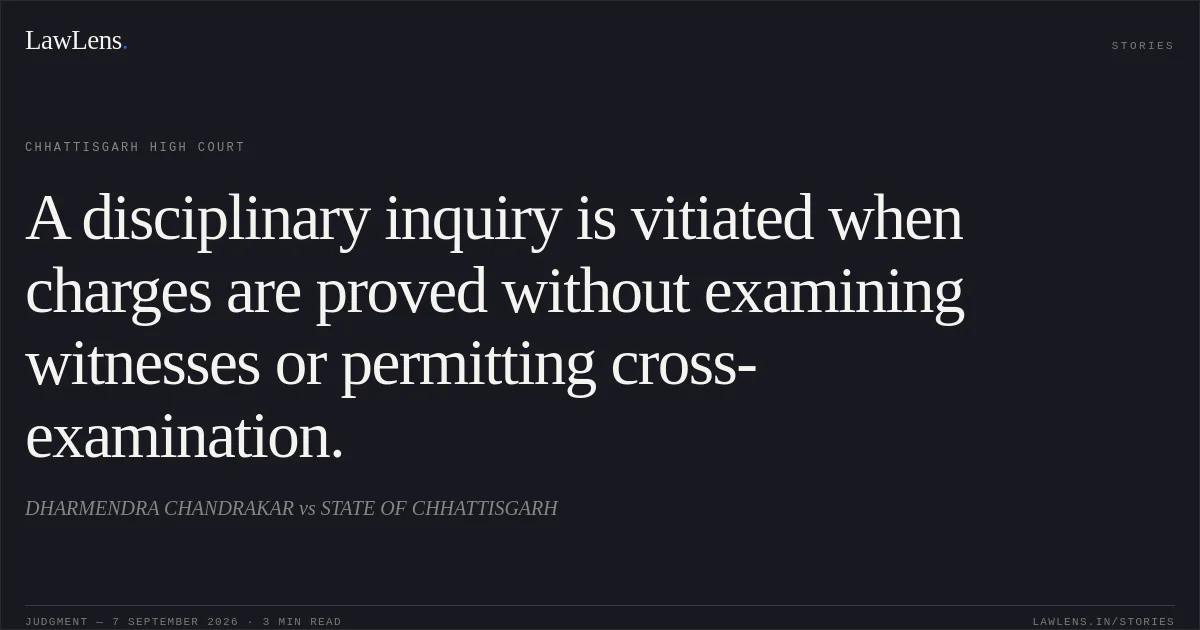
¶ 9The Inquiry Officer consequently recorded findings solely on documentary material without following the safeguards mandated by Rule 58. Since the procedural violations deprived the petitioner of a meaningful opportunity to contest the evidence and cross-examine witnesses, the inquiry was contrary to the Service Rules and principles of natural justice.
¶ 9–11The Deputy Registrar had correctly identified these deficiencies, whereas the Registrar and the Tribunal failed to give them proper effect.
¶ 9–1105Holding
The High Court held that the departmental inquiry was legally unsustainable because the mandatory procedure under Rule 58 was not followed and the charges were not proved through a fair evidentiary process.
¶ 13–14The orders of the Cooperative Tribunal dated 8 February 2017 and 14 May 2018 were quashed, and the Deputy Registrar’s order dated 6 November 2015 allowing the petitioner’s dispute was restored. The writ petition was accordingly allowed.
¶ 13–14Original Court PDF
DHARMENDRA CHANDRAKARvsSTATE OF CHHATTISGARH
Click to open original judgment
Original judgment, available to read, download and summarize on LawLens.in