Facts
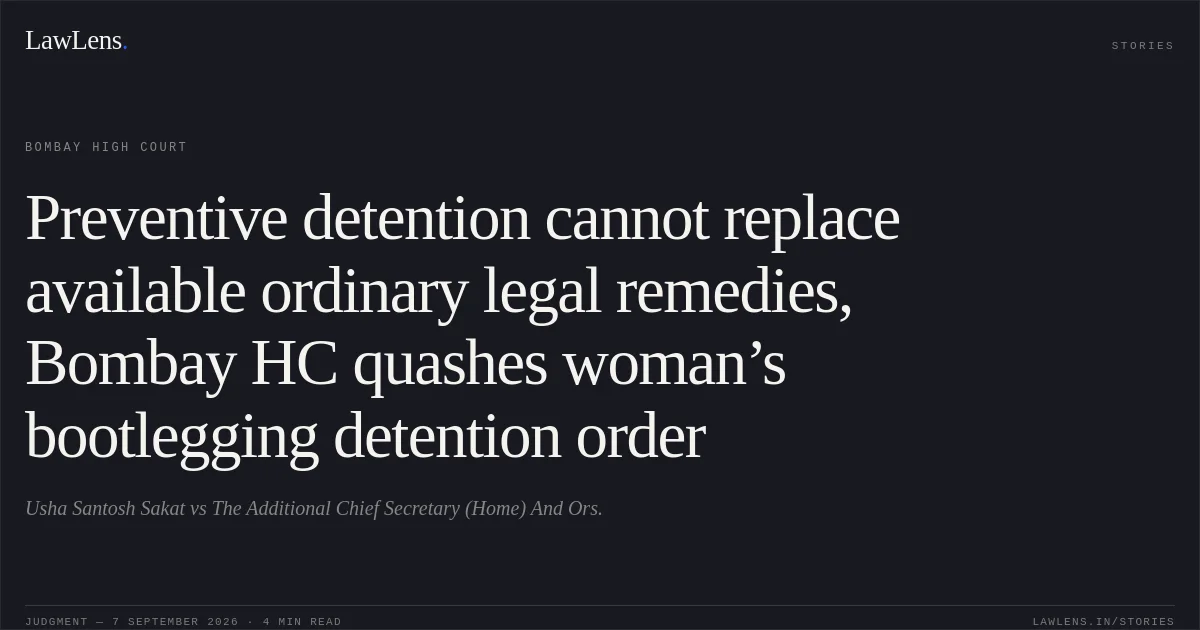
The Petitioner challenged the detention order dated 30 June 2026 passed by the Commissioner of Police, Pune City under the Maharashtra Prevention of Dangerous Activities Act, 1981 (“MPDA Act”), by which she was classified as a “bootlegger” under Section 2(b) and committed to Kolhapur Central Prison.
Source reference: paras. 2, 4; pp. 1–2The detention order referred to eleven offences under Section 65(e) of the Maharashtra Prohibition Act registered between July 2023 and February 2025, for which the Petitioner had generally been served notices under Section 41(a)(1) of the CrPC or Section 35(3) of the BNSS, without being arrested.
Source reference: para. 7; p. 3The immediate material relied upon for detention consisted of one registered prohibition offence, C.R. No. 48 of 2026, and two in-camera statements alleging assault, threats and forcible removal of money from witnesses.
Source reference: paras. 9–12; pp. 5–7It also referred to prior preventive proceedings, including execution of a good-behaviour bond, externment, and a subsequent bond executed on 31 May 2025 for two years.
Source reference: para. 8; pp. 4–5Issues
Whether the Detaining Authority properly classified the Petitioner as a “bootlegger” under Section 2(b) of the MPDA Act on the basis of the two in-camera statements alleging assault and robbery-like conduct?
Source reference: paras. 10–14; pp. 6–8Whether the detention order was vitiated by an incorrect satisfaction that the ordinary law was insufficient to curb the Petitioner’s activities, when the Petitioner had not been arrested in connection with the latest offence and the authorities could invoke the statutory consequences of breach of her subsisting bond?
Source reference: paras. 15–17; pp. 8–10Whether Section 5A of the MPDA Act could independently sustain the detention order on the basis of the registered offence?
Source reference: para. 15; p. 8Law Applied
The Court applied the MPDA Act, particularly Section 2(b), which defines a “bootlegger” as a person involved in distilling, manufacturing, storing, transporting, importing, exporting, selling or distributing liquor or intoxicants in contravention of law, or in aiding such activities.
Source reference: para. 13; p. 7It contrasted this definition with Section 2(b-1), which defines a “dangerous person” by reference to habitual commission or abetment of specified offences under the Penal Code or the Arms Act.
Source reference: para. 13; p. 7The Court also considered Section 5A of the MPDA Act, under which a detention order may not necessarily fail merely because one ground is invalid, but held that the remaining material must independently and lawfully sustain the Detaining Authority’s subjective satisfaction.
Source reference: para. 15; p. 8Further, under Section 141(1)(b) of the BNSS, where a person breaches a bond executed for keeping the peace, the Magistrate may order the person’s arrest and detention until expiry of the bond period, after recording the grounds of breach.
Source reference: para. 16; pp. 9–10Preventive detention cannot be justified merely by a mechanically recorded assertion that ordinary law is inadequate when the ordinary legal remedies remain available and have not been effectively pursued.
Source reference: paras. 16–17; pp. 9–10Reasoning
The Court held that the two in-camera statements described alleged assaults, threats and forcible taking of money; they did not allege that the Petitioner had distilled, stored, transported, sold or distributed liquor, or otherwise aided such activities.
Source reference: paras. 10–14; pp. 6–8Those statements could potentially relate to the concept of a “dangerous person,” but could not support the specific finding that the Petitioner was a “bootlegger” under Section 2(b) of the MPDA Act.
Source reference: paras. 10–14; pp. 6–8Relying on such statements to reach that satisfaction demonstrated non-application of mind.
Source reference: paras. 10–14; pp. 6–8Although the State relied on the registered prohibition offence and Section 5A, the Court noted that the Petitioner had not been arrested in that case and had merely been served a notice under Section 35(3) of the BNSS; there was also no allegation that she had breached the notice.
Source reference: para. 15; p. 8More importantly, the Petitioner was subject to a subsisting two-year good-behaviour bond.
Source reference: paras. 16–17; pp. 9–10If the alleged subsequent offence constituted a breach, the authorities could have proceeded under Section 141(1)(b) of the BNSS and secured her arrest and detention until expiry of the bond.
Source reference: paras. 16–17; pp. 9–10Since the police neither arrested her in the latest offence nor invoked the available bond-breach mechanism, the assertion that ordinary law was insufficient was incorrect.
Source reference: paras. 16–17; pp. 9–10The subjective satisfaction underlying the detention order was therefore legally unsustainable.
Source reference: paras. 16–17; pp. 9–10Holding
The Court allowed the petition and set aside the detention order.
It held that the in-camera statements did not support the Petitioner’s classification as a “bootlegger,” and that the Detaining Authority had incorrectly concluded that ordinary law was insufficient when statutory remedies under the BNSS remained available.
Source reference: paras. 14–17; pp. 8–10Rule was made absolute in terms of the prayer clause, and the Petitioner was directed to be released forthwith unless required in any other case.
Source reference: para. 18; p. 10Acts & Sections Cited
6 provisions across 2 statutes referred to in this judgment. Each provision opens on LawLens.
Code of Criminal Procedure, 19731
Bharatiya Nagarik Suraksha Sanhita, 20235
Original Court PDF
Usha Santosh SakatvsThe Additional Chief Secretary (Home) And Ors.
Click to open original judgment
Original judgment, available to read, download and summarize on LawLens.in