Facts
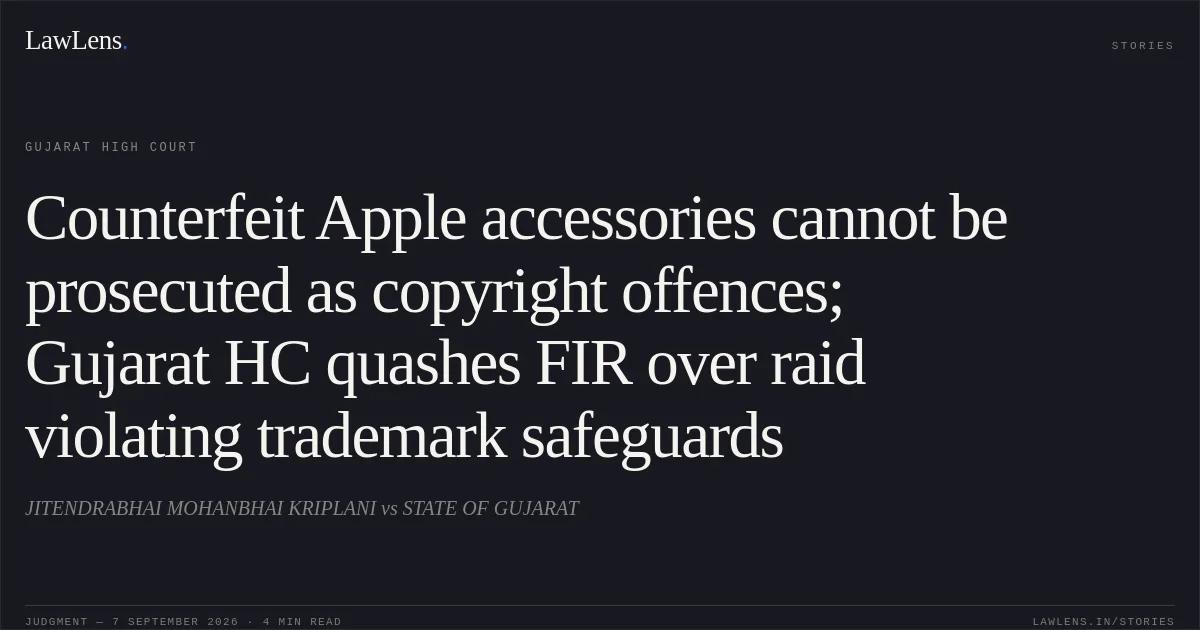
The petitioner invoked Section 482 Cr.P.C. seeking quashing of FIR C.R. No.11191026220492 of 2022, registered at Kalupur Police Station, Ahmedabad, for alleged offences under Sections 51, 63 and 64 of the Copyright Act, 1957.
Source reference: p.1The complainant, a manager of Griffin Intellectual Property Services Pvt. Ltd., claimed authority from Apple Inc. to take action against counterfeit Apple products.
Source reference: pp.1–2Acting on information regarding alleged counterfeit Apple accessories, the police, accompanied by the complainant’s representatives and panch witnesses, conducted a raid at the petitioner’s shop, “Raj Cover House”.
Source reference: pp.2–4The search resulted in seizure of AirPods, cables, power adapters, a smartwatch, stickers, seals, MRP labels and barcode labels, allegedly bearing Apple’s marks, with a total stated value of Rs.15,11,193/-.
Source reference: pp.4–5The petitioner contended that the seized commercial hardware and labels were not copyrightable literary or artistic works and that the allegations, if anything, concerned trademark infringement.
Source reference: pp.5–13The complainant and the State opposed quashing, asserting that the packaging, labels, product literature and manuals constituted copyright-protected literary or artistic works.
Source reference: pp.5–13Issues
Whether the allegations concerning the sale and possession of counterfeit AirPods, cables, adapters, smartwatches and related stickers disclosed offences under Sections 51, 63 and 64 of the Copyright Act, 1957, particularly when the FIR did not identify any specific copyright-protected literary or artistic work.
Source reference: pp.13–17, paras. 5–9Whether the alleged use of Apple’s marks could sustain prosecution under Sections 103 and 104 of the Trade Marks Act, 1999 despite the absence of the Registrar’s prior opinion and the search and seizure having been conducted by officers below the rank prescribed under Section 115(4).
Source reference: pp.24–27, paras. 14–19Whether continuation of the FIR and consequential proceedings would amount to an abuse of the process of court warranting exercise of inherent jurisdiction under Section 482 Cr.P.C.
Source reference: pp.27–28, paras. 20–22Law Applied
The Court applied Sections 13, 2(c), 2(o), 2(m), 14, 51, 63 and 64 of the Copyright Act, 1957, holding that copyright protection concerns original literary, dramatic, musical or artistic works and does not ordinarily extend to commercial hardware, functional accessories or standard factual labels.
Source reference: pp.13–17, paras. 5–9It applied Sections 103 and 104 and the mandatory safeguards under Section 115(4) of the Trade Marks Act, 1999, which require the police, before search and seizure, to obtain the Registrar’s opinion and prohibit an officer below the rank of Deputy Superintendent of Police from conducting such search and seizure without warrant.
Source reference: pp.24–26, paras. 15–18The Court relied on authorities including Binita Rahul Shah v. State of Gujarat, Mayur Kanaiyalal Shah v. State of Gujarat, Dagubhai Musabhai Sheikh v. State of Gujarat and Sandip Ramashankar Dube v. State of Maharashtra for the principle that counterfeit or duplicate commercial goods and trademark disputes cannot, without more, be converted into criminal copyright offences.
Source reference: pp.19–23, paras. 11–12It also applied the inherent-jurisdiction principle that criminal proceedings may be quashed where the allegations, even if accepted at face value, do not disclose the statutory ingredients of the alleged offences or where continuation would constitute abuse of process.
Source reference: p.28, paras. 20–22Reasoning
The Court held that the principal articles described in the FIR—AirPods, cables, power adapters and smartwatches—were commercial and functional products, not literary, dramatic, musical or artistic works protected under Sections 13 and 2 of the Copyright Act.
Source reference: pp.13–16, paras. 5–8Although the complainant argued that packaging, labels and instruction manuals constituted literary or artistic works, the FIR and seizure material did not identify or recover any specific original manual, user leaflet, literary work or artistic packaging design.
Source reference: pp.15–17, para. 9The Court further held that MRP labels, barcodes and standard stickers primarily contained functional or factual information and could not, on the allegations pleaded, establish infringement of an original copyright-protected work.
Source reference: p.17, para. 9The allegations therefore essentially concerned alleged falsification or misuse of Apple’s trademarks.
Source reference: no citationHowever, the Court declined to permit continuation under the Trade Marks Act because the raid was conducted without the Registrar’s prior opinion and by police officers below the rank of Deputy Superintendent of Police, contrary to the mandatory requirements of Section 115(4).
Source reference: pp.24–27, paras. 15–19The Court viewed the attempt to proceed under copyright law as an impermissible circumvention of the procedural safeguards applicable to trademark offences.
Source reference: p.26, para. 19Holding
The Court held that the FIR did not disclose the essential ingredients of copyright infringement under Sections 13 and 63 of the Copyright Act, since the seized commercial hardware and functional stickers were not shown to reproduce any identified original literary or artistic work.
It further held that prosecution under Sections 103 and 104 of the Trade Marks Act could not be sustained or substituted because the search and seizure violated the mandatory requirements of Section 115(4).
Source reference: p.27, para. 20(ii)The petition was accordingly allowed, and FIR C.R. No.11191026220492 of 2022, together with all consequential proceedings qua the petitioner, was quashed and set aside.
Source reference: p.28, paras. 21–22Rule was made absolute, with direct service permitted.
Source reference: p.28, paras. 21–22Acts & Sections Cited
14 provisions across 4 statutes referred to in this judgment. Each provision opens on LawLens.
Code of Criminal Procedure, 19731
Copyright Act, 19578
Trade Marks Act, 19994
Bharatiya Nagarik Suraksha Sanhita, 20231
Original Court PDF
JITENDRABHAI MOHANBHAI KRIPLANIvsSTATE OF GUJARAT
Click to open original judgment
Original judgment, available to read, download and summarize on LawLens.in