Facts
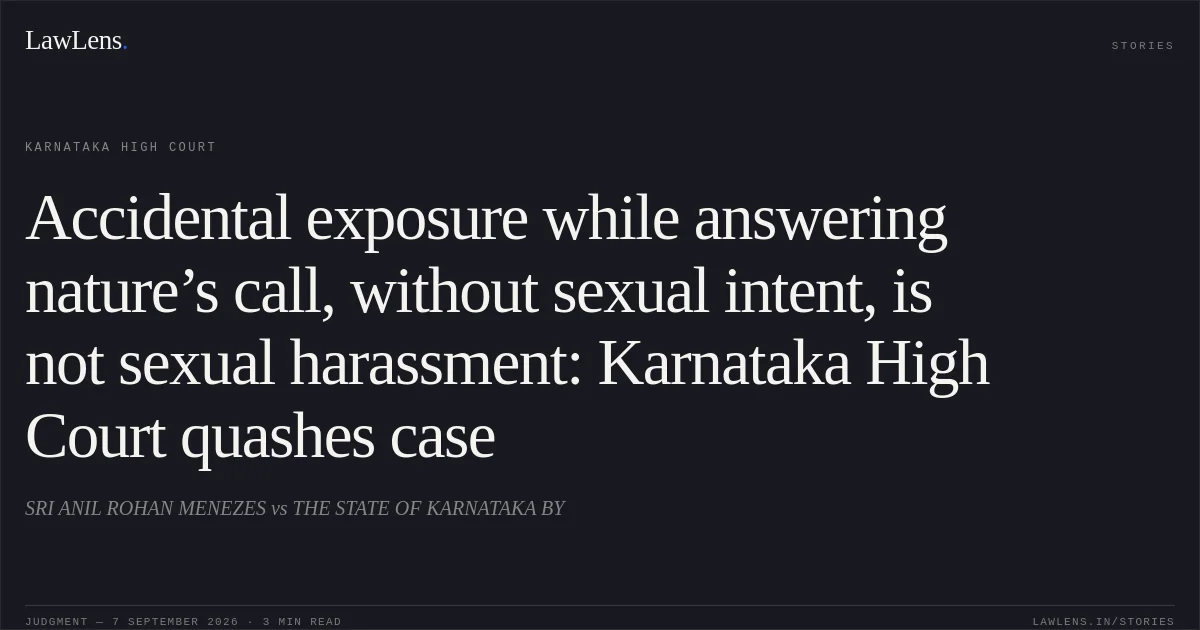
Respondent No. 2 filed a complaint alleging that, on 24 January 2026 at approximately 3:40 p.m. near Hebbal, Bengaluru, the petitioner exposed his private part while she was walking towards a nearby railway track.
Source reference: para. 3.1; p. 3The complaint led to registration of Crime No. 35 of 2026 for an offence under Section 75(2) of the Bharatiya Nyaya Sanhita, 2023 (“BNS”).
Source reference: para. 3.1; p. 3The police investigated and filed a charge sheet, resulting in registration of C.C. No. 14887 of 2026 before the 7th Additional Chief Judicial Magistrate, Bengaluru.
Source reference: para. 3.2; p. 3The petitioner invoked the High Court’s inherent jurisdiction under Section 482 of the Code of Criminal Procedure, filed under Section 528 of the Bharatiya Nagarik Suraksha Sanhita, seeking quashing of the cognizance order and criminal proceedings.
Source reference: p. 2He contended that the exposure occurred accidentally while answering nature’s call, without sexual intent or conduct directed towards the complainant.
Source reference: paras. 4–4.1; pp. 4–5The complainant and the State opposed the petition, asserting that the petitioner had also made gestures and that the matter required trial.
Source reference: paras. 5–6; p. 5Issues
1. Whether the allegations in the complaint and the material collected during investigation, even if accepted in their entirety, disclosed the ingredients of an offence under Section 75(2) of the BNS.
Source reference: para. 11; p. 82. Whether continuation of the criminal proceedings amounted to an abuse of process warranting exercise of the High Court’s inherent jurisdiction under Section 528 of the BNSS.
Source reference: paras. 16–17; pp. 11–14Law Applied
The Court considered Section 75(2) of the BNS, described in the judgment as corresponding to Section 354A of the Indian Penal Code, and held that the alleged conduct must involve the requisite sexual overtone and mens rea; accidental or unintended exposure, without sexual intent or conduct directed towards the woman, does not by itself constitute sexual harassment.
Source reference: paras. 11–14; pp. 8–10The Court applied the inherent-power jurisdiction under Section 482 CrPC/Section 528 BNSS to prevent abuse of process and secure the ends of justice.
Source reference: para. 17; p. 13It relied on State of Haryana v. Bhajan Lal, 1992 Supp. (1) SCC 335, particularly the categories permitting quashing where the allegations, taken at face value, do not constitute an offence, or where the uncontroverted allegations and collected evidence fail to disclose commission of any offence.
Source reference: para. 17; pp. 11–13Reasoning
The Court found that the complaint and charge sheet described the petitioner as answering nature’s call when the complainant happened to pass by.
Source reference: paras. 8–10; pp. 6–8The materials did not allege that he had waited for, beckoned, followed, or made sexually coloured remarks to the complainant, or that he deliberately exposed himself after noticing her.
Source reference: para. 13; p. 9His alleged reaction of sudden shock was inconsistent with an inference of sexual intent.
Source reference: para. 13; p. 9The Court distinguished mere exposure resulting from the circumstances from intentional exposure for a sexual purpose, holding that the complainant’s inadvertent viewing of the petitioner’s private part could not supply the missing statutory element of mens rea.
Source reference: paras. 14–15; pp. 9–10Since the foundational facts necessary to constitute the alleged offence were absent, permitting the prosecution to continue would amount to abuse of process and would improperly convert the criminal proceedings into punishment by trial.
Source reference: para. 16; p. 11Holding
The Court answered both issues in favour of the petitioner.
It held that the complaint and investigation materials did not prima facie establish deliberate exposure, sexual intent, or the ingredients of Section 75(2) of the BNS.
Source reference: para. 15; p. 10Applying the principles in Bhajan Lal, the Court exercised its inherent jurisdiction and allowed the criminal petition.
Source reference: para. 17; p. 14The proceedings in C.C. No. 14887 of 2026 pending before the 7th Additional Chief Judicial Magistrate, Bengaluru, were quashed.
Source reference: para. 18; p. 14Acts & Sections Cited
5 provisions across 3 statutes referred to in this judgment. Each provision opens on LawLens.
Bharatiya Nyaya Sanhita, 20231
Code of Criminal Procedure, 19733
Bharatiya Nagarik Suraksha Sanhita, 20231
Original Court PDF
SRI ANIL ROHAN MENEZESvsTHE STATE OF KARNATAKA BY
Click to open original judgment
Original judgment, available to read, download and summarize on LawLens.in